
















Cold response to call to break Iran’s Hormuz blockade prompts Trump threat to NATO
text_fields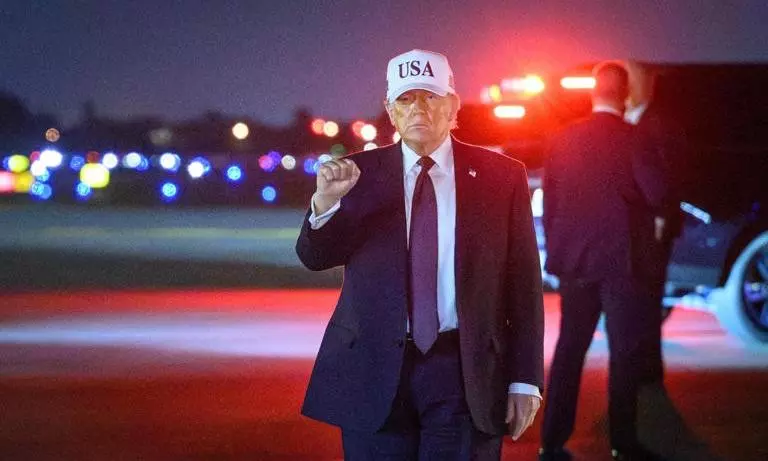

The geopolitical architecture of the West appeared to teeter on a precipice as Donald Trump’s aggressive pursuance of a maritime coalition to surmount the Iranian blockade of the Strait of Hormuz yielded scant traction among traditional allies, while Trump reportedly warned NATO of a “very bad” future if its members failed to support Washington’s naval ambitions, with Japan and Australia declining to dispatch warships and the UK indicating that sending vessels might aggravate the already volatile situation.
The strategic impasse remains absolute as Japan and Australia, two of the Pacific’s most formidable naval powers, have explicitly declined to dispatch warships to the volatile waterway, citing both constitutional constraints and the perilous potential for miscalculation.
Tokyo’s Prime Minister, Sanae Takaichi, maintained a posture of studied neutrality, noting that while the energy-dependent nation has begun the unprecedented depletion of its strategic oil reserves to mitigate the catastrophic disruption of global trade, the threshold for military intervention remains “extremely high.”
This sentiment was echoed in Canberra, where Australian officials rebuffed the American entreaty, prioritising regional stability over a mission that remains fraught with existential risk to their naval assets.
Concurrently, the United Kingdom has adopted a position of cautious divergence; while London is reportedly contemplating the deployment of aerial minesweepers to neutralise the submerged threats haunting the conduit, Downing Street remains of the firm view that the introduction of heavy surface combatants would merely exacerbate an already febrile atmosphere.
British officials have whispered concerns that such a flotilla would serve as a catalyst for further Iranian recalcitrance rather than a deterrent, thereby worsening a situation that has already propelled crude prices to a staggering $104 per barrel.
The Iranian regime, despite sustaining a relentless bombardment from U.S. and Israeli forces that has decimated its conventional missile batteries and naval infrastructure, remains defiantly bellicose.
Foreign Minister Abbas Araqchi recently dismissed the prospect of capitulation or ceasefire, asserting that Tehran is prepared for a protracted struggle of endurance, even as the regional death toll climbs and vital hubs like Dubai Airport face repeated closures due to drone-related incursions.
As the "largest oil supply disruption in history" continues to strangle the global economy, Mr Trump has turned his gaze toward Beijing, suggesting that a failure by China to intervene in the blockade could jeopardise a scheduled summit with President Xi Jinping.
Nevertheless, with the French rejecting further military escalation and South Korea remaining mired in "careful review," the American President finds himself increasingly isolated in his demand that allies protect the very arteries from which they draw their lifeblood.
The reluctance of key allies has surfaced as the strategic waterway — through which roughly one-fifth of the world’s oil supply transits — remains effectively paralysed following retaliatory actions by Iran after a series of airstrikes by the United States and Israel, a development that has convulsed global energy markets and precipitated what analysts describe as the most severe oil supply disruption in modern history.
Oil prices surged beyond $104 per barrel in early trading as tanker traffic through the narrow maritime corridor dwindled sharply, while the paralysis of the shipping route has rattled energy-importing economies and triggered mounting anxiety within international trade networks.