


















Who will be the losers if Iran is strangled?
text_fields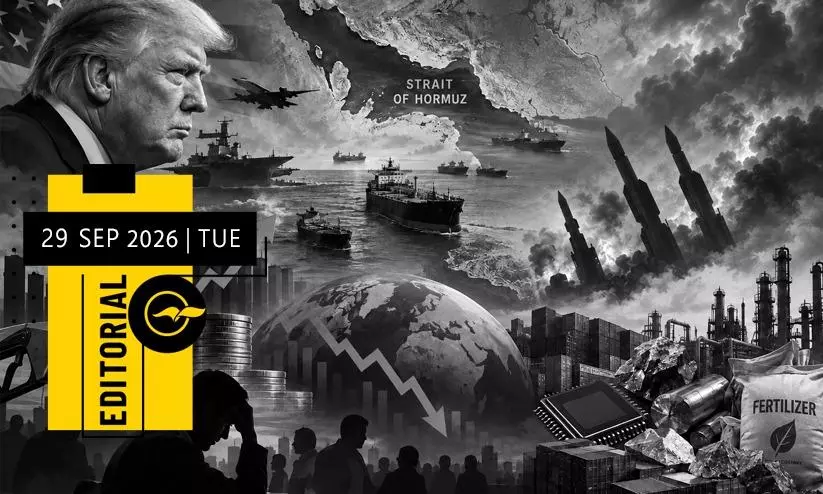

The course of the war in West Asia continues to remain dicey. It can be said that the situation has now reached a point where the United States itself must take the initiative to bring to an end the war, which was launched by Israeli and American forces last February. Looking at the positions taken most recently on Sunday, what can be seen is a deadlock. Iranian Foreign Minister Abbas Araghchi said that Iran was ready to fully reopen the Strait of Hormuz, subject to the conditions set for a ceasefire to be fulfilled first. The impact the war has had on the global economy continues unabated, without any relief. In that sense, this is a conflict that cannot be allowed to remain merely a bilateral issue. Alongside this, public understanding and concerns about the conflict are also growing. The war has affected the American people themselves in various ways. For instance, estimates show that vehicle fuel prices have increased by one-third since the war began.
Following the closure of the Strait of Hormuz, the price of crude oil has remained above an average of $100 per barrel, except for fluctuations whenever reports of peace efforts surface. According to Moody’s Analytics, American consumers are estimated to have spent an additional $121 billion on energy since the war began, amounting to an average of nearly $900 per household. At the same time, according to an opinion poll conducted by the research firm Ipsos a few months ago, six out of 10 American citizens are opposed to the war, with the majority believing that it would adversely affect their household budgets. However, the question arises as to why people there are not protesting. One major reason is that only a small percentage of the American public has made the effort to seriously review the various aspects of the war. This is probably part of their broader indifference towards world affairs in general. At the same time, there is a fact that in the process the United States became the world’s largest petroleum and natural gas exporting country during the war, along with the cheaper cost of imports resulting from the appreciation of the dollar; and this has also had an influence, at least for the time being, for the people to remain indifferent.
That however is not the situation in most other countries. In a sample survey conducted in six countries in the Global South, 100 per cent of the people expressed concern about the conflict. The main reason is that most of the world’s 200 countries are oil-importing nations. Asia accounts for 40 per cent of global crude oil demand. Compared with the Americans, citizens of developing countries have less purchasing capacity to pay higher prices for fuel as prices rise. In addition, when the value of the dollar rises, imports into their countries also become more expensive. Add to it the loss of income suffered by migrant workers and the decline in foreign exchange received by their home countries due to the economic slowdown in oil-rich countries in West Asia that employ such work force. For the time being, the United States also has the upper hand in artificial intelligence, which is capturing the market. The main beneficiaries are the so-called ‘Magnificent Seven’: Alphabet (the owner of Google), Amazon, Apple, Meta, Microsoft, Nvidia and Tesla.
But even if the United States has not yet suffered a direct blow, it would be too soon to say that it has been unaffected. It is only that the impact on its people is relatively less severe compared with other countries. To give an example, one projection by the International Monetary Fund (IMF) is that the global growth rate will fall to three per cent this year and next year. The United States is likely to be at the forefront of experiencing the global losses. Inflation related to petroleum will not affect fuels alone. As long as the Strait of Hormuz remains closed, the availability of raw materials used in the resulting products, ranging from semiconductors in computers to chemicals, fertilisers and even weapons will also decline, leading to higher product prices. The countries that export these products and the multinational companies that own them will also bear the resulting losses.
Economic experts have pointed out that the United States could also face a more direct economic blow than this. One study estimates that US taxpayers may have to bear a cost of $1 trillion for the war. However, the White House has asked Congress for $1.5 trillion for defence, which is 40 per cent more than the previous year. America has benefited from increased oil and natural gas production following the expansion of shale extraction since 2003. However, it is also a fact that this alone will not be enough, and that the United States is not self-sufficient in many other materials needed for products and energy it produces. China dominates the market for many of these, including various minerals and critical metals. On the other hand, although Iran has been economically weakened, it has many factors within its economy and, beyond that, among its people that can help sustain the system. Therefore, it remains an enigma as to who will ultimately suffer the consequences of a war with Iran. Perhaps, this is this very fear that is currently deterring Trump from excessive adventurism.