










India is in perpetual election mode, with citizens in constant political consumption
text_fields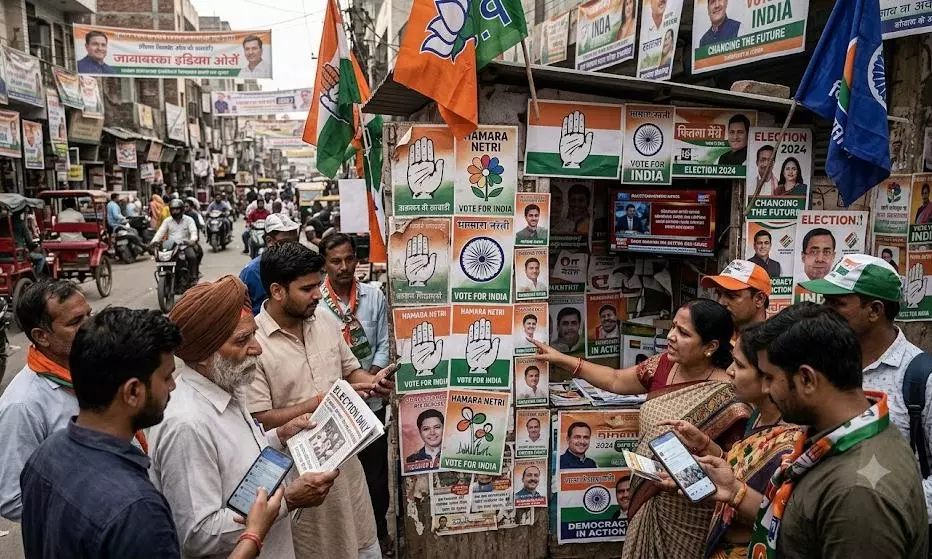
V.D. Satheesan’s swearing in as the Chief Minister of Keralam finally brings an end to a long wait for the people of the state, also marking the conclusion of the cycle of the recent five-state assembly elections. The nation may finally appear to rest after a long haul of electioneering cacophony. But is it really so? In reality, this may merely be a brief pause–brief, illusory, and fleeting–before the next round of political mobilisation begins. In today’s India, elections do not conclude; they only recede momentarily.
Technically, like any other election cycle, the latest round of elections for five state assemblies lasted five to six weeks after the Election Commission announced dates in mid-March, ending in the first week of May. But in reality, it stretched far longer. The political build-up in states like West Bengal, Kerala and Tamil Nadu had begun months, if not over a year, before formal campaigning began. What the country witnessed was a relentless, high-decibel phase of electioneering that drew in not just the concerned states but the entire nation.
The conclusion of the current assembly election phase is, therefore, merely a churn within a larger and continuous cycle of election mode that India now inhabits. Even as we pause and expect the nation to return to a normal rhythm of governance, another set of state assemblies is approaching the end of their tenure in early to mid-2027. With seven state assemblies set to complete their terms in 2027, the so-called “election year” is already underway. This will be another ‘mother of all’ assembly elections, with Uttar Pradesh–the politically most significant state–awaiting polls. It is only a matter of time before the nation is once again drawn into an indistinguishable pre-election phase, followed by intense campaigning once elections are formally announced, likely early next year. We must, therefore, brace for yet another extended phase of political positioning, narrative-building and voter mobilisation.
From Cyclical Mandates to Continuous Elections
At one level, the persistence of elections in India is entirely consistent with its constitutional design. A federal polity with 28 state assemblies will, by its very nature, produce a staggered electoral calendar.
The year 2024 offers a clear illustration. The country underwent general elections to the Lok Sabha even as seven state assemblies–Arunachal Pradesh, Sikkim, Andhra Pradesh, Odisha, Haryana, Jharkhand and Maharashtra–also went to the polls in the same year. The churn did not pause. In 2025, two politically consequential elections–Delhi and Bihar–sustained the national campaign climate. This was followed, in 2026, by another round of five state assembly elections. Next in line is a set of seven state assemblies completing their five-year terms: Uttar Pradesh, Goa, Uttarakhand, Punjab and Manipur in February/March 2027, and Himachal Pradesh and Gujarat in November/December the same year.
This continuity is constitutionally structural. It is how Indian democracy was designed to function.
Yet, what demands attention is not the frequency of elections, but their transformation into a condition of permanence. India is no longer merely a country that votes often; it is a country that campaigns incessantly. The constitutional cycle has been overlaid with a political culture of uninterrupted mobilisation.
The Political Context: Consolidation and Expansion
This transformation must be situated within the broader reconfiguration of India’s political landscape since 2014.
When the BJP came to power at the Centre in 2014 with a thumping majority of 282 seats, the Congress was reduced to just 44 seats–its lowest ebb in parliamentary history. Yet, at that moment, the Congress still governed 13 state assemblies out of 28.
Over the past decade, that footprint has contracted sharply. Today, the Congress governs only a handful of states–Karnataka, Telangana, Himachal Pradesh and the recently won Keralam.
In contrast, the BJP, which held power in only 7 to 8 states directly or through alliances in 2014, now holds direct power in 17 states, while the broader NDA governs in as many as 22 states and Union Territories.
In a democracy, such shifts in the political landscape are natural. However, this trajectory also appears to be part of a well-designed and articulated strategy of “Congress Mukt Bharat,” as envisaged by Narendra Modi. First forcefully invoked in June 2013 at the BJP national executive meeting in Goa, this articulation has, over the past 12 years, translated into a structural consolidation of power. The current political map reflects this starkly: the saffron footprint today spans more than 73% of India’s geographical expanse and roughly 78% of its population.
Union Home Minister Amit Shah reiterated recently that the BJP is moving ahead in the direction of “one umbrella rule” in the country, as it “rules states from Uttarakhand to Uttar Pradesh to Bihar till West Bengal; covering the area between the origin of the river Ganga and the place where it merges with the ocean”.
This is not merely electoral success; it is political centralisation on a scale that inevitably reshapes the functioning of a federal democracy. Keeping the nation in a constant continuum of campaign mode has, in this sense, worked as a reinforcing mechanism.
Permanent Campaign as Strategy
One clear explanation for India’s constant election mode lies in this sustained and methodical expansion.
What we are witnessing is not incidental–it is strategic. The electorate is kept in a state of continuous political activation, where elections are preceded by long phases of narrative construction. Issues are identified, amplified and embedded into public consciousness well before formal campaigning begins.
West Bengal illustrates this pattern with particular clarity. Much before the election year, the political discourse was saturated with themes such as “ghuspaithia” (illegal infiltration), law and order concerns, especially following the R.G. Kar Medical College rape and murder incident, and allegations of systemic corruption. These issues were amplified across television studios, digital platforms and social media ecosystems, often blurring the line between fact and political construction. For those outside the state, this produced simplified and at times distorted perceptions of complex social realities.
Keralam and Assam, in different ways, have witnessed similar narrative build-ups. The election, in such a framework, is merely the culmination of a much longer political process.
Nationalising the Local, Diluting the Federal
The more consequential shift, however, lies in the systematic nationalisation of elections, irrespective of their scale.
Elections that are constitutionally local–municipal, ward, panchayat or state-level–are increasingly framed through national narratives: Hindutva, nationalism, infiltration and identity. This is not incidental rhetoric; it is a deliberate political method.
During municipal elections in Kolkata and surrounding regions, civic contests were framed around infiltration and appeasement. In several recent municipal corporation elections across Maharashtra, Delhi and Haryana, including key urban bodies, Prime Minister Modi was the central face of the campaign, and elections were contested on the delivery of central welfare schemes.
In the last Municipal Corporation of Delhi elections, central BJP leaders foregrounded themes of cultural nationalism, alleged encroachments and ideological binaries–far removed from the core concerns of urban governance.
This raises a fundamental constitutional question: what happens to federalism when local mandates are persistently subsumed under national narratives?
India’s Constitution envisages a layered democracy–Union, State and Local, each with distinct domains, responsibilities and political accountability. When every election is reframed as a national referendum, this layered structure begins to flatten. Local governance loses salience, state autonomy is politically diluted, and electoral choice is refracted through a centralised ideological lens.
Centralisation and Constitutional Propriety
At the heart of this transformation is the growing centralisation of political leadership. Elections across the country are increasingly fought under the direct leadership of the Prime Minister and the Union Home Minister. Campaigns are designed, driven and personified at the national level, often reducing state leadership to a secondary role.
This raises questions that go beyond political strategy and enter the domain of constitutional propriety.
The Prime Minister, under oath, holds office not merely as a party leader but as the executive head of the Union, expected to function with a degree of constitutional neutrality. While political campaigning is an accepted part of democratic practice, the scale and frequency of direct involvement in every electoral contest–state, municipal or otherwise–risks blurring the distinction between the office of the Prime Minister and the interests of a political party.
The recently concluded West Bengal elections exemplified this centralisation, with Narendra Modi as the principal face and Amit Shah as the chief strategist. This model, replicated across states, reflects not just political dominance but an institutional shift–where national authority increasingly permeates arenas constitutionally reserved for state-level political contestation.
The ‘One Nation, One Election’ Paradox
It is within this context that the push for “One Nation, One Election” must be examined.
The 129th Constitutional Amendment Bill, introduced in December 2024, seeks to synchronise elections across the country. Its stated aim is to reduce costs, administrative burden and governance disruptions.
Yet, the paradox is evident. The very forces that sustain continuous electioneering also provide the justification for its proposed solution.
While the argument of efficiency is compelling, it risks overlooking the foundational principle of Indian federalism–that political power must remain dispersed, responsive and locally accountable. Synchronisation may reduce frequency, but it could also intensify nationalisation, further marginalising regional voices and issues.
The Cost of Continuous Electioneering
The consequences of a permanently mobilised democracy are neither abstract nor distant.
First, governance risks are being subordinated to electoral calculation. Policy becomes reactive, shaped by immediate political gains rather than long-term public interest.
Second, local issues are persistently diluted. Elections cease to be instruments of accountability for governance and become platforms for ideological contestation.
Third, institutions are drawn into political cycles in ways that test their neutrality and resilience.
And finally, the citizen is placed in a state of constant political consumption, where reflection is replaced by reaction, and democratic choice is shaped as much by sustained narrative exposure as by lived governance experience.
Democracy Without Pause
India’s democracy is defined by its scale, diversity and capacity for participation. Frequent elections are a reflection of that vitality. But there is a critical distinction between a democracy that votes often and one that campaigns endlessly.
The electoral trajectory from 2024 through 2026 demonstrates a system in continuous motion. This continuity is constitutionally grounded. But the manner in which it is politically operationalised today reflects something more profound, a shift towards perpetual electioneering. And in that shift lies the deeper concern.
For when every election is fought as a national contest, on a common set of issues and led by centralised leadership, the federal balance begins to tilt. The distinction between Union and State blurs. The space for local political agency narrows. India, in effect, becomes not just a union of states, but a single, continuous political theatre.
The question, therefore, is not whether elections are too frequent. It is whether the democratic process has been stretched into a permanent campaign, where governance, federalism and institutional propriety are increasingly shaped by the imperatives of electoral politics.
For a democracy to endure, it must not only speak through elections, but it must also know when to pause between them.