


















When a deity becomes a litigant to claim the Taj Mahal
text_fields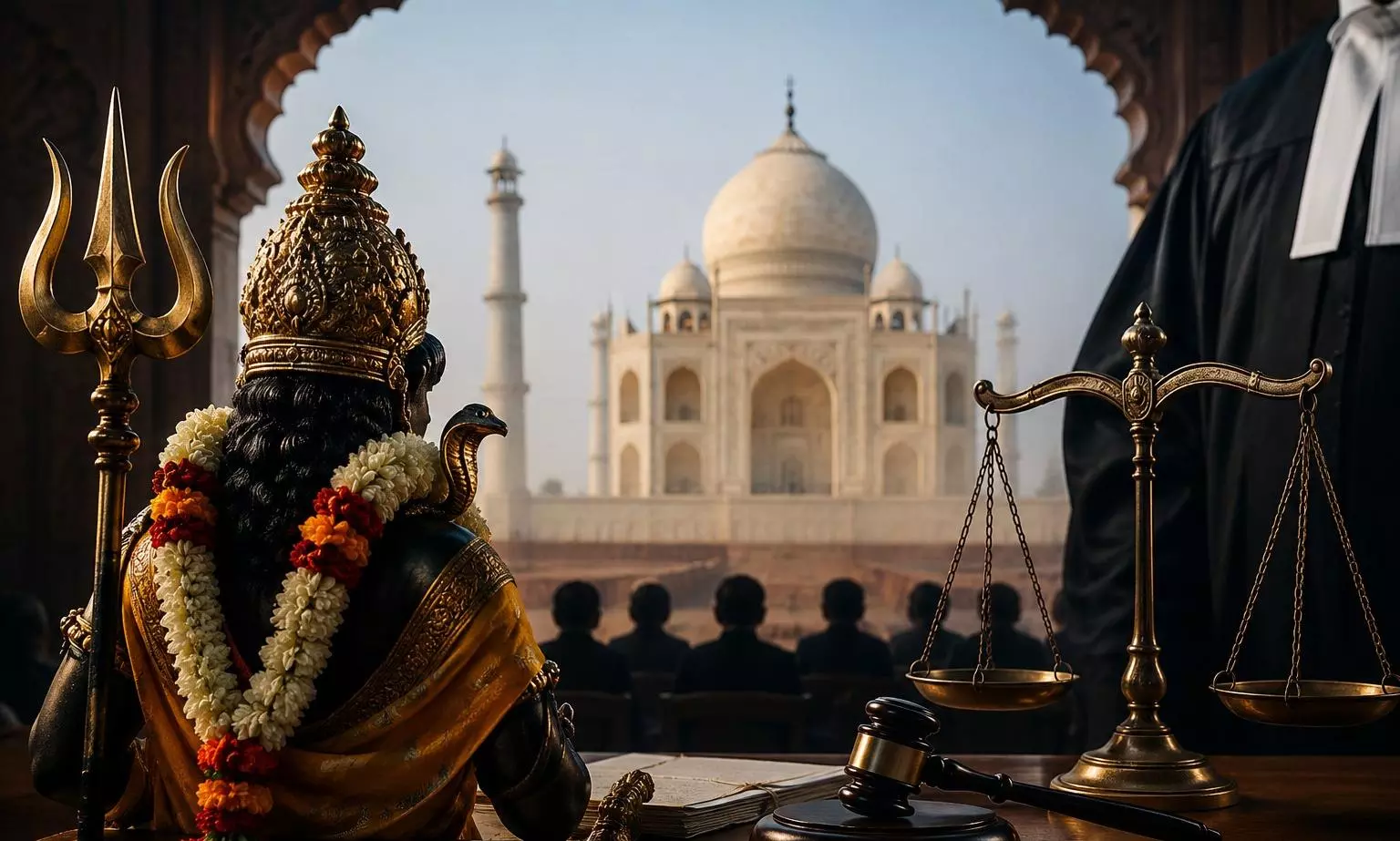

There was a time when I enjoyed reading two unusual writers, Purushottam Nagesh Oak and Sita Ram Goel. I admired them not because I believed what they wrote but because they possessed an extraordinary ability to make astonishing claims with supreme confidence. Their books were packed with gyan, but also with ideas that often stretched the imagination beyond its limits.
Oak’s most famous argument was that Christianity and Islam were derivatives of Hinduism. According to him, the Vatican, the Kaaba in Mecca, Westminster Abbey in London, and even the Taj Mahal were originally Hindu temples dedicated to Lord Shiva. He also claimed that the Papacy was nothing but a continuation of the Vedic priesthood.
The Taj Mahal became the centrepiece of his campaign. Oak insisted that it was originally a Shiva temple called Tejo Mahalaya and that Hindus should be allowed to worship there. So convinced was he of his theory that he approached the Supreme Court seeking a declaration to that effect.
The Supreme Court was not impressed. On July 13, 2000, a two-judge Bench dismissed his petition as “misconceived” and memorably remarked that Oak had “a bee in his bonnet” about the Taj Mahal. The expression describes someone who cannot stop thinking or talking about one particular subject because it has become an obsession.
Oak died in December 2007 without seeing his theory accepted by any court. Yet he probably believed that he had planted enough seeds of doubt for future generations to continue the battle.
Perhaps he was right.
Twenty-six years after the Supreme Court rejected his plea, the Allahabad High Court has asked the Archaeological Survey of India and the Union government to explain why a photographic and videographic survey of the Taj Mahal should not be permitted. Ironically, Oak had once approached the same High Court and received a similar rejection.
This time, however, the petitioner is not an ordinary citizen. The plea has been filed on behalf of the deity, Lord Sri Agreshwar Mahadev Nagnatheswar Virajman, through “next friend” Hari Shankar Jain, along with several devotees. They challenge the refusal of two Agra courts to appoint an advocate commissioner to inspect, photograph and videograph the monument.
The legal strategy is interesting. When a deity becomes a litigant, the case naturally acquires a different emotional dimension. Courts, however, are still expected to decide such matters on evidence rather than faith. That distinction is vital if law is to remain law.
Oak’s imagination knew few limits. Besides the Taj, he argued that the Red Fort, Delhi’s Jama Masjid, Hyderabad’s Charminar and even the Qutub Minar had Hindu origins before being converted into Islamic monuments. His writings also extended far beyond India. He maintained that the Kaaba had been built during the Vedic age of Arabia and produced booklets filled with imaginative interpretations to support his theory.
If one accepted Oak’s version of history, the Mughal emperors scarcely built anything. They merely spent their leisure converting magnificent Hindu structures into Islamic monuments. It was a remarkable theory, though historians and archaeologists found little evidence to support it.
Oak even established a History Rewriting Institute. Although the institute faded away, the broader project of rewriting history has acquired fresh energy. The Sangh Parivar has consistently argued that ancient India possessed knowledge of virtually everything—from astronomy and aeronautics to plastic surgery, atomic science and hydrogen bombs—long before Europe emerged from what it describes as a primitive age. Such narratives appeal to national pride but often blur the line between documented history and mythology.
The politics surrounding the Taj Mahal reflects this larger ideological struggle. Because the monument is closely associated with the Mughal emperor Shah Jahan, it has often received less official enthusiasm than its global importance deserves. A few years ago, the Uttar Pradesh government published a World Tourism Day booklet showcasing thirty-two attractions in the state. Astonishingly, the Taj Mahal did not feature among them.
The omission was difficult to understand. The Taj attracts more visitors than any other monument in India and earns well over Rs 2 billion annually through tourism and related economic activity. It is one of the country’s greatest cultural ambassadors.
Everyone knows that Emperor Shah Jahan built the Taj Mahal. Far fewer people know the role played by Lord Curzon in saving it from decay.
By the time Curzon became Viceroy, the monument had suffered two centuries of neglect and plunder. As the Mughal Empire declined, invaders looted its precious stones. During the Revolt of 1857, British troops occupied the complex, causing further damage. The marble walls had lost many of their original inlaid gems.
Curzon launched one of the most ambitious conservation programmes in colonial India. He restored not only the mausoleum but also its gardens and outer courts. He championed the Ancient Monuments Protection Act of 1904, which laid the foundation for systematic heritage conservation in India. He is also credited with initiating the excavation and preservation of the temples of Khajuraho.
Curzon remains a deeply controversial figure because of the Bengal Partition and the devastating famine during his tenure. His administration came to be remembered by many as Curzonshahi, almost as oppressive as Nadirshahi.
Yet history is seldom black and white. Whatever his political failures, his contribution to preserving India’s architectural heritage cannot easily be dismissed. The Taj that millions admire today owes something not only to Shah Jahan but also to Curzon’s determination to rescue it.
Oak himself quietly modified one of his major claims. He initially argued that the Taj dated back to the fourth century. Historians pointed out that the engineering techniques required for such a structural building simply did not exist then. Monumental architecture of that period was largely rock-cut rather than free-standing. Oak later shifted the date to the twelfth century.
Another favourite subject was the Taj’s twenty-two sealed chambers. They became fertile ground for speculation about hidden idols and secret passages. The Archaeological Survey of India has repeatedly explained that these are merely empty arched corridors designed to strengthen the foundation and allow floodwaters to pass safely beneath the structure. It has even released photographs showing that there is nothing mysterious inside.
Conspiracy theories, however, have a remarkable ability to outlive evidence. Every clarification seems only to inspire another question, another petition and another attempt to rediscover a past that never existed.
What a tragedy that a monument built to celebrate eternal love is repeatedly dragged into endless battles over imagined histories, while documented heritage struggles to command equal respect.