











World Cup: the most memorable moment wasn't the goal
text_fields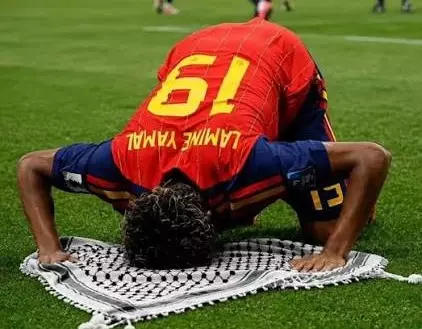

The image that has stayed with me from Spain's World Cup victory was not the winning goal, the trophy presentation, or even the celebrations that followed. It was something much quieter.
As emotions spilled over after the final whistle and players became embroiled in heated confrontations, 19-year-old Lamine Yamal walked away, knelt on the pitch, and prayed. It lasted only a few moments, but it stood in sharp contrast to everything happening around him. While others were caught up in triumph, frustration, or anger, he sought stillness.
The reactions online were predictable. Admirers hailed him as an example of faith. Critics were quick to point out that a single act does not define a person. Before long, the conversation had become another familiar social media argument about whether someone deserved admiration or condemnation.
I think that debate misses the point.
The significance of that moment was not whether Lamine Yamal is a perfect role model. None of us is. Nor was it about elevating a footballer into a symbol of religious virtue. What made the image compelling was something much more universal: at one of the highest moments of his young life, he paused long enough to acknowledge that success is never entirely our own.
Modern culture celebrates the myth of the self-made individual. We are encouraged to believe that talent, discipline, and determination alone explain success. Those qualities matter, but they are never the whole story. None of us chooses where we are born, the abilities we inherit, the mentors who guide us, or the opportunities that come our way. Even the most gifted athlete depends on countless factors beyond personal control—a supportive family, good health, timely opportunities, and sometimes nothing more than luck.
Recognizing that reality is not an excuse for complacency. It is an antidote to arrogance.
Perhaps that is why gratitude has become such a countercultural virtue. We live in an age of relentless self-promotion. Social media encourages us to curate an image of complete control, as though every achievement is entirely self-created. Gratitude interrupts that narrative. It reminds us that accomplishment and humility are not opposites. In fact, one often depends on the other.
Success, if we are honest, can be more dangerous than failure. Failure usually makes us reflective. Success can make us forget how dependent we remain on others—and, for believers, on God. History is full of brilliant people undone not by adversity but by the illusion that they alone were responsible for their achievements.
There is another reason the image resonated with me. It offered a rare moment of stillness in a world that has become addicted to noise. We increasingly measure importance by visibility, volume, and constant performance. Reflection has become a casualty of our attention economy. Yet some of life's most meaningful moments happen not in the spotlight but in silence.
We should also resist the temptation to turn public figures into either heroes or villains. We know remarkably little about the inner lives of people whose public images we consume every day. A single photograph cannot reveal a person's character, just as a single mistake cannot define an entire life. We would all benefit from extending to others the same grace we hope others extend to us.
Whether one shares Yamal's faith or not is ultimately beside the point. What made that brief moment memorable was the reminder that achievement need not produce arrogance, that success need not drown out gratitude, and that even in the midst of celebration, there is value in pausing to remember that we are not entirely self-sufficient.
Long after the score is forgotten and the trophy finds its place in a museum, that may be the lesson worth remembering. Not because it tells us anything definitive about Lamine Yamal, but because it asks each of us a simple question:
When success comes our way, do we celebrate only ourselves, or do we remember all those—and all that made it possible?