















Raghav Chadha defends anti-paper leak bill in Parliament, calls student concerns valid
text_fields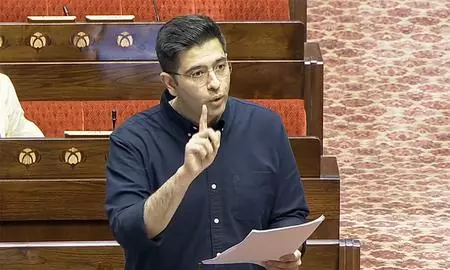

New Delhi: Bharatiya Janata Party (BJP) Rajya Sabha MP Raghav Chadha extended strong support to the Public Examinations (Prevention of Unfair Means) Amendment Bill in the Upper House on Thursday, asserting that the demands of students were fully justified and that Prime Minister Narendra Modi had responded not just as a head of state, but as a guardian to the nation's youth.
Addressing queries around his earlier "silence" on the issue, Chadha clarified that while he was previously on the Opposition benches, his current role on the Treasury benches comes with greater responsibility to fix systemic flaws through concrete, legislative solutions.
During the debate, Chadha emphasized that whenever issues regarding students arose, the Union government listened, acted, and delivered. He highlighted several government initiatives aimed at preventing paper leaks, including a push toward computerized examinations and stringent statutory penalties designed to dismantle organized syndicates.
"Paper leaks cannot be addressed through media sound-bites but require institutional solutions. We cannot treat cancer with crocin; exam leaks cannot be removed with sound-bites," Chadha remarked, acknowledging that student frustration over the issue was completely valid.
Painting a vivid picture of student life across major educational hubs like Kota, Chandigarh, Jaipur, Delhi, and Patna, Chadha spoke about families who cut household budgets or take on debt to send their children to study for up to 18 hours a day. A single leak, he warned, destroys years of hard work, eroding trust, mental health, and future aspirations. Drawing on his own background as a Chartered Accountant, he noted that he understood the pain firsthand.
Chadha also highlighted historical paper leaks under Congress administrations in Karnataka and Himachal Pradesh, pointing to incidents such as the SSLC exam leak in January 2026 and the Class 12 Chemistry paper leak in 2016. He cautioned against the politicization of student movements.
"Their voice matters. Their demands are justified. Protesting, asking questions, raising demands, coming out, and taking out peaceful marches are all their constitutional rights. But a student protest should remain a student protest; it should not become a rally of any political party," he stated, while also criticizing the Punjab government over exam-cheating instances.
Outlining the key provisions of the legislation, Chadha noted that the Bill explicitly treats paper leaks as crimes committed by organized syndicates rather than isolated individuals. The framework targets coaching mafias, printing-press staff, solver gangs, logistics providers, and compromised exam officials. Offences under the law carry fines up to ₹10 crore and have been made cognizable, non-bailable, and non-compoundable.
Additionally, any suspected breach will trigger an investigation by a Special Task Force, which must conclude its probe within two months, while fast-track courts with dedicated prosecutors will work to ensure sentencing within three months.
Concluding his address, Chadha affirmed that these comprehensive reforms reflect a zero-tolerance stance toward paper leaks to safeguard the integrity of India's examination system. "Nothing is more important than the students and their future. Their voices mattered, their voices were heard, and systemic changes have been brought about," he said.
(Inputs from IANS)