


















Saudi Royal reserve launches satellite tracking for endangered Red Sea turtles
text_fields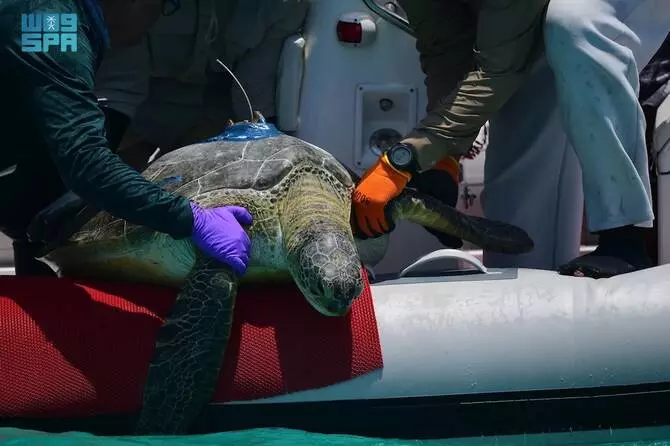

The Prince Mohammed bin Salman Royal Reserve has launched a satellite-tracking program for hawksbill and green turtles, marking the first known tagging of a pre-nesting and egg-carrying green turtle in the Red Sea. Officials describe the effort as a significant step in filling long-standing data gaps that have limited regional conservation planning for endangered turtle populations.
According to the Saudi Press Agency, the initiative is led by senior marine ecologist Ahmed Mohammed and King Abdullah University of Science and Technology Beacon Development specialist Hector Barrios-Garrido. Their team recently captured and tagged three critically endangered hawksbill turtles and seven green turtles. The devices send real-time movement data that will show feeding areas, migration paths and for the egg-carrying green turtle, the specific nesting site.
Reserve officials say the program extends ongoing turtle nesting-site monitoring that began in 2023. The protected area spans 4,000 sq. km of Red Sea waters, about 1.8 percent of Saudi Arabia’s marine zone and a 170 km coastline linking Neom and Red Sea Global, forming an 800 km chain of safeguarded shoreline. The region is a refuge for five of the world’s seven turtle species and a major breeding ground for green and hawksbill turtles. Ranger teams continue to track nesting behaviour at sea and on land, focusing on sites essential to natal homing.
Commenting on the risk level facing hawksbill turtles, CEO Andrew Zaloumis said, “critically endangered hawksbill turtles face an extremely high risk of extinction in the wild within our lifetime".
“With fewer than 200 breeding-age females remaining in the Red Sea, their survival depends on closing vital knowledge gaps to enable effective conservation".
He added, “Hawksbill turtles hatching on the reserve’s protected beaches range across 438,000 sq. km of open sea bordered by eight MENA (Middle East North Africa) countries, returning some three decades later to the same sandy beach to lay their eggs".
“This data will support national and regional efforts to drive a unified, ecosystem-wide turtle conservation management plan".
Reserve leaders say the project contributes to Saudi Arabia’s obligations under the UN Environment Programme’s Convention on Migratory Species and the Indian Ocean–South-East Asian Marine Turtle Memorandum of Understanding.
Mohammed noted the capabilities of the tracking devices, saying “These state-of-the-art, lightweight tags operate for at least 12 months, providing continuous data for detailed analysis of seasonal patterns and developmental habitats, contributing valuable insights to regional and global sea turtle research.
“Additionally, depth sensors reveal seagrass meadows, essential foraging grounds for green turtles and critical blue carbon sinks".
Despite the recent global reclassification of green turtles, experts say the species is still regarded as vulnerable in the region. All five marine turtle species found in the Red Sea are listed under the Convention on Migratory Species, which Saudi Arabia joined in 1979.