












When the Modi government 'develops' Nicobar
text_fields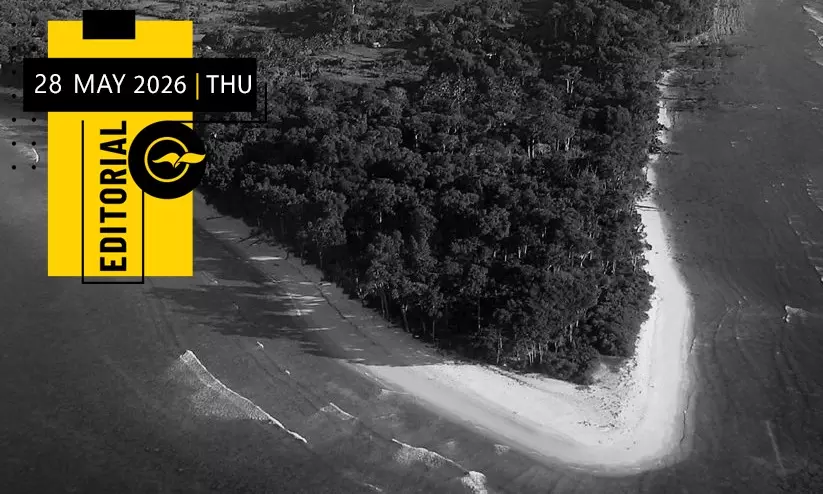

The development project (Great Nicobar Project) launched by the Central Government in 2021 in Nicobar — part of the Andaman and Nicobar Islands in the Bay of Bengal, about 1,200 kilometres off India’s southeastern coast — has already become a subject of intense discussion among economic, planning, and environmental experts, as well as political leaders.
Ramesh flags inadequate studies for Great Nicobar project, seeks public release of panel report
The criticism is that the project will lead to numerous hazards, including deforestation, loss of shelter and threats of extinction for indigenous tribal communities, potential land subsidence and flooding of the island, and the destruction of biodiversity. The project, proposed by NITI Aayog in 2015, took shape as a blueprint in 2021. With an estimated cost of ₹92,000 crore, the Central Government announced that the project would develop Great Nicobar into a strategically important economic and maritime hub. The government claims that Nicobar — located just 40 nautical miles from the vital East-West shipping lane through which nearly 40% of global trade passes — can become a transshipment hub for maritime and air cargo traffic, offering immense naval and industrial potential. The Centre estimates that, once the project — which includes a port, an airport, gas and solar power plants, and a vast township — is completed, it will provide facilities for three to four lakh people. It also envisions large-scale cargo transit through the port and improved facilities for civil and military movement through the new airport.
Great Nicobar project: Cong seeks access to green panel report
Putting aside the details, the result will be that Nicobar Island will cease to be what it is today. The proposed project also has a military facet. With the coordinated operations of the three military wings centred around the Andaman capital of Port Blair, it will be possible to monitor naval, air, and land movements in the region far more efficiently than before. This factor could also be used to attach an ‘anti-national’ dimension to responses directed against those opposing the project. It is precisely because of this that Congress leader Jairam Ramesh once stated that they would not oppose any project meant for national security, but that the same cannot be said of development achieved through environmental destruction.
India to build new military airfield in Andaman and Nicobar to counter China
The problem arises when many other things are lost in the course of a construction project. The population of the indigenous tribes in the Andaman and Nicobar Islands has been dwindling for some time. When such projects are introduced, laws such as the Forest Rights Act exist to protect the rights and interests of tribal communities. Allegations have emerged that the mandatory clearance required under the Act was obtained through coercion and later presented before the National Green Tribunal. The loss of natural assets and geographical uniqueness is of little concern to the Modi government at the Centre in its rush to showcase the outward glitz of development. When the tsunami struck in 2004, around 3,500 people lost their lives in the Nicobar Islands alone. Even today, the population of the two major tribes — the Nicobarese and the Shompen — continues to decline. Tribal communities are people who refuse to live away from the environment in which they were born and raised. Added to this is the displacement that will become inevitable once the project is implemented.
Deforestation is even more alarming. While the Union Ministry of Environment, Forest and Climate Change estimates that 8.5 lakh trees will have to be felled, unofficial estimates suggest that the actual figure could rise to between 32 and 58 lakh. The reforestation proposed as compensation for this appears absurd; instead of addressing the deforestation in the Nicobar Islands, the Centre proposes to plant ten lakh trees in Haryana, far away from the islands. Project experts point out that the site earmarked for the port lies in an earthquake-prone zone and that the ground level there permanently subsided by around 15 feet during the 2004 tsunami. Furthermore, under Coastal Regulation Zone laws, the port area falls within the CRZ-1A category, where construction is prohibited. It is also pointed out that the project will adversely affect the biodiversity of the region, including species such as monkeys and sea turtles that already face the threat of extinction.
Green Tribunal rejects pleas, allows Greater Nicobar project
It is the National Green Tribunal (NGT) that must examine all these aspects and grant clearance. However, its procedures, too, have been marked by questionable decisions. Earlier this year, the tribunal certified that environmental safety measures had been ensured. Amid conflicting arguments, the tribunal appointed a high-powered committee in 2023. Subsequently, it granted clearance after verifying that precautionary measures, including coral conservation and environmental protection, had been undertaken. This was challenged in court, and the case is currently awaiting consideration by the Calcutta High Court.
When it comes to projects involving massive contracts, the Centre’s history reveals a pattern of benefiting corporate giants close to the ruling party. Meanwhile, it is evident that matters are moving forward with an attitude of indifference towards whether Nicobar loses its tranquillity or whether the island itself is swallowed by the sea.
Congress criticises Centre over altered official maps of Great Nicobar