
















Historians allege intentional ignoring of evidence to erase Islamic history in Kamal Maula verdict
text_fields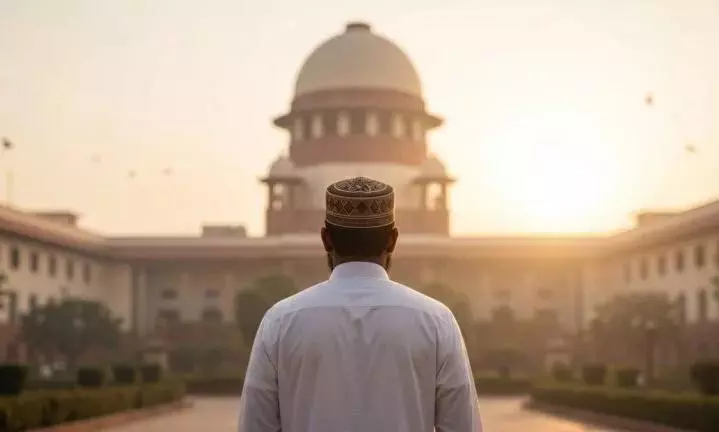

The Madhya Pradesh High Court verdict declaring the 700-year-old Kamal Maula Mosque a Saraswati temple has drawn sharp criticism from historians, who argue that the judgment relies on flawed ASI findings, ignores substantial historical evidence presented by Muslims, and advances conclusions on demolition and religious continuity that go even beyond the contentious logic of the Ayodhya verdict.
The dispute concerns the 14th century hypostyle mosque in Dhar, popularly referred to in modern political discourse as “Bhojshala”, a term several scholars insist is itself historically dubious and absent from pre-modern Sanskrit literature.
The court relied heavily on a court-ordered Ground Penetrating Radar survey conducted by the ASI, which claimed that a “massive” pre-existing structure existed beneath the mosque and that sculptural fragments reused in the building indicated the remains of temples.
Yet critics point out that the ASI report itself contradicts its own findings, because while one section states the underlying structure was reused after damage, another concedes that the pillars and architectural fragments originated from multiple temples rather than a single monument, according to The Wire report.
Historians further argue that the ASI entirely ignored the possibility that the reused material could have originated from palace architecture rather than a razed temple, despite extensive scholarship demonstrating that sculptural depictions of deities routinely adorned secular royal structures during the Paramara period.
Scholars cite the work of Felix Otter on the Sanskrit architectural text Samranganasutradhara, which details the integration of sacred imagery into palatial spaces, thereby undermining the survey’s sweeping assumption that every reused sculptural fragment necessarily originated in a temple.
The controversy has intensified over the court’s treatment of the so-called “Vagdevi” statue, which the judgment repeatedly identifies as an idol of Saraswati allegedly concealed by Muslim rulers.
However, the sculpture displayed in the British Museum is officially catalogued not as Saraswati but as a Jaina yakshini Ambika, while its inscription explicitly identifies the sculptor as a follower of Jain traditions.
Scholars have also noted that the figure was discovered not at the mosque site but in palace ruins in Dhar by colonial surveyor William Kincaid in 1875, a fact critics say was conspicuously omitted from the judgment. The Wire report further noted.
The ruling has also drawn condemnation for asserting that Jainism and Hinduism are “not distinct entities”, a proposition historians describe as historically indefensible and contrary to extensive academic scholarship documenting centuries of theological and political conflict between Brahmanical traditions, Jainism and Buddhism across South India.
Researchers point to medieval Shaiva and Vaishnava movements, which oversaw the conversion of numerous Jaina shrines, demonstrating that these traditions historically functioned as separate and frequently antagonistic religious systems.
Equally contentious is the court’s reliance on colonial-era interpretations and inscriptions disconnected from the mosque premises themselves. A 15th-century inscription found kilometres away at the tomb of Sufi saint Abdullah Shah Changal was invoked as proof of temple destruction, although historians insist the inscription merely reproduces later hagiographical rhetoric rather than factual testimony.
Critics also accuse the judgment of misquoting the 14th century Jaina text Prabandha Chintamani by attributing references to “Bhojshala” that do not exist in the original Sanskrit work.
Beyond the archaeological dispute lies what scholars describe as the systematic erasure of the site’s long Islamic history. Inscriptions cited even within the ASI survey itself record repairs to the mosques of Dhar in 1392-93 under Dilawar Khan Ghori, while the structure still bears unmistakable Islamic features, including a mihrab, Quranic inscriptions, a minbar and zenana galleries.
Historians warn that by subordinating seven centuries of continuous Islamic association to conjectural readings of reused fragments and disputed colonial narratives, the verdict risks institutionalising a deeply selective understanding of India’s layered past.