















Gujarat tables UCC bill, mandates live-in relationship registration
text_fields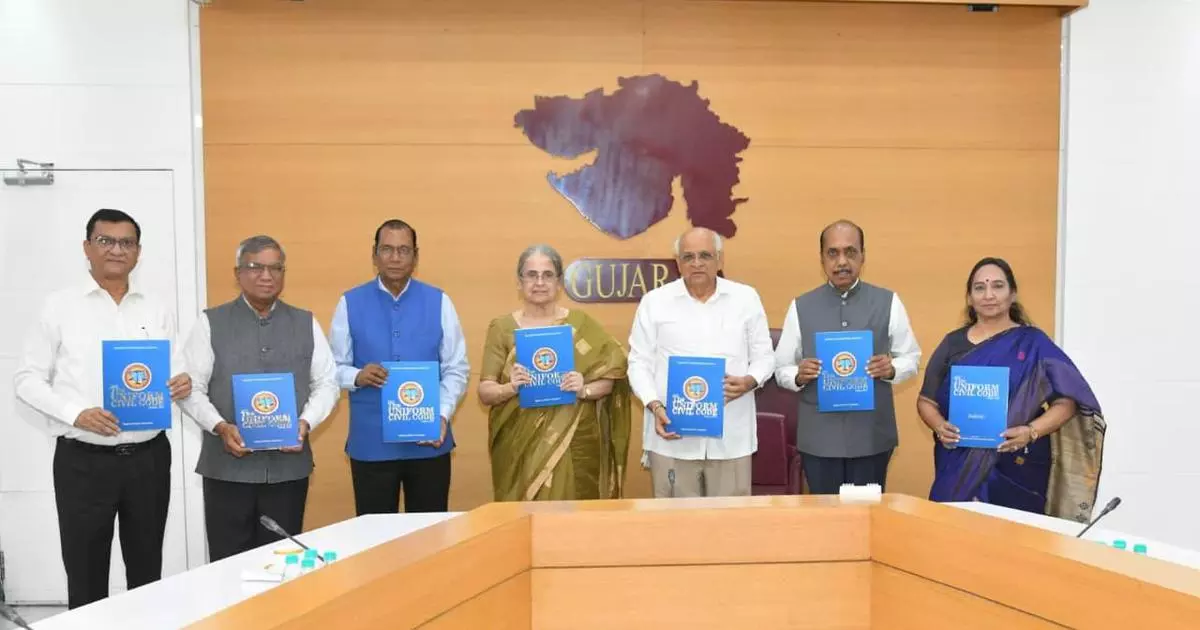

Gandhinagar: The Gujarat government on Wednesday introduced the 2026 Gujarat Uniform Civil Code (UCC) Bill in the state Assembly, The Indian Express reported.
If passed, Gujarat would become the second Bharatiya Janata Party-ruled state to move towards a common personal law framework, after Uttarakhand implemented a Uniform Civil Code in 2025.
Deputy Chief Minister Harsh Sanghavi tabled the bill, which proposes a uniform legal framework governing marriage, divorce, succession, live-in relationships, and related matters for all residents, regardless of religion, according to the Hindustan Times.
The Uniform Civil Code establishes a single set of laws for marriage, divorce, succession, and adoption. Currently, these personal matters are regulated by community-specific laws based on religious or customary practices.
The Gujarat bill follows recommendations from a committee chaired by retired Supreme Court judge Ranjana Prakash Desai, whose report was submitted to Chief Minister Bhupendra Patel on Tuesday. Patel said the report was based on “detailed study, public consultations and visits across districts,” and claimed that the recommendations prioritise equal rights and the protection of women. “The geographical and cultural diversity of Gujarat has also been kept in mind,” he added.

The proposed legislation will cover the entire state and apply to residents living elsewhere in India or abroad. However, it will not apply to members of Scheduled Tribes or groups whose customary rights are protected under the Constitution, the Hindustan Times reported.
Article 44 of the Constitution directs the state to “endeavour to secure for the citizens a Uniform Civil Code throughout the territory of India.” The provision, however, is part of the Directive Principles of State Policy and is not legally binding.
Introducing a common personal law has long been a priority for the BJP, and several states governed by the party have been taking steps towards its implementation. In January 2025, Uttarakhand became the first BJP-ruled state to implement a Uniform Civil Code post-independence. Goa has had a common civil code since the adoption of the Portuguese Civil Code in 1867.
During Uttarakhand’s UCC campaign, the BJP primarily targeted Muslim personal law, arguing that it discriminates against women by allowing practices such as polygamy, unequal inheritance, unilateral divorce, and denial of alimony. Legal experts have noted that Uttarakhand’s UCC largely mirrors Hindu personal law and could lead to the erosion of minority communities’ personal law practices.
The 2026 Gujarat UCC Bill establishes uniform conditions for valid marriages, including a minimum age of 21 for men and 18 for women, valid consent, and a prohibition on bigamy. While marriages can follow religious or customary ceremonies, registration is mandatory, with penalties for non-registration or false declarations. The bill also prohibits dissolution of marriages outside court procedures, requiring all divorce decrees to be registered.

Grounds for divorce under the bill include cruelty, desertion, conversion of religion, and mental illness. It recognises women’s rights to maintenance, child custody, and alimony.
The bill makes registration of live-in relationships mandatory for couples residing in Gujarat, while keeping it optional for residents living outside the state, according to the Hindustan Times. Registrars must ensure neither partner is a minor, already married, or within prohibited degrees of relationship. Children from such relationships will be recognised as legitimate, and deserted partners may claim maintenance.
Failure to register a live-in relationship within one month may attract imprisonment of up to three months or a fine of Rs 10,000. Registration obtained through force or fraud could result in up to five years’ imprisonment.