











Bhojshala site in Dhar ‘was never a mosque’: State, ASI to court
text_fields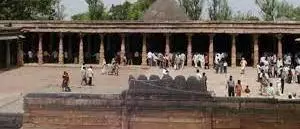

The Madhya Pradesh government has told the High Court in written submissions that the disputed Bhojshala site in Dhar was never a mosque and that the Muslim community does not have the right to offer namaz there, according to The Indian Express.
The replies were filed on behalf of several respondents, including the State government, the Dhar Archaeological Officer, the District Magistrate and the Superintendent of Police. The court is hearing rebuttal arguments in five petitions related to the disputed site before delivering its verdict, Indian Express reported.
In its submission, the state government argued that permission granted to Muslims to offer namaz at the site had only been intended to ease communal tensions. The government maintained that the structure was never a mosque and therefore the Muslim community could not claim ownership or exclusive prayer rights over the premises. It further stated that the entire Bhojshala complex belongs to the state government and has remained under the control of the Archaeological Survey of India even before Independence.
The respondents also reportedly contended that the site had historically functioned as a school associated with King Bhoj of the Parmar dynasty and not as a mosque. On that basis, they argued that the question of violation of the Muslim community’s fundamental rights did not arise.
According to the submissions, the present structure does not satisfy the essential characteristics of a mosque and still bears visible impressions of Hindu deities. The respondents further claimed that there had been no regular namaz at the site before 1935 and that archival correspondence from the erstwhile princely state of Dhar suggested only occasional and irregular prayers by a small number of Muslims.
The state argued that after communal tensions escalated in 1935, the princely administration allowed Muslims to offer prayers there solely as a measure to restore peace.
In a separate reply, the ASI stated that remnants of the original Bhojshala or Saraswati temple remain visible in the monument. It claimed that the structure was converted into a mosque by later Muslim rulers in the 14th century using architectural elements from the pre-existing Bhojshala complex.
The respondents further submitted that subsequent orders issued by the ASI and district authorities were intended to maintain communal harmony in the region. They pointed out that an ASI order dated April 7, 2003, permitted the Hindu community to access the premises every Tuesday from sunrise to sunset.
Meanwhile, one of the petitions filed by Maulana Kamaluddin argued that the Bhojshala-Kamal Maulana Masjid is fundamentally a mosque and that, under Muslim law, no activities other than namaz are permitted there.
The petitioner also alleged that the state government had failed to prevent aarti and puja rituals at the site, which, according to the plea, amounted to a violation of the constitutional rights of Muslims. The petitioners argued that the authorities were obligated to ensure that no Hindu religious rituals were conducted at the Bhojshala-Kamal Maulana Masjid premises.