













NASA to launch twin orbiters to study Mars’ magnetosphere
text_fields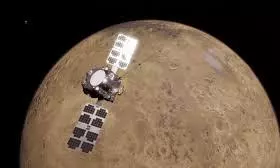

NASA will launch its ESCAPADE mission to Mars on November 9.
The spacecraft will fly on Blue Origin’s New Glenn rocket from Cape Canaveral Space Force Station in Florida.
ESCAPADE stands for Escape and Plasma Acceleration and Dynamics Explorers.
The mission uses two identical probes, named Blue and Gold. These orbiters will analyse Mars’ magnetosphere and the way the solar wind causes atmospheric loss. Scientists want to understand how charged particles from the Sun interact with Mars’ magnetic environment and strip away its atmosphere.
The mission is led by the Space Sciences Laboratory at UC Berkeley. Rocket Lab has built the spacecraft.
This will be NASA’s first two-spacecraft science mission that will go into orbit around Mars.
After lifting off from Florida, the pair will enter an orbit around Earth. For about a year, they will stay near the Earth-Sun L2 libration point. There, they will observe space weather. They will then begin a 10-month flight to Mars.
The mission’s main objective is to study how Mars changed from a planet that may once have been warm and wet to the cold and dry world seen today. With two orbiters taking measurements from different locations at the same time, researchers will be able to track spatial and time-based changes. This will create a clearer 3D picture of the Martian magnetic system, something that cannot be done with a single spacecraft.
The mission’s principal investigator, Dr. Rob Lillis, explained that the two spacecraft would be characterizing the magnetic and space weather (such as plasma and radiation) environment on their way to Mars, and that after they achieved Mars orbit, they would be measuring this environment in the solar wind and within Mars’ upper atmosphere, including the rates of atmospheric escape.
After the November 9 launch, the spacecraft will raise their orbit and wait near L2 for the right alignment. In November 2026, they will carry out a Trans-Mars Injection. They are expected to arrive at Mars in September 2027. They will then settle into orbit. The primary science mission will last 11 months and will start in mid-2028.
This flight is important for the New Glenn rocket. It will be the rocket’s second launch and its first interplanetary mission. New Glenn is 98 metres tall. It is designed to carry up to 45 metric tons to Low Earth Orbit, and 7 metric tons to Trans-Lunar Injection. Its first stage runs on seven BE-4 engines using liquid methane and liquid oxygen. The second stage has two BE-3U engines that burn liquid hydrogen and oxygen. The rocket also has a 7-metre payload fairing, which allows space for large spacecraft.