

















Trump’s desire for Greenland after the Venezuelan episode
text_fields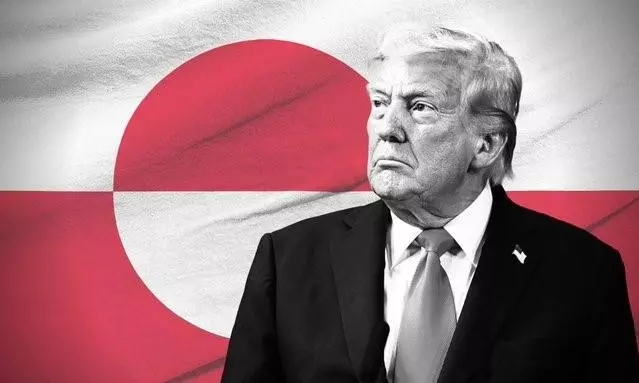

Donald J Trump has again expressed his wish to annex the largest island in the world. President Trump said he might use military means to annex it. He said that Greenland is crucial for American national security. Like most bullying leaders, he defines his nation’s security as the insecurity of his neighbours. But what about the security of Greenland and Denmark, to which it belongs? It is true that there is a security problem: Greenland is threatened by the United States.
After the alleged US military raid that reportedly kidnapped Mr Maduro and killed 32 of his bodyguards, Trump is riding high. He may be too full of himself, convinced of the efficacy of military action and the obsolescence of international law.
If the United States wants to annex Greenland, there is no doubt that it has the military capability. But ‘can’ does not equal ‘should’. The United States has a population of 330 million people. Denmark, which owns Greenland, has 5.5 million. The two militaries are grossly disproportionate. It would be totally impossible for Denmark to defend the island.
What right does the United States have to Greenland? The US has never owned an inch of it. Legally, Greenland belongs to Denmark, and the Trump administration does not even dispute that. Opinion polls show that almost no Greenlanders want to belong to the United States of America. The US has no legal or moral claim to it. In his first presidential term, Donald Trump said he wanted to purchase Greenland. This was seen as risible, and the idea was dropped. The Danes had politely informed Washington, DC, that Greenland was not for sale.
If the United States were to invade Greenland, it would be yet another blatant breach of international law. The UN Charter says that no state shall start a war, nor threaten to do so, nor seek to change borders by force. It would be a flagrant violation of lex gentium. Denmark has never attacked the United States. No Danish soldier has ever fired a shot at the United States, nor threatened to do so, nor set foot on US soil without permission. Denmark has never claimed any American land. On the contrary, Denmark has long been an ally of the United States.
Denmark is a founder member of the North Atlantic Treaty Organisation (NATO). For decades Denmark has allowed the United States to maintain military bases in Greenland. This gives the US early warning in the event that Russia fires nuclear missiles over the North Pole. If the United States were to annex Greenland, it might deal a deathblow to NATO. NATO is supposed to be about solidarity: an attack on one is an attack on all. But what happens if one NATO country initiates a war of aggression against another?
In 1946, President Harry S Truman asked the Danish government whether he could buy Greenland. The Danes courteously declined. So soon after the Second World War, Denmark was suffering economically, and a cash injection might have persuaded them. Truman’s offer was not as daft as it might seem.
Greenland is over two million square kilometres in area. It is larger than Mexico but has only about 83,000 inhabitants. Almost 90 per cent are indigenous Greenlanders, related to the Inuit. There are also ethnic Danes and people of mixed ancestry. Greenlandic men often find it difficult to find women willing to marry them.
Few people want to live in such a remote and icy place. Greenland may seem like a barren land covered in permafrost, but there is more to it. It is rich in rare-earth minerals, which are vital for semiconductors, renewable energy technologies and electric vehicles. It also has large deposits of uranium, which is needed for nuclear energy and nuclear weapons.
China controls most of the world’s rare-earth supply. China may well take back Taiwan this year. Taiwan produces most of the world’s advanced semiconductors, which are used in almost all electronic devices. Control over semiconductor production would therefore become even more valuable than it already is.
With global warming, the Northern Sea Route is navigable for more of the year. It runs through the Arctic Circle and provides the shortest sea route between North America, Asia and Europe. For this reason, bases in Greenland that allow control over this route are of growing strategic importance. Russia is also trying to use the route more, because it has such a long Arctic coastline.
Trump’s wish to buy or annex Greenland may be rooted more in psychology than in strategic or economic thinking. He is a man possessed by rampaging vanity. His egomania is fed by his entourage. His cognitive decline appears to be advancing, hence his emotional lability and his desire to make dramatic gestures. He has failed on other policy fronts, such as ending the war in Ukraine or lowering the cost of living.
The notion of purchasing sovereign territory is not new, but it is archaic. In the nineteenth century, the United States expanded through several purchases. Florida was bought from Spain; there was the Gadsden Purchase; and, most famously, Alaska was bought from the Russian Empire.
The brainchild of buying Alaska belonged to the US Secretary of State, William Henry Seward. Some decried it as ‘Seward’s Folly’, especially because in 1867, just after the Civil War, the United States was heavily in debt. But it proved to be an exceptionally astute move. Notably, the inhabitants of the land purchased were never consulted.
The principle of national self-determination did not emerge until President Woodrow Wilson set it out in his Fourteen Points in January 1918 as the basis for ending the First World War. Britain, France and other colonial powers did not accept this principle at the time. Nor did the United States live by it, since it did not undo its own earlier expansions that had been carried out without consent.
Wilson himself had authorised the purchase of the Virgin Islands from Denmark only a year before he proclaimed national self-determination to be sacrosanct. His hypocrisy was striking. The US Virgin Islands lie in the Caribbean and have been ruled by Denmark for centuries. Denmark had taken enslaved Africans from West Africa and shipped them to the islands, where they were forced to labour under brutal conditions.
In the nineteenth century Denmark emancipated them. During the First World War, the United States became worried that Germany might overrun Denmark and then claim the Virgin Islands, which would have placed German naval bases dangerously close to the American coast. The Danish government was persuaded to sell. The United States also hinted that if Denmark refused, the islands would simply be seized. That is why today there are both the US Virgin Islands and the British Virgin Islands lying close together.
The US Virgin Islands are a territory of the United States rather than a state. Their inhabitants are American citizens and may live in the continental United States, just as Americans from the mainland may move to the islands. However, the territory does not have a vote in presidential elections. It has representatives in the House of Representatives who may speak but not vote, and it has no senators at all. Other US territories such as Puerto Rico, Guam and American Samoa exist in the same constitutional limbo, more than a century later.
Greenland lies in the North Atlantic Ocean and has been inhabited for thousands of years by indigenous peoples related to the Inuit. In the ninth century, Scandinavian explorers arrived. They had earlier reached a bleak, rocky island about a thousand kilometres to the east and had called it, accurately, Iceland.
Fearing that no one would settle another place described honestly as even colder, they named this new land ‘Greenland’ — perhaps the first recorded example of misleading real-estate advertising. In reality, Greenland is mountainous and permanently ice-covered, with little fertile soil. Its inhabitants traditionally survived by fishing and hunting seals. The island was claimed by Denmark, just as Iceland had been.
Denmark, Norway and Sweden were united for several centuries in the Kalmar Union, named after the castle in Sweden where it was formed. Their languages all derive from Old Norse and are closely related, especially Swedish and Norwegian. Denmark, being the most southerly, had the mildest climate and the most fertile land, and Copenhagen became the centre of the union.
Sweden conquered Finland. The Finns preserved their own language and identity but also learned Swedish, even though Finnish is a Finno-Ugric language unrelated to the Scandinavian tongues.
The Kalmar Union collapsed in the sixteenth century, with Sweden going its own way and taking Finland with it. Norway was separated from Denmark and later placed in union with Sweden. Finland was annexed by Russia. Norway became fully independent in 1905. Finland did so in 1917. Iceland became a republic in 1944. Greenland has been internally self-governing since 1979. It could seek independence or full integration into Denmark, but opinion polls suggest that most Greenlanders are content with the present arrangement.
Denmark often ranks at or near the top of the Human Development Index, which measures life expectancy, education, income and environmental quality. It has short working hours, low crime, secure employment, a strong welfare state, low unemployment, excellent healthcare, first-rate education and efficient public transport. It abolished the death penalty after the Second World War.
Denmark invented Lego and the Danish pastry and gave the world Hans Christian Andersen. It has advanced technology and one of the highest proportions of renewable energy in its power mix anywhere. It is also a diverse society. There are Danish citizens of Ghanaian, Indian, Afghan, Chinese and Nigerian origin, as well as many from other European countries. Around 90 per cent of Danes speak English, and among those under 50, it is almost always excellent. Denmark is about three per cent Muslim.
Denmark has the oldest continuous monarchy in Europe and is a constitutional monarchy. The current Queen Consort is Australian-born. The country has been a democracy since the mid-nineteenth century. Its Prime Minister is Mette Frederiksen, the second woman to hold the office, and a Social Democrat.
Greenland enjoys the same social benefits as mainland Denmark. Greenlanders, whether indigenous or ethnically Danish, may move freely to Denmark, and Danes may do the same in reverse.
In the 1950s, Denmark pursued a policy of removing children from indigenous Greenlandic families and sending them to Denmark, sometimes against their parents’ wishes. The children were raised by Danish foster families and taught to speak only Danish before being sent back years later. In many cases, family relationships were permanently damaged. This policy was rooted in a belief among some Danes that Danish culture was inherently superior.
When one compares Denmark with the United States, it is not difficult to see which offers the better quality of life. Since the early twentieth century, almost no Danes have emigrated to the US. There was little incentive to do so.
The question remains: will Trump attempt to annex Greenland? Some of his supporters encourage him. Vladimir Putin would welcome it, because it would fracture NATO and weaken the Western alliance. It would also legitimise territorial conquest elsewhere.
The best that can be hoped for is that Trump is dissuaded. Denmark could offer him much of what he wants without surrendering sovereignty. Or he may simply grow bored with the idea. A crisis in Venezuela or Taiwan might distract him.