


















James Webb Telescope creates first 3D map of Uranus, reveals auroras and cooling atmosphere
text_fields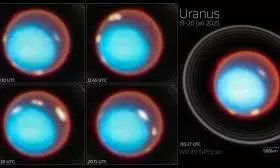

For the first time, the James Webb Space Telescope has mapped the upper atmosphere of Uranus in three dimensions, revealing bright auroras shaped by the planet’s tilted magnetic field and confirming that the ice giant is still gradually cooling.
According to the European Space Agency, astronomers used Webb’s infrared spectrograph to observe Uranus continuously for 15 hours as it rotated. The observations allowed scientists to measure temperature and ion concentration at different altitudes, mapping atmospheric layers up to 5,000 kilometres above the clouds.
The data show that temperatures peak between 3,000 and 4,000 kilometres above the surface, while ion density reaches its highest levels near 1,000 kilometres. The vertical profile also identified where auroras form in the ionosphere. Two bright auroral bands were detected near the magnetic poles, separated by a darker gap, a pattern also observed on Jupiter.
Uranus has one of the most unusual magnetic fields in the solar system. It is tilted about 60 degrees from the planet’s rotational axis and is offset from the planet’s centre. Because Uranus rotates on its side, its auroras move across mid latitudes rather than remaining confined to polar regions as on Earth.
The new 3D map also highlights the extent of Uranus’s magnetosphere and how the tilted magnetic field interacts with the atmosphere. Scientists say the findings confirm that Uranus’s atmosphere continues to cool over long timescales.
Researchers plan to use the data to refine models of ice giant planets, including those beyond the solar system, and to improve understanding of planetary climate systems.