



















Elegy for a peepal tree where gods, ghosts and villagers gather
text_fields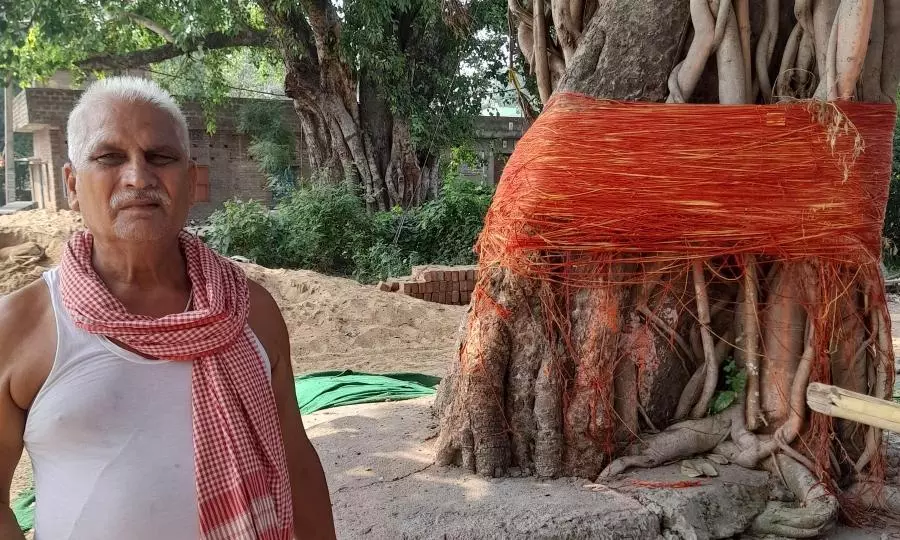

It’s a Peepal tree about 200 years old at Korji-Mohammadpur on the south-western outskirts of Patna. One day, road construction officials marked ‘54’ on its trunk, signalling that the tree would be cut to widen the road.
There is an equally old and majestic Banyan tree across the canal—waterless and dry for long now—barely 10 metres away from the Peepal tree. The villagers have built two brick-and-cement benches on the bridge that connects the Peepal and the Banyan, where they sit and relax under the shade of the two trees.
“There is no threat to the Banyan tree for now, as the officials haven’t marked it yet. But the days of the Peepal tree are numbered; the officials and labourers can descend any day to fell it. The government has decided to widen the Bhusaula-Danapur road passing through the twin village of Korji-Mohammadpur,” said Pappu Thakur, a young barber, trimming my hair and beard. Pappu sees the prospect of his salon attracting more customers when the road is widened.
The Banyan tree, just beside the staircase of his salon, has its trunk wrapped in thousands of yellow and red cotton threads. “Women gather on every Jyeshtha Amavasya (an auspicious day in May-June) to worship Goddess Savitri for the long life of their husbands. They tie sacred threads around the tree and circumambulate it, singing devotional songs to invoke Savitri, who rescued her husband Satyavan from the jaws of Yamraj—the Lord of Death,” said Satyadeo Sharma, a 71-year-old villager of Korji, a small brass tumbler in his hand. He had just poured holy water at the roots of the Peepal tree to propitiate Lord Vasudev, who is believed to reside in the Peepal.
Another elderly villager, Umesh Sharma, joined in. “Years ago, my brother dived from the Peepal tree into the canal—which was full of water then—and drowned in its swirling currents. The spirit of my brother lives in these Peepal and Banyan trees, which have served as the abode of gods and ghosts for generations.”
“These trees are more than two hundred years old. My grandfather, who died decades ago, would tell us that he had seen them with denser and more luxuriant branches even when he was a child,” Satyadeo Sharma muttered.
Peepal: an abode of ancestors’ spirits
When a family member passes away, the soul becomes a wandering spirit, embarking on a long, invisible journey. To comfort this thirsty traveller, the family hangs a small picture of the departed on a sacred Peepal tree—the bridge between earth and heaven—along with a small earthen pot.
Every morning at dawn, before the heat of the day takes hold, a male family member—preferably a son or other direct descendant of the departed—walks to the tree carrying a brass vessel filled with fresh, cool water. He pours it gently into the pot, watching it trickle down, believing with absolute certainty that the water will quench the deep, unceasing thirst of the departed spirit as it navigates the ethereal spaces.
For thirteen to fourteen days, this daily offering continues. It ensures that the soul is neither forgotten nor left thirsty until it completes its transition to the next world. For generations, this Peepal tree has served as an abode of departed souls, allowing their descendants to offer water in their memory.
Savitri-Satyavan Story
Mystics, saints, scholars of Indology, and folklorists have told and retold the Savitri-Satyavan story, whose roots are traced to ancient Hindu scriptures, for centuries.
Savitri, the beautiful and deeply virtuous daughter of King Ashwapati, was given the freedom to choose her own husband. Her quest led her to the forest, where she met Satyavan, a handsome and noble prince. His blind father had lost his kingdom and lived in a humble forest hermitage. Satyavan supported his parents by chopping wood.
Savitri fell in love with his kindness and integrity and resolved to marry him.
When she returned to court to announce her choice, the sage Narada happened to be visiting. Narada revealed a terrible prophecy: Satyavan was destined to die exactly one year from that day.
Despite her father’s pleas to choose someone else, Savitri remained steadfast. She married Satyavan and joined him in his simple forest life, keeping the dark prophecy to herself.
For a year, Savitri counted the days. On the fateful day, she accompanied Satyavan into the forest. While cutting wood, he suddenly grew weak, complained of a terrible headache, and lay down with his head in her lap. Moments later, his breath left him.
Then Yama, the Lord of Death, appeared to claim Satyavan’s soul and began his journey to the underworld. Refusing to surrender her husband, Savitri followed him.
Again and again, Yama asked her to return. Again and again, Savitri answered with such wisdom, devotion, and righteousness that the Lord of Death was moved. He granted her successive boons—restoration of her father-in-law’s eyesight and kingdom, and blessings upon her own father’s lineage—but forbade her from asking for Satyavan’s life.
Finally, Yama offered one last boon. Savitri asked to be blessed with a hundred sons. Yama granted it immediately.
Then Savitri gently reminded him that, as a faithful wife, she could not bear children without her husband. To fulfil his own divine word, Yama would have to restore Satyavan to life.
Realising that he had been outwitted by her unwavering devotion and sharp intelligence, Yama smiled and returned Satyavan’s soul. Savitri returned to the tree, where Satyavan awoke as if from a deep sleep, unaware that his wife had journeyed to the edge of death and back to save him.
The women live in Savitri
The women of Korji-Mohammadpur—particularly those who are poor, unlettered, and largely bereft of modern economic means and lifestyle—live Savitri and Satyavan through their devotion and worship at this Banyan tree. It is heartwarming to see these women in yellow saris, with vermilion extending from the forehead into the parting of their hair, gathering under the Banyan tree on every Jyeshtha Amavasya. They sing in chorus, extolling Savitri in her quest to rescue her husband Satyavan from Yamraj, the God of Death.
Nearly two decades ago, these Banyan and Peepal trees on the banks of the canal, flanked by wild growth of reeds, bamboo, and other bushes teeming with birds, reptiles, and pastoral life, attracted yours truly to make his home in this locality. Family members and friends did not like the idea because of the remoteness and the “hidden dangers” of what they described as an “unsafe” area. But two factors inspired me to buy a flat in the solitary apartment coming up at this place—first and foremost, its affordability, something a man of modest means could manage. Secondly, I could see fireflies glowing and wild boars and jackals passing by when I strolled at dusk.
Loss and lament
A renowned neurologist of Patna and friend, Dr Ajay Kumar—a devotee of Prime Minister Narendra Modi—repeatedly shares a story about how Modi had given an “enriching lecture” on the medicinal value of moringa when the former had met him at his Gandhinagar residence during his tenure as Gujarat chief minister. People have also seen the Prime Minister feeding peacocks under tall trees at his Lok Kalyan Marg residence and meditating in caves amidst lush hills, reinforcing his image as a lover of nature.
Nitish Kumar, during his long tenure as Bihar’s chief minister, carried out several yatras as part of his much-vaunted Hariyali Mission, inspiring people and officials to plant trees and protect biodiversity, for which he earned widespread appreciation in both social and mainstream media.
But yours truly, a poor pen-pusher with little influence in the corridors of power, can share his melancholy only with the people reading this column. Thank you for reading it and sharing my moments of sadness.