

















PM SHRI: UDF should not betray Kerala
text_fields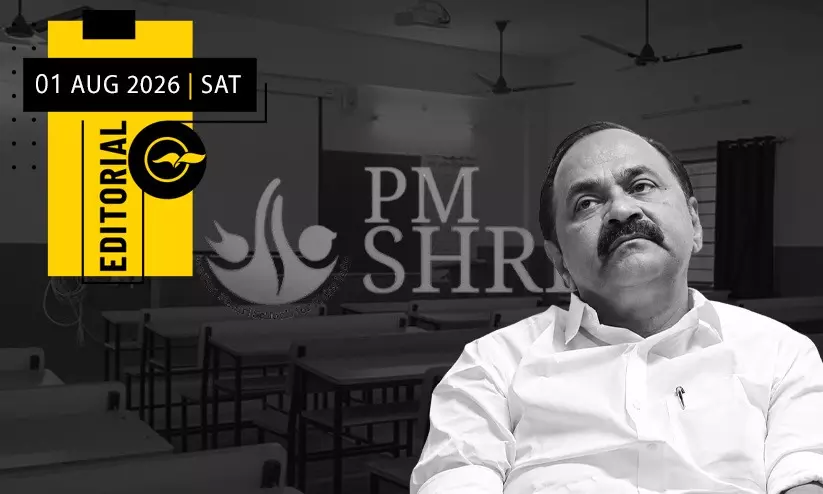

Kerala's ruling United Democratic Front (UDF) convener Adoor Prakash told the media after the recent UDF meeting that there was no choice but to move forward with the Central Government's PM SHRI (Prime Minister Schools for Rising India) scheme, a scheme that aims to saffronise education and schools. While in the opposition, the UDF had unleashed severe criticism against the LDF government for signing the scheme's Memorandum of Understanding (MoU); however, the reasons they now put forward for this shift in stance are strange: one is a technical justification that since the previous government signed it, there is no room to withdraw. Another is that although they have no interest in PM SHRI, the funds coming through the project can be used for the state to tide over its financial crunch. Adoor Prakash made it clear that they would proceed with the project as a tactical policy. However, all these justifications collapsed 24 hours prior to that statement. That was revealed only later. In a written reply given on July 29 in the Rajya Sabha to questions raised by MPs PV Abdul Wahab and Jebi Mather regarding PM SHRI, the Union Minister of State for Education stated that states can withdraw from the scheme even after signing the MoU. Citing Tamil Nadu as an example, the Minister also explained that non-plan funds would not be withheld on those grounds. That is to say, it is clear that neither of the two justifications currently put forward by the UDF carries any substance. It may be after realising this that P. K. Kunhalikutty, Muslim League parliamentary party leader and Industry Minister, indirectly corrected Adoor Prakash. Denying news that they would move forward with the scheme, he informed that the report of the ministerial sub-committee studying the issue had not yet come up for discussion in the Cabinet. At any rate, with the statement of the UDF convener, the government's stance on the PM SHRI project has become clear: that there is nothing wrong with trading off the state's public education sector to the Sangh Parivar for a bit of funds. If this is the policy, it has to be described as nothing short of betrayal.
Also read: Kerala's UDF govt to implement PM SHRI scheme, reversing earlier stance
Opposition, i.e. non-BJP ruled states, including Kerala, generally view the National Education Policy (NEP) of 2020 — formulated by the committee headed by former ISRO Chairman K. Kasturirangan — as an RSS project. The Union Government conceptualised the PM SHRI scheme with the goal of establishing model schools across the country based on the NEP. The Modi government pressured states to implement this scheme with the threat of cutting central funds and other means. Nevertheless, Kerala, Tamil Nadu, and West Bengal initially held out without signing. Tamil Nadu and West Bengal formulated their own State Education Policies. Although Kerala did not make such a move, it radically revised its curriculum as an alternative syllabus. However, in the midst of this, Kerala secretly shifted its stance. Ignoring opposition from alliance partners including the CPI, General Education Secretary Dr. Vasuki signed the Memorandum of Understanding (MoU) on behalf of Kerala on October 23, 2025. The very next day, the then Education Minister V. Sivankutty justified it by pointing to the lack of funds. The Minister's argument was that central allocations to the state, including the 'Samagra Shiksha Kerala' funds, were in arrears and that other funds would also be withheld. Moreover, he and Left leaders, including chief minister Pinarayi Vijayan, reiterated that even if the project were implemented, Kerala would not yield to the NEP. However, opposition members led by present Chief Minister V. D. Satheesan blunted those arguments by quoting details presented in the Assembly by the Minister himself. They also declared that if they came to power, they would scrap the project. Eventually, when the UDF government assumed power, some moves in that direction became obvious. The public viewed the appointment of a cabinet sub-committee to study the issue and reach a practical decision as part of that effort. But following the statement of the front convener, one is left wondering whether it is pragmatic thinking on how to implement the project that is actually guiding them.
Also read: Congress high command objects to Kerala implementing PM SHRI
Anyone following the PM SHRI discussions since the previous government's tenure will understand that Kerala, too, desires an alternative education policy along the lines of the Tamil Nadu model. The political essence of this stance is to distance itself from the Sangh Parivar agenda of saffronising the education sector and to uphold the nation's secular tradition. It was when this public sentiment was ignored that the LDF, in a sense, stumbled; and the moment the UDF declared it would dump PM SHRI into the Arabian Sea out of respect for that very public sentiment, it gained political momentum. However, upon coming to power, the UDF also forgot the people. Why the LDF government signed the Memorandum of Understanding (MoU) still remains a mystery. One has to suspect whether the UDF is now attempting to implement the project under the cover of that very same mystery. If so, it can only be viewed as subservience to the Sangh Parivar. Now that the Centre itself has clarified that states can withdraw from the project even after signing the MoU without having non-scheme funds withheld, the government is engaging in this risky game just when Kerala has found an opportunity to step away from PM SHRI once and for all. It is certain that Kerala will not compromise on this.
Also read: PM SHRI row: UDF-LDF clash ends in oppn walkout in Kerala Assembly