













If the Home Department were handled by Jamaat-e-Islami…!
text_fields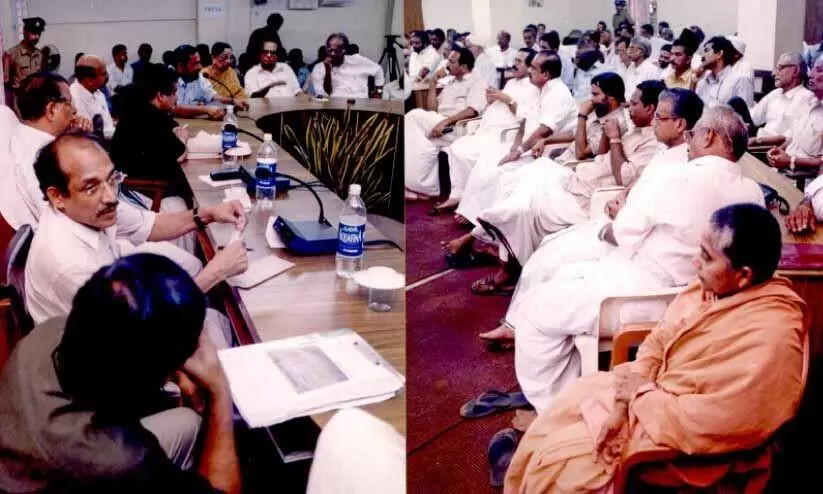
“If the UDF comes to power, it will be Jamaat-e-Islami handling the Home Department. Then, many more ‘Marads’ will happen.” It was after seeing these words of A.K. Balan—a former minister, senior leader, and former CPM state committee member—go viral on social media that I felt compelled to remind the younger generation of certain past events.
One is reminded of the old proverb, “The cow has died, but the buttermilk is still sour,” as the CPM (the main ruling party and the largest leftist party) directed the entire spearhead of its campaign against Jamaat-e-Islami throughout the Lok Sabha elections. Despite this, the election results ended in an unprecedented loss for them. At least based on that realisation, the public expected the party to leave Jamaat-e-Islami alone—an organisation which, in the party’s own words, does not even have one per cent support within the Muslim community.
In the subsequent Assembly by-elections and the recent local body elections, however, we saw heavyweights including Chief Minister Pinarayi Vijayan, Party Secretary M.V. Govindan, and Politburo member A. Vijayaraghavan repeatedly performing the “Slaying of Jamaat” Kathakali (a political act) without fail.
Meanwhile, both religious and secular media outlets did everything possible to keep the issue fuelled. Their constant warning was that the Muslim League and the UDF, influenced by the “terrorist, extremist, communal, and fundamentalist” Jamaat-e-Islami, were leading Kerala towards a massive catastrophe.
While the majority of the people of Kerala did not quite grasp the logic, a sense of dread—that some great disaster was about to strike—certainly gripped a few. However, when the local election results were declared, the public was left stunned. As the Muslim League swept nearly all the seats in its stronghold of Malappuram and the UDF secured record victories across Malabar, the people realised one truth: there was no factual validity to the CPM’s campaign, and it was driven by other hidden agendas they refused to speak of openly.
With the Assembly elections just around the corner, the public would have expected the Government and the Party to discover new mantras and strategies to survive the looming threat of a massive defeat. However, A.K. Balan’s aforementioned statement leads people to believe that the Party has nothing new to say. Even as Jamaat-e-Islami has repeatedly made it clear that they do not participate in elections or field candidates, it is unlikely that the organisation would have a presence even at a swearing-in ceremony should the UDF come to power.
Given that, the claim that the Home Department would be handed over to Jamaat is nothing but a “blank fire” (a hollow threat)! Even if one dismisses that as mere empty talk, since he has predicted that “many more Marads” will occur, it is important to remind him of certain truths regarding that matter.
In 2002, a brutal incident occurred in the Marad area of Kozhikode, a locality inhabited by fisherfolk, where five individuals, including Abubacker—the gravedigger at the Muslim cemetery—were murdered. Since the incident carried communal overtones, it was the responsibility of the police to conduct an immediate investigation, apprehend the culprits, and ensure that the peaceful atmosphere did not deteriorate.
However, due to a lack of vigilance by the authorities, this was neglected. Although the police took some individuals into custody, they were all released following the intervention of the political party members concerned. Driven by a thirst for revenge, the sons of Abubacker carried out a planned operation, which eventually culminated in the horrific incident on 3 May 2003, in which eight members of the Araya (Hindu fisherman) community and one Muslim were killed.
The government led by A.K. Antony and the UDF leadership realised that the incident could trigger communal riots, tarnishing the reputation of Kozhikode, which has historically maintained a great tradition of communal harmony.
Consequently, the Chief Minister, P.K. Kunhalikutty, and other ministers set out for Marad, but leaders of the Araya Samajam blocked them. The police intervention proved futile, and the cabinet team was forced to turn back. At the same time, Prof. K.A. Siddique Hassan, the then Kerala Ameer of Jamaat-e-Islami, reached the Marad checkpoint and bravely moved forward to speak with the leaders and workers of the Araya Samajam. Following this, they agreed to let him pass. He returned only after assuring them that he would make every effort to get their legitimate demands accepted and seeking their cooperation for the restoration of peace.
As a result of the efforts of the Ameer (Prof. Siddique Hassan) and P.K. Kunhalikutty, a reconciliation meeting was convened at the Kozhikode Guest House. This meeting was attended by representatives of the Araya Samajam-BJP, various Muslim organisations, the Chief Minister, Cabinet members, and UDF leaders, in the presence of Gandhi Peace Foundation Chairman Gopinathan Nair.
I was also a participant in that meeting. Representing the BJP side were Adv. P.S. Sreedharan Pillai and Araya Samajam Secretary Suresh. The discussions, which began at 7.00 pm, dragged on past 10.00 pm without reaching a resolution, giving rise to much anxiety.
The primary demands of the Araya Samajam side were ₹10 lakh in compensation for each of the deceased families and a CBI investigation. When the government hesitated to accept these terms as they were, the talks hit a deadlock. However, Prof. Siddique Hassan insisted that the stalemate—which was paving the way for a thickening atmosphere of communal riot—could not be allowed to continue.
Consequently, it was decided to pause the talks and resume the following day at Chief Minister A.K. Antony’s residence in Thiruvananthapuram. The next day, when the Araya side agreed to the proposal of ₹10 lakh compensation and a judicial inquiry, the threat of a major riot was averted. Kerala welcomed this development with immense relief. This is the “Marad Model” of Jamaat-e-Islami.
One must remember that while 78 workers from A.K. Balan’s own party were accused in the riots, not a single worker of Jamaat-e-Islami was implicated. And what did the Thomas P. Joseph Commission, which investigated the riots, point out regarding the CPM’s role? Comrade Balan should at least read pages 149 and 150 of that Commission Report, which charged that the accused were NDF members who had infiltrated the CPM along with the IUML.
The people of Kerala are currently witnessing exactly how “safe” and “healthy” the Home Department is in the hands of the Karanabhoothan (the Architect/Supreme Leader) himself. Comrade Balan should not have forgotten that it is certainly not while Jamaat-e-Islami handles the Home Department that K.K. Rema—who was born into a Communist family and grew up through the SFI as an active party worker—is being made to drink her tears for the rest of her life.
It is only natural that such things happen when the land is ruled by those who fear neither the Creator nor His creations. In any case, let us hope that the people, having been bitten twice in the same hole, will remain vigilant to ensure they are not bitten a third time.