

















Kerala High Court: Bank officers bound by strike curbs once sector is declared public utility service
text_fields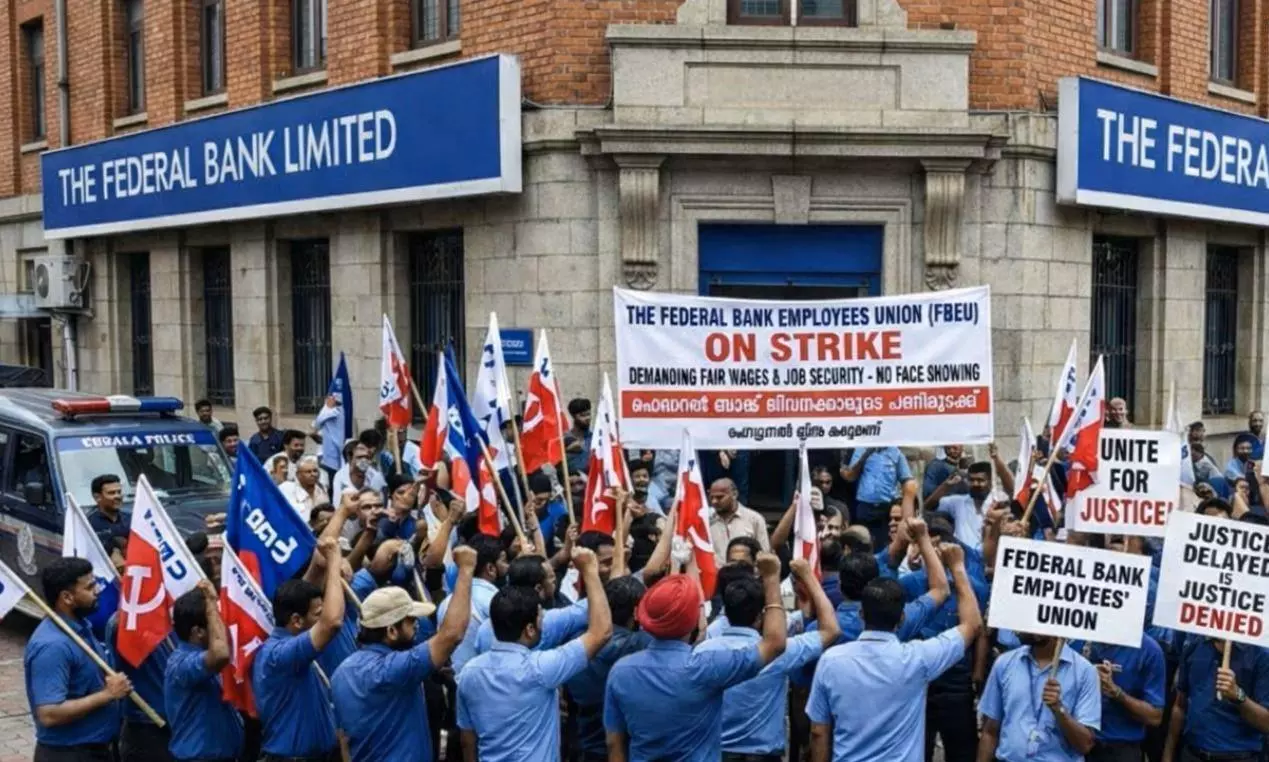

Kochi: The Kerala High Court has ruled that bank employees, including officers, are subject to statutory restrictions on strikes once the banking sector is notified as a public utility service under the Industrial Disputes Act, 1947.
A division bench of Justices Sushrut Arvind Dharmadhikari and Syam Kumar V M delivered the judgment while allowing an appeal filed by The Federal Bank Limited against a March 28, 2025 order of a single judge that had quashed conciliation proceedings initiated over a proposed strike by the Federal Bank Officers’ Association.
Observing that the banking sector directly serves ordinary citizens, the court said strikes in such institutions disproportionately affect the common public.
If bank officers go on strike, it is the common citizen, the lower-middle-class or poor citizens, who are most adversely affected, not the wealthy. This is because the banking sector’s interface today is far more with ordinary citizens than with the affluent. Even for basic services such as issuing a money order or demand draft, ordinary citizens must wait in long queues, running from one counter to another, the bench said.
The court held that Article 19(1)(c) of the Constitution, which guarantees the right to form associations, does not include a fundamental right to strike or declare lockouts independent of statutory provisions.
It observed that strikes or lockouts in sectors of public importance primarily harm ordinary citizens and can paralyse establishments that provide essential services. Such actions are regulated under law precisely because of their far-reaching public impact.
The bench emphasised that once a service is declared a public utility service, any person employed in it must follow the prescribed statutory procedure before resorting to strike action, including participation in conciliation proceedings. It added that allowing otherwise would defeat the purpose of notifying banking as a public utility service and could legitimise disruptive action in essential sectors.
The court set aside the single judge’s ruling and upheld the validity of the conciliation proceedings initiated under Section 22 of the Industrial Disputes Act. It clarified that once banking is notified as a public utility service, officers cannot bypass statutory strike restrictions even if they do not fall within the definition of workman under the Act.
The controversy began after the Federal Bank Officers’ Association, representing Scale I to Scale III officers of the private sector bank headquartered in Aluva, called for a strike or abstention from work.
The regional labour commissioner invoked Section 22 of the Industrial Disputes Act and commenced conciliation proceedings. The provision bars strikes and lockouts in public utility services without strict compliance with notice requirements, including six weeks’ prior notice and a prohibition on strike action during the pendency of conciliation.
The association challenged the proceedings, arguing that its members were not workmen under Section 2(s) of the Act and that no industrial dispute could exist in their case. A single judge accepted this contention and quashed the proceedings, prompting the bank to file an appeal.
The division bench relied on a June 5, 2023 notification issued by the Union Ministry of Labour and Employment declaring banking services a public utility service in public interest. It held that the notification carried substantive legal consequences and was not a mere formality.
The association argued that Section 22 should apply only to workmen. The court rejected this view, drawing a distinction between Sections 22 and 23 of the Act.
While Section 23 specifically refers to workmen, Section 22 uses the broader expression no person employed in a public utility service. The bench held that this wording was deliberate and extended the statutory embargo on strikes to all employees in a notified public utility service, not just workmen.
If Parliament intended to confine the restriction to workmen, it would have said so, the court observed, adding that Section 22 operates independently of provisions governing adjudication of industrial disputes.
The bench also noted the central role of banking in the national economy, referring to official data placed on record. It observed that domestic deposits increased from Rs 88.35 lakh crore in 2015 to Rs 231.90 lakh crore in 2025, while bank credit expanded from Rs 66.91 lakh crore to Rs 181.34 lakh crore over the same period.
Gross non-performing assets fell from 11.46 per cent in 2018 to 2.31 per cent in 2025, and net profits of scheduled commercial banks rose significantly, the court noted. These figures reflected a sector that had moved from crisis to confidence and now stood at the forefront of economic growth, it said.
The court concluded that labour law must be interpreted in light of these realities and that the functioning of a public utility service such as banking cannot be halted through collective action without adherence to statutory safeguards.