















Why lament Kejriwal, who traded ideals for expediency?
text_fields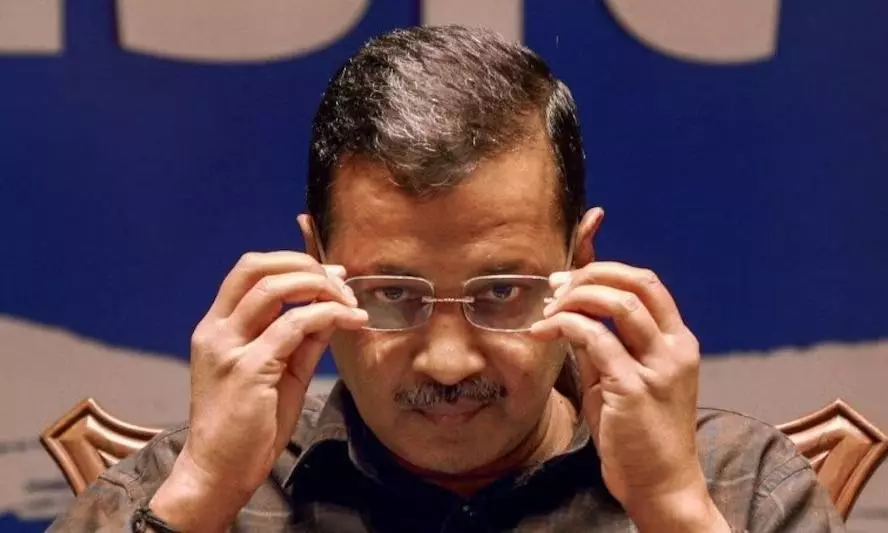
Remember Anna Hazare, the man who descended on Delhi draped in Gandhian symbolism, promising to cleanse India of corruption? It was presented as a moral uprising, almost saintly in its intent. But it was never a one-man show. Behind the fasting figure stood an organised machinery.
The Sangh Parivar lent muscle and logistics. Bureaucrats like Vinod Rai supplied the intellectual ammunition, popularising the now-famous theory of “presumptive loss” to paint the Manmohan Singh government as irredeemably corrupt.
A powerful section of the media played along enthusiastically. The movement gathered familiar faces: Kiran Bedi, projecting administrative rectitude; Baba Ramdev, blending spirituality with enterprise; and Arvind Kejriwal, an IRS officer-turned-activist, who would soon emerge as the most politically astute among them. They did not leave Delhi until the government yielded and agreed to establish the Lokpal. It was projected as a moral victory. In hindsight, it was also a political launchpad.
The dividends were handsome. The 2014 general election brought Narendra Modi to Delhi. Those who had ridden the anti-corruption wave found their rewards. Vinod Rai entered the Rajya Sabha. Kiran Bedi was briefly projected as Delhi’s chief ministerial face and later appointed Governor. Ramdev built a sprawling business empire worth thousands of crores. And Kejriwal, sensing the political vacuum, carved out his own space by forming the Aam Aadmi Party and capturing Delhi’s imagination.
Kejriwal cultivated the image of the ordinary citizen—armed with a broom, driving a modest car, speaking the language of the street rather than the drawing room. Reports surfaced that, during his tenure as an IRS officer, he had allegedly tried to avoid paying government dues, which he later returned when confronted. For his supporters, this was a minor blemish. For critics, it was an early sign of contradiction between rhetoric and reality.
He pioneered what might be called “anti-politics politics”—positioning himself as an outsider while mastering the craft of insider manoeuvring. His early demand for full statehood for Delhi was framed as a democratic necessity, given that key subjects like law and order remained under the Union government. Yet, when a full-fledged state like Jammu and Kashmir was downgraded into Union Territories, he supported it wholeheartedly.
Symbolism, too, became a tool. A grand replica of the Ayodhya temple was erected in Delhi for a one-day event attended by his MLAs. It was dismantled soon after, leaving behind questions about cost, purpose, and public access. The “common man” was conspicuously absent from this spectacle, except perhaps as a taxpayer footing the bill.
Free pilgrimages for senior citizens to Ayodhya were organised. To maintain a semblance of balance, similar promises were made for Velankanni and Ajmer Sharif. His MLAs were asked to recite the Hanuman Chalisa. These gestures blurred the line between governance and symbolism, between secular politics and religious signalling.
Moments of crisis revealed another side. During the Northeast Delhi riots, expectations were clear: a chief minister must be visible, decisive, and present on the ground. Kejriwal chose instead to sit on a fast at Rajghat. Leadership is not only about moral positioning but also about timely action.
The pattern repeated during the protests against the Citizenship Amendment Act. While large sections of society expressed concern over its implications, Kejriwal chose to support the central government. At Shaheen Bagh, where women staged a prolonged, peaceful protest, his response was telling. He lamented that the police were not under his control, suggesting he would have cleared the protest swiftly if they were. Ironically, even Home Minister Amit Shah refrained from using force, wary of public backlash. The contrast was striking.
To Kejriwal’s credit, his government did deliver tangible benefits. Subsidised electricity and water reached households across income groups. Women were allowed free travel on public buses. Government school infrastructure improved, with new buildings replacing crumbling structures. These were not trivial achievements.
Yet, beneath the surface, familiar problems persisted—bureaucratic inefficiency, administrative lethargy, and allegations of corruption, particularly in private school fee approvals.
Then came the optics that proved costly. The merging of two government bungalows into a lavish residence became a symbol in itself. In the 2025 election, the BJP’s branding of the house as “Sheeshmahal” cut through Kejriwal’s carefully constructed image of simplicity. Politics often turns on perception, and here perception proved decisive. He was himself defeated.
His ambitions extended beyond Delhi. In states like Himachal Pradesh and Haryana, AAP attempted to expand its footprint. The results were uneven at best. In some cases, the party’s presence split anti-BJP votes, indirectly aiding the BJP’s victories. Whether intentional or incidental, the outcome raised uncomfortable questions about strategy and alignment.
Internal dissent added to his troubles. Early associates like Yogendra Yadav and Prashant Bhushan parted ways, citing differences over ideology and internal democracy. More recently, the exit of Raghav Chadha and six other Rajya Sabha members has dealt a severe blow.
Unlike earlier departures, this was not a trickle but a rupture.
The legal questions surrounding their move—whether it constitutes defection under the anti-defection law—will be examined by the Rajya Sabha authorities and possibly the courts. But politically, the impact is immediate. The BJP’s strength in the Upper House has increased, and Kejriwal’s hold over his party appears weakened.
There is also the uncomfortable issue of how these Rajya Sabha seats were allocated in the first place. It has long been whispered that financial capacity played a role in nominations. If that is indeed the case, loyalty becomes transactional, not ideological. And when a more powerful player offers greater rewards, the shift is hardly surprising. Add to this the pressure that central investigative agencies can exert, and the exits begin to look less like isolated acts and more like a pattern.
All of this comes at a delicate time. The Punjab Assembly elections are less than a year away, and AAP’s internal instability could prove damaging. What was once projected as a movement of clean politics now appears entangled in the same contradictions it once condemned.
And so we return to the question: why lament, Kejriwal? The trajectory, in many ways, was set long ago. The anti-corruption movement that promised a new political culture ended up reinforcing old power structures, albeit with new faces. The Lokpal, once the rallying cry of a nation, has faded into near irrelevance.
In the end, both Kejriwal and Anna Hazare achieved something undeniable—they altered the course of Indian politics. But not necessarily in the way they had promised. So, lament if you must. But it would be more honest to acknowledge that this was never a fall from grace. It was, rather, the inevitable outcome of a journey where ideals were steadily traded for expediency—and where the broom, once raised high, slowly became just another political prop.