


Hyder Ali, Tipu Sultan hero-worshipped by Americans — yes, you read that right
text_fields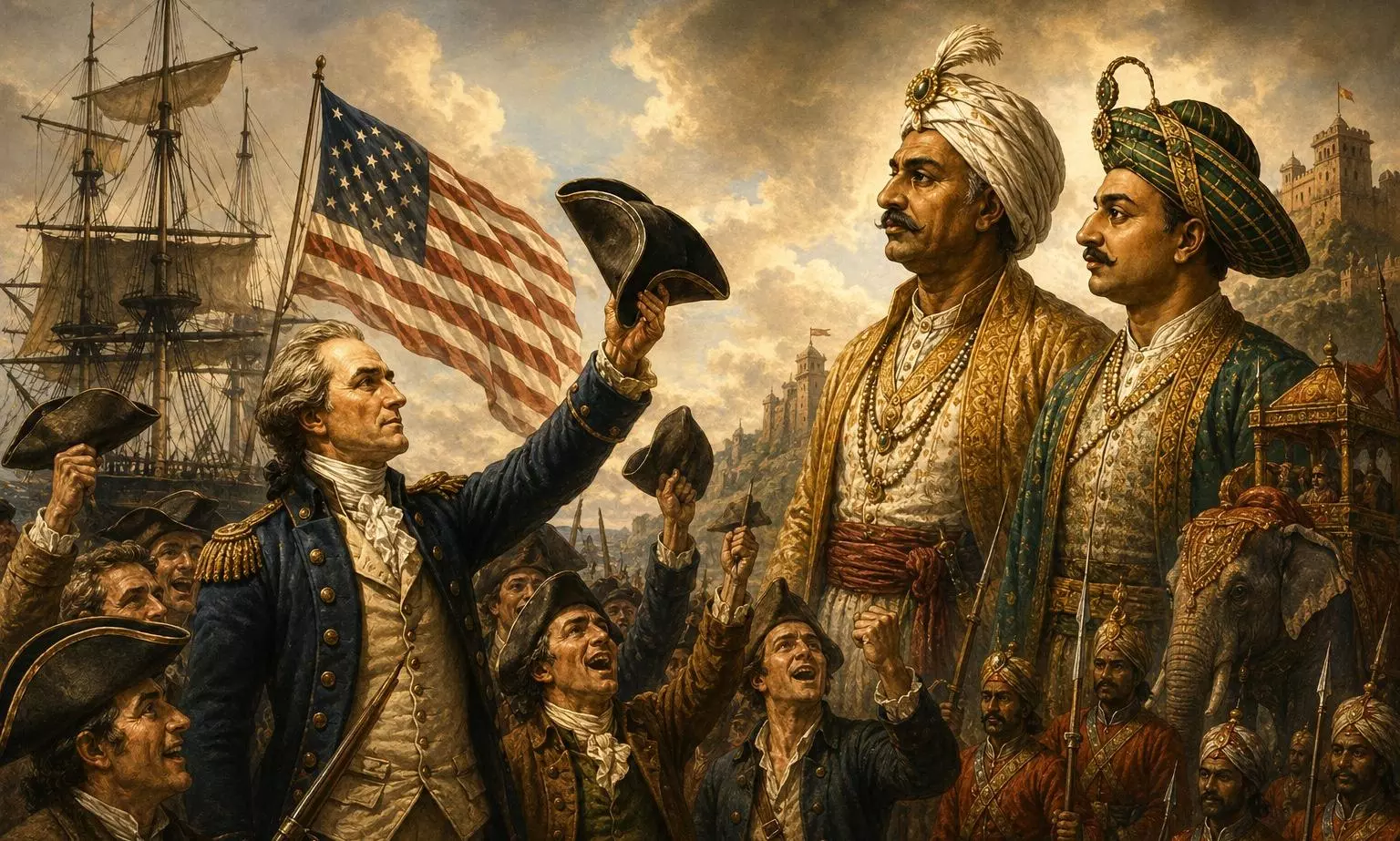

One may wonder what it would be like to discover that Hyder Ali and Tipu Sultan were exalted, praised and celebrated in song during the American War of Independence. American revolutionaries fighting British colonial rule sang, "Come, all ye lads who know no fear... Embark in our Hyder-Ally!" Ballads echoed through the streets of Philadelphia, hailing the rulers of Mysore as symbols of resistance against the British Empire. Such was the admiration they inspired that even an American warship was named Hyder Ally after Hyder Ali.
Such was the admiration that even an American warship was christened Hyder Ally, immortalising an Indian ruler as an emblem of liberty in a conflict unfolding thousands of kilometres away, according to an article published in India Today.
Though Hyder Ali and his son, Tipu Sultan, never forged a formal alliance with George Washington's revolutionaries, their resistance against the British East India Company resonated deeply across the Atlantic. For many Americans seeking to overthrow British rule, the rulers of Mysore embodied courage, military prowess and an unwavering refusal to bow before imperial domination.
The American Revolution was never merely a struggle confined to North America. As Britain fought to suppress rebellion in its 13 colonies, it was simultaneously locked in a bruising conflict with Mysore in southern India. Historians argue that these parallel wars stretched Britain's military resources, forcing it to divide soldiers, ships and finances across continents while France supported both the American revolutionaries and Mysore in its broader campaign to weaken Britain.
Hyder Ali's victory over the East India Company at the Battle of Pollilur in 1780 captured the imagination of Americans. Newspapers and public gatherings celebrated his successes as blows against a common enemy. In Trenton, New Jersey, shortly after the British surrender at Yorktown in 1781, one of the ceremonial toasts honoured "the great and heroic Hyder Ali" for helping curb Britain's power in the East Indies.
The admiration reached its most enduring expression in 1781 when Pennsylvania commissioned the warship, Hyder Ally. The vessel went on to defeat the larger British ship General Monk, becoming one of the fledgling American navy's finest victories. Poet Philip Freneau celebrated the ship in verse, praising the eastern prince whose name had become synonymous with resistance to British rule.
After Hyder Ali's death in 1782, American fascination did not fade. Tipu Sultan inherited both Mysore's throne and its struggle against Britain, remaining a familiar figure in American newspapers and schoolbooks. When he was killed defending Srirangapatnam in 1799, some Americans mourned the loss of a ruler they regarded as a fellow opponent of British imperialism.
The rulers of Mysore did not secure American independence, nor did they fight alongside Washington's forces. Yet, for a generation of American revolutionaries, Hyder Ali and Tipu Sultan stood as distant comrades in a shared contest against empire—proof that Britain's might could be challenged, and that resistance, wherever it emerged, could inspire freedom far beyond its own shores.