


















NASA sends 2026 World Cup ball to ISS to study balance in microgravity
text_fields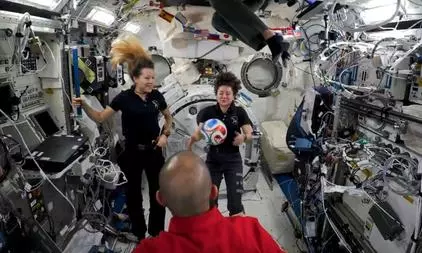

Washington: The official match ball for the 2026 FIFA World Cup, the Trionda, was taken to the International Space Station to study how a ball’s centre of mass and balance behave in microgravity.
NASA said on Instagram that predictability in a soccer ball’s movement is critical, so sports engineers carefully measure and optimise a ball’s centre of mass and balance. Researchers first used the station’s microgravity environment in 2019, in partnership with the ISS National Laboratory, to investigate how a ball’s internal mass affects motion, stability and rotation. Those results helped improve understanding of how embedded technologies, such as match-ball sensors, can influence on-field performance and contributed to development and testing for major tournaments, including the World Cup.
This year, NASA and adidas recreated the 2019 experiment using the 2026 Trionda as part of a STEMonstration that compares how differently balanced balls spin and move in microgravity. NASA said the demonstration highlights how the same physical principles that govern motion in space also affect the behaviour of balls played on Earth.
The Trionda—Spanish for “three waves”—features a red, green and blue design that honours the three host countries: Canada, Mexico and the United States. Its new four-panel construction, described by adidas as “fluid geometry,” forms a triangle at the ball’s centre and echoes the three-nation hosting arrangement. Country-specific icons appear on the ball: a maple leaf for Canada, an eagle for Mexico and a star for the United States, while gold accents reference the FIFA World Cup Trophy.
FIFA says the Trionda includes several performance innovations. Deep seams in the four-panel design are intended to create evenly distributed drag for improved in-flight stability, and embossed close-up icons are said to enhance grip in wet or humid conditions. The official match ball also incorporates connected-ball technology, using a 500Hz motion sensor chip that provides detailed movement data in real time to assist the video assistant referee system, including for offside decisions.
(Inputs from IANS)