


















Scientists identify deep solar layer as origin of storms
text_fields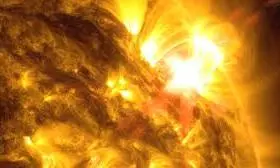

Scientists have traced the origin of solar storms to a hidden layer deep inside the Sun known as the tachocline, according to a new study published in Scientific Reports.
Researchers from the New Jersey Institute of Technology found that magnetic activity responsible for solar storms begins about 200,000 kilometres beneath the Sun’s surface in this thin transitional zone.
Solar storms, which include flares and coronal mass ejections, release bursts of radiation and charged particles and typically occur during peaks in sunspot activity. Understanding their origin has been a key challenge for scientists studying space weather.
The study identifies the tachocline as a critical region where the Sun’s outer convection zone meets its inner radiative zone. Differences in rotational speed between these layers create strong shearing motions in charged plasma, which amplify magnetic fields.
Researchers Mandal and Alexander Kosovichev analysed nearly three decades of acoustic data collected from NASA’s SOHO satellite and the ground-based GONG telescope network. These instruments detect subtle surface ripples linked to internal solar activity.
The team observed rotating bands of plasma in the tachocline forming a pattern resembling a butterfly shape, similar to the movement of sunspots toward the equator during the Sun’s 11-year cycle.
The findings suggest that current forecasting models, which focus mainly on surface activity, may be incomplete. Solar storms can disrupt satellites, communication systems, and power grids on Earth, making accurate prediction critical.
By incorporating processes occurring deep within the Sun, particularly in the tachocline, scientists say future models could provide earlier and more precise warnings of potentially harmful solar events.