




















Hubble detects giant 10-sided atmospheric wave on Saturn
text_fields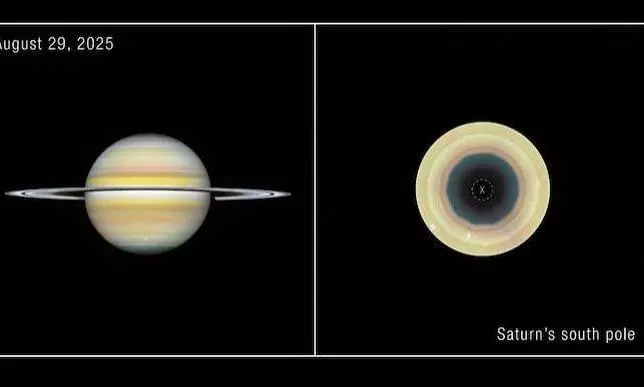

NASA’s Hubble Space Telescope has detected a giant, evolving 10-sided atmospheric wave around Saturn’s south pole, the first large regular-sided jet pattern observed in the planet’s southern hemisphere.
The feature resembles Saturn’s famous six-sided storm system at its north pole, but its differences suggest it may represent a new atmospheric phenomenon, NASA said. The findings were published in Science Advances.
Researchers combined Hubble observations dating back to 2023 to study the structure. The observations were made through the Outer Planet Atmospheres Legacy (OPAL) programme, which has been capturing annual images of the outer planets for more than a decade.
Scientists first spotted indications of the feature in ground-based images as Saturn’s changing seasons brought its south pole back into view. In 2024, Agustin Sanchez-Lavega of the University of the Basque Country in Spain, along with amateur astronomers Trevor Barry and Jean-Paul Oger, identified a faint, wavy band near the south pole.
Further ground-based images taken in 2025 showed clearer evidence of a 10-sided structure. Hubble subsequently provided sharper observations, allowing researchers to study the feature in greater detail.
The wave lies within Saturn’s powerful jet stream and extends across several atmospheric layers, indicating that it is not limited to the planet’s visible cloud tops. Its apparent position shifts slightly in Hubble images taken at different wavelengths because those wavelengths probe different atmospheric altitudes.
Researchers said they had searched for a southern counterpart to Saturn’s northern hexagon since 1990. Images from NASA’s Cassini spacecraft, which orbited Saturn from 2004 to 2017, showed no evidence of such a persistent structure, while Hubble observations confirmed its presence from 2023.
Study co-author Amy Simon said the feature appears to have formed relatively recently, raising questions about why it has emerged now.
Scientists plan to use further observations from Hubble and NASA’s James Webb Space Telescope to determine how the decagon formed, how long it will last, and how it compares with Saturn’s long-standing northern hexagon.