














Why does immigration concern British conservatives?
text_fields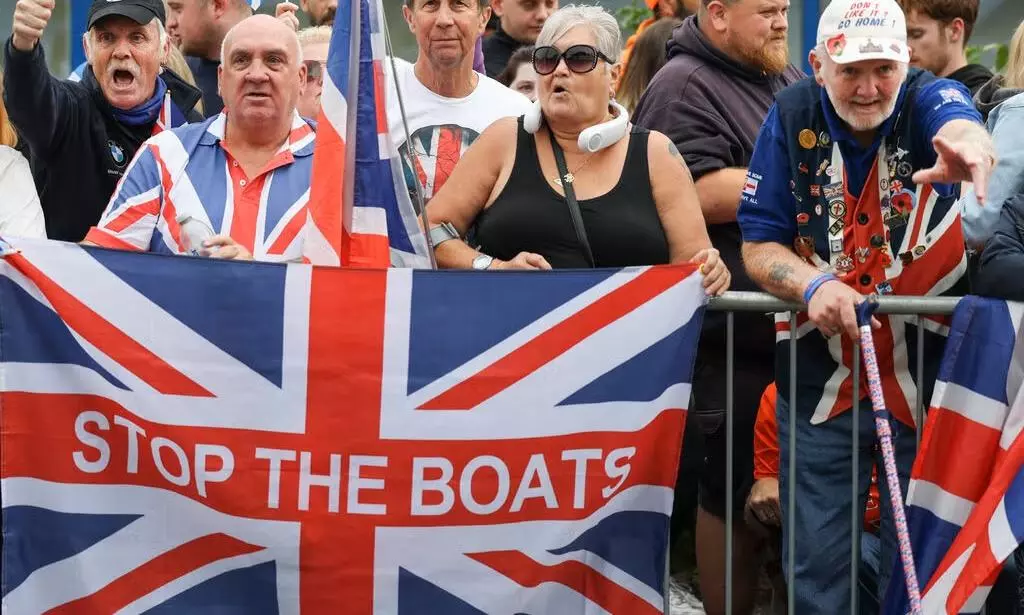

In the last five elections, the Conservative Party's manifesto said that the party would reduce immigration. The party failed to do so on the first four occasions and lost the election the fifth time, partly because it had so dismally failed on immigration over 14 years. Conservatism is, by definition, about conserving things: keeping things the way they are.
Large-scale immigration necessarily changes a country. The change could be good, bad or indifferent, but what is indisputable is that it changes a country. The greater the immigration, the greater the change. The greater the difference between the immigrants and the indigenous population, the more noticeable the change becomes.
Conservatives are not reactionaries. They do not oppose all change, but they are circumspect about it, agreeing only to small, gradual and necessary changes. The 17th-century statesman Lord Falkland proclaimed, ‘That which it is not necessary to change, it is necessary NOT to change.’
The Conservatives came to office in 2010, with David Cameron as Prime Minister. Cameron vowed to keep net immigration below 100,000 per annum. He never managed to bring it below 200,000. Cameron’s name in Scottish Gaelic means ‘crooked nose’, but his nose was the least crooked thing about him. David Cameron knew that it was impossible to limit immigration from the European Union because the United Kingdom was an EU member state and a core principle of the EU was the free movement of people.
There were 27 EU member states, ten of which had joined between 2004 and 2007. These tended to be poorer Eastern European countries. The wealth gap between Eastern and Western Europe ensured that Poles, Lithuanians, Romanians, Hungarians and others of similar nationalities were attracted to the UK by higher wages.
Western European countries were allowed to introduce restrictions on the right of citizens from the new ten EU member states to come and live and work in their countries. The United Kingdom was almost alone among the older EU member states in granting citizens of these ten countries the immediate right to come and work.
Immigration to the United Kingdom has, in some regards, been a boon. Fifty per cent of nurses are from abroad, as are 25 per cent of doctors. Immigrants make a tremendous contribution to construction, IT, banking, farming and teaching. In London, it is rare to be served by a waiter or waitress who is British, regardless of race. British people often refuse to do menial jobs because it is so easy to obtain government handouts called ‘benefits’.
The United Kingdom has always had immigration and always will. However, until the late 20th century, immigration was on a small scale and came mostly from nearby countries such as France, Belgium, Germany, the Netherlands and Denmark. These were white, Christian countries with kindred cultures and languages that enabled immigrants to learn English quickly.
Likewise, British people moved to those countries. The numbers moving back and forth were about equal. The alarm about large-scale immigration into the UK is, in some cases, rooted in colour prejudice. Few Britons ever complained about white Americans or white Swedes moving in.
It was only after the Second World War that the UK faced a labour shortage, when it began to invite workers from the colonies to settle in the United Kingdom. Back then, everyone in the Empire was a British subject. A white Briton, a black Nigerian and a Kenyan of Indian descent were all regarded as the same in terms of their status as British subjects. Therefore, all had the right to live in the United Kingdom.
In 1948, a ship called the SS Empire Windrush docked in Britain. It had sailed from the Caribbean with more than 400 passengers aboard, many of them black men, some of whom had already lived in the United Kingdom during the Second World War and had indeed served in the British Armed Forces.
This marked the beginning of significant-scale non-white immigration to the UK. There had been black people in the British Isles since the Middle Ages, but they constituted a microscopically small percentage of the population. There were Indian sailors who came in the 17th century.
These Indian men married white women, so their children were half-white. The next generation did the same, so their grandchildren were three-quarters white. This process continued, and those of Indian descent soon disappeared into the white community. Likewise, Chinese mariners who came to live in British ports married white women, so there was no sizeable, self-sustaining Chinese community composed of both sexes until the late 20th century.
In the 1960s, anxiety over non-white immigration led to Acts of Parliament that restricted and removed the rights of Commonwealth citizens to live in the United Kingdom. The legislation said that a Commonwealth citizen still had the right of abode in the UK if at least one of their grandparents had been born in the United Kingdom. Of course, in the case of New Zealanders and Australians, this was almost always the case. The idea seems to have been to block non-white immigration without saying so.
Some non-white immigrants were subjected to insults, torment and even violence. In the 1950s, there were the Notting Hill race riots in London, during which white youths attacked black male immigrants. In response, the Notting Hill Carnival was founded as a celebration of black culture. It remains the largest black festival outside Africa. Its founder was a black woman from the Caribbean: Claudia Jones.
The anxiety over non-white immigration to the UK in the 1960s seems ludicrous, considering that the country was only 2 per cent non-white. Non-white people were concentrated in certain cities: Birmingham, London, Liverpool and Manchester. Nowadays, 20 per cent of the population is non-white. White immigration in the 1960s caused far less pushback. White people from Malta, Greece, Italy and Spain came to the United Kingdom without much ado. More Irishmen came to the UK every day in 1948 than arrived on the Empire Windrush in an entire year.
The Conservatives led the campaign to limit immigration. The Labour Party was more dubious about it, despite being a party with most of its support among the working class. Working-class Britons often feared being undercut by cheap foreign labour.
The UK had net emigration in the 1950s, with many British people moving to Australia, the USA, Canada and South Africa. The United Kingdom only began to experience immigration on a significant scale in the 1990s.
Some Hong Kong Chinese settled in the UK in the 1990s to escape integration into China. They were seen as model immigrants: highly educated, English-speaking and scrupulously law-abiding.
When Tony Blair’s Labour Party came to office in 1997, it greatly loosened immigration rules. As one Labour Party official said, this was ‘to rub the right’s nose in diversity’. Non-white Britons also tended to favour the Labour Party. Note that, in the UK, Commonwealth citizens have the right to vote. The Conservative Party stood to lose as ever more immigrants arrived.
The embourgeoisement of the British Indian community meant that its members gradually became more Conservative, as the party was perceived as the party of the middle class. In the 2010s, the Conservative Party gained some famous MPs of Indian descent, such as Rishi Sunak, who became Prime Minister; Suella Braverman, who became Home Secretary; and Priti Patel, who also served as Home Secretary. In all three cases, their parents had been born in British Africa. British Indians whose ancestors had lived in Kenya and Uganda tended to be more Conservative than other British Indians.
The UK Independence Party was founded in 1992 by Britons who wanted the country to withdraw from the European Union. One of its bugbears was excessive immigration. Nigel Farage was sometimes its leader.
Most UKIP members decamped to form the Brexit Party in 2019, which has since renamed itself Reform UK. The leader of Reform UK is Nigel Farage. He says that large-scale immigration is responsible for wage compression, excessive house prices, too many cars on the road, too many passengers on trains and a lot of crime. There is some validity to his comments.
The flip side is that wages are down in real terms for broader economic reasons; immigrants build houses as well as live in them, and governments have failed to build enough social housing for decades; immigrants build roads, work on the railways and are sometimes police officers and prison officers. But he is correct that large-scale immigration is a mixed blessing.
Reform UK promises net zero non-essential immigration. Therefore, even the party acknowledges that some immigration is vital. Reform UK’s plans are unworkable and undesirable. The party wants to copy the Immigration and Customs Enforcement (ICE) agency in the United States. It promises millions of deportations, including of people who have lived in the country for decades.
Left-wingers pretend that immigration has been entirely beneficial and that all immigrants are saintly people who come only because they want to help Britain. Immigrants want a better life, and that is a good Conservative motive. There are left-wingers who say, ‘Open the borders.’ The UK has net immigration of around 200,000 people a year, which is about right. It had net immigration of one million in 2022. If the borders were genuinely open, the figure would be 10 million a year. For the left, any attempt to limit immigration is racist, which is preposterous.
People who enter the UK illegally often claim asylum. They are put up in hotels at public expense and given clothes and phones, as well as free healthcare. Those who are under 18 receive free education. Some adults claim to be under 18 and are often accepted as minors unless a dental examination indicates that they are substantially older. British people are fed up with paying for refugees who have crossed 20 safe countries to come to the UK.
Why do they come to the United Kingdom rather than claim asylum in other safe countries? They do so because the UK grants asylum in a higher percentage of cases than some other countries; the UK’s benefits are higher; illegal immigrants are more likely to speak English than French or German, for example; and they may already have family or friends in the country. In many countries, entering the country illegally can result in several years in prison.
Some immigrants commit crimes in the United Kingdom, and the media give considerable attention to such cases. The UK is bad at deporting foreign nationals after they have served prison sentences. These criminals sometimes appeal for the right to stay in the UK after being released from prison. They sometimes win the right to remain on human rights grounds, such as the argument that they would be separated from their children, who are British citizens.
Right-wingers believe in capitalism. The free market needs some free movement of labour. Those who want net zero immigration account for only 20 per cent of the British electorate: Reform UK voters. The Conservative Party does not go that far.