











When Kerala’s Communists follow the Sangh’s path to undermine Muslim politics
text_fields
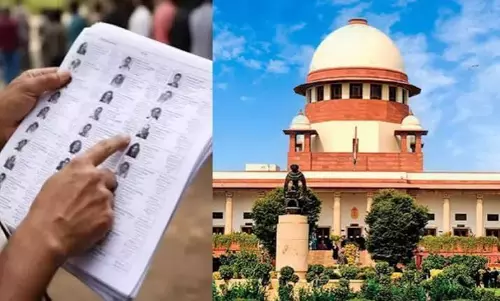
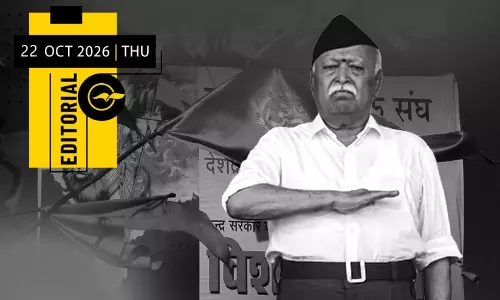
In the national political scenario, where the RSS Sarsanghchalak, Mohan Bhagwat, and Prime Minister Narendra Modi jointly hoisted the flag of Ram Rajya in Ayodhya and Hindu fundamentalist leaders proclaimed the inauguration of a Hindu Nation, the Sangh Parivar government is moving forward with Governor’s rule—restraining even the Pinarayi government in Kerala—and implementing bulldozer rule against minority communities, along with citizenship and voter verifications. Despite all this, the Communists in India have not yet resolved their doubt as to whether Fascism has actually arrived in the country.
Meanwhile, in this election campaign for the local bodies’ election in Kerala, what has been consistently observed is that the Communists in Kerala have undertaken the task of the Hindu fundamentalist forces’ politics of hatred and are raising a hell against Muslim politics with the same fervour with which Stalin, who once found an ally in Hitler, handed over the Communists seeking refuge in Russia to the Nazis for incarceration in concentration camps.
While the entire country sees the Fascist politics of the Sangh Parivar as the main threat and is engaged in resistance movements against it, the grouping that the Kerala Communists have declared as their principal enemy is the Jamaat-e-Islami, a Muslim organisation, and the Welfare Party, which was formed under their initiative.
The reason for this is claimed to be that, in the 2019 Parliament election, the Welfare Party supported the candidates of the Congress-led UDF in Kerala, in line with its national stand against the BJP. Ever since then, as the SFI State President stated, the Kerala Communists have been afflicted with a Jamaat-e-Islami phobia. In their agitation, they have forgotten old friendships and electoral understandings, and now they see Jamaat-e-Islami everywhere—in the pillars and posts—raising alarm that ‘religious nationalism is coming!’
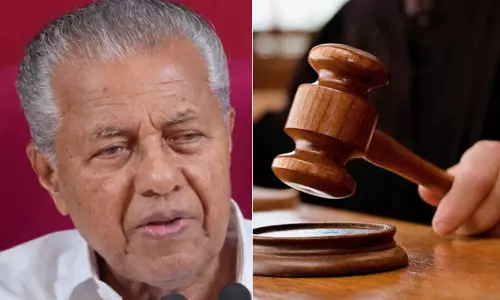
The cyber-era comrades may not know that the theoretical foundation for the actual religious state in India, or the Pakistan claim, was laid, and intense efforts were made to make it succeed, by Communist leaders and theoreticians like G. Adhikari, P. C. Joshi, and Sajjad Zaheer. But leaders like Pinarayi Vijayan and M. V. Govindan surely should not forget this fact.
(Even after the election, the Communists can continue the dialogue on subjects like religious nationalism, infiltration, parliamentary democracy, the freedom struggle, and armed extremism by presenting their own history.)
The anger towards the Muslim political stance
If one probes into the reason for this anger towards the Muslim political stance, the answer arrives at the fact that the Muslim minority takes an opportune and independent political position. Since independence, whenever Muslim individuals, leaders, and organisations have adopted stances beneficial to the community and the nation, taking into account the respective political context, they have been subjected to the wrath of both the Communists and the secularists.
Muslims are not supposed to ask for proportionate representation in power and rights. They should not raise their voice for entitlements and rights that are being usurped. They should not seek their own path for solving backwardness and for empowerment. They are not supposed to stand on their own feet, but rather on the stilts of mainstream politicians—Left, Right, and Centre.
Where this has led the Muslims and other backward communities, both at the national level and in Kerala, has been brought to light by reports ranging from the Ranganath Mishra Commission and the Rajindar Sachar–Amitabh Kundu Committees to the Narendran Commission and the Paloli Committee.
That is why Muslim organisations are seeking a path of unity based on the understanding that their votes should be utilised for positions that are conducive to the prosperity of the community and in tune with the national interest, rather than simply following the dictates of the vote-bank politicians who come offering solutions to Muslim issues.
Political moves that began with the Majlis-e-Mushawarat
The long decades of bitter experiences in the political and social spheres since independence have enabled Muslims to identify those who were slowly choking them to death. The demolition of the Babri Masjid in 1992 and the Gujarat genocide a decade later opened their eyes.
In the aftermath of the Babri demolition, a study by Umar Khalidi, a scholar of Muslim politics, was published in the January 1993 issue of Economic and Political Weekly. This study detailed the stands adopted by Indian Muslims in post-independence elections and the approach taken by mainstream secular political parties towards those stands.
It was a study of the conscious attempts made by Indian Muslims to adopt realistic positions on which party or front to choose, instead of blindly submitting to the dictates of political parties.
Immediately after independence, in the general elections held in 1952, 1957, and 1962, Muslims voted en masse for the Congress. However, the communal riots in Kolkata, Jamshedpur, Rourkela, and Jabalpur in 1963 and early 1964 led to a loss of faith in the Congress among Muslims.
Following this, on 8 and 9 August 1964, in Lucknow, the All India Muslim Majlis-e-Mushawarat (All India Muslim Consultative Committee) was formed as a common Muslim platform. This included organisations like the Jamiat Ulema-e-Hind, Jamaat-e-Islami, and the Indian Union Muslim League, as well as Muslim modernists from the Congress and Left parties, and secular liberals.
Maulana Abul Hasan Ali Nadwi inaugurated the conference. Qaid-e-Millat Muhammad Ismail (President of the Muslim League), Maulana Abul Lais Islahi (Amir of Jamaat-e-Islami), Mufti Atiqur Rahman Usmani, Maulana Manzoor Nu'mani, and Maulana As'ad Madani were among the founding members. Sayyid Mahmood became the first President, and M. N. Anwar M.P. the General Secretary.
Leaders from the Muslim League, Jamaat-e-Islami, Tablighi Jamaat, and Ahle Hadees, along with secular dignitaries, all stood united on a single platform. For the 1967 General Election, the Majlis-e-Mushawarat prepared a People’s Manifesto and presented it to the political parties. They took the initiative in discussions regarding candidate selection and the formation of front alliances. This yielded partial results. They were able to create an understanding among political parties that Muslims deserve attention and consideration.
The community leadership repeatedly attempted to find an independent path for the protection of minority rights, not by transforming into a political platform, but by embracing existing political parties and community organisations, similar to what the Mushawarat did.
The fact that the Jamiat Ulema-e-Hind, Jamaat-e-Islami, and the Muslim League, who stood at ideologically different poles, as well as Abul Hasan Ali Nadwi and Manzoor Nu'mani, who had initially left the Jamaat-e-Islami, had no difficulty in uniting on the platform of the Majlis-e-Mushawarat, makes it clear how seriously they viewed the condition of Indian Muslims.
It is also noteworthy that the Mushawarat’s very first resolution, titled National Integration, lamented the stance of certain sections of the majority community who did not take the Muslim minority into confidence, and called for them to come together in the effort to gain the general trust of the nation.
For a dignified existence: an independent stance
In essence, all Muslim organisations moved forward with stances aimed at preserving the dignified existence of the community in independent India. Not all efforts succeeded; there were also abject failures. However, the greater share of the responsibility for this lies with the mainstream political parties and fronts that backtracked on their promises.
It must be remembered that Muslim organisations formulated their political stances, standing firm on their own soil, at a time when even the Communist parties were travelling to Moscow to seek a ‘fatwa’ from Stalin regarding their positions in India. Even then, there were ‘showboys’—Muslims who stood weakly on the sidelines, taking orders from the Left and Right parties that had taken on the mantle of ‘protection’—a fact which the Muslim MP N. M. Anwar mocked in the Rajya Sabha in the sixties.
The Sachar Committee Report in 2006 presented the progress report to the nation on what the secular parties, who had taken up the responsibility of protection, had actually given the Muslims of the country. The Report highlighted that the agency and protection of others were mere empty talk, revealing the extremely poor condition of Muslims in West Bengal, and the strides made by Muslims in Kerala with the support of non-governmental empowerment factors, including remittances from abroad.
The resulting zeal and initiative taken by the Muslim community to move forward on their own feet is the outcome of the progress seen in the Muslim social sphere across India over the past two decades.
Just as during the formation of the Mushawarat, the decision to stand together on issues of survival, despite differences in ideology, practices, and rituals, is part of this collective move.
But racialists (or communalists), envious of such progress, express their politics of hatred through mob lynchings, communal riots, and social exclusion, all overtly. On the other hand, mainstream politicians, with the ‘liberal secular’ tag around their necks, are restless because the Muslim minority is moving forward on its own, without their support and shade.
This discomfort, which is shared by those engaging in cultural, social, and media activities under their patronage, often spills out, sometimes even in the style and language of the Sangh Parivar. This is what is currently manifesting as the Communist low-pressure (or negative campaign) against the Muslim vote.
The Communists, who turned Muslim life in West Bengal into the country’s worst example and proved themselves incapable of even implementing the recommendations of their own Paloli Committee Report for Muslim welfare in Kerala, cannot save them. When Muslims realise this and seek other paths, shouldn’t the Left parties be keen to correct their own mistakes and mend their ways, rather than blaming the Muslims?