
















Will the court's mild admonition suffice?
text_fields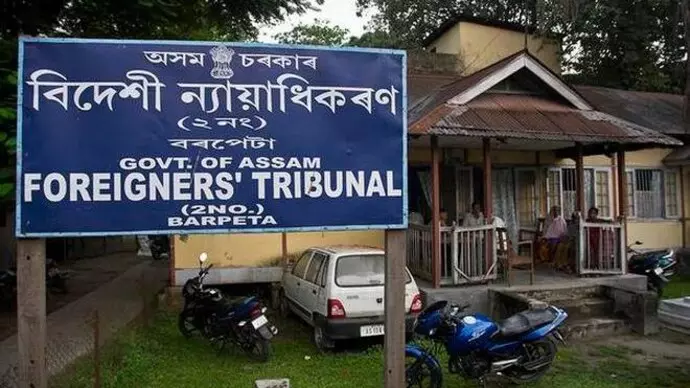

The Supreme Court has reminded those entrusted with the task of determining citizenship that classifying citizens as natives or foreigners is a process of the highest constitutional and legal significance, and that the task on their hands is not a matter to be treated lightly. The observation was made by a Bench comprising Justice Vikram Nath and Justice Sandeep Mehta while hearing petitions challenging the move to brand 27 people in Assam as foreigners and deport them from the country on the ground that the documents they had produced were insufficient. The petitioners approached the Supreme Court after the Gauhati High Court upheld the Foreigners Tribunal's decision rejecting the citizenship claims of the 27 persons for the "absence of sufficient documentary evidence". The State may have a compelling interest in ensuring that those who are not legally entitled to citizenship do not secure such status through false claims, abuse of legal procedures, or by exploiting delays in the process. However, the procedure adopted for determining citizenship must be fair, just, and reasonable. The Supreme Court directed that it must be ensured that all the legal principles embodied in Section 9 of the Foreigners Act, 1946, are duly followed in this regard. Setting aside the Gauhati High Court's judgments and the orders of the Foreigners Tribunals constituted to identify foreigners, the apex court remanded the cases to the Foreigners Tribunal for fresh consideration.
Among the 27 persons who alleged that they had been declared foreigners on the basis of minor technical discrepancies such as spelling mistakes and differences between names appearing in two electoral rolls, Savitri De, Ajbar Ali, Mohammad Akbar Ali, Abid Khatun and Anwara Khatun approached the Supreme Court. Citing the legal issues, litigation and judicial precedents arising from the citizenship determinations made by the Foreigners Tribunals in Assam, they had first sought justice before the High Court and, after failing to obtain relief there, approached the Supreme Court. Last month, another Bench of the Supreme Court stayed the deportation of five women whom the Tribunals had declared to be foreigners. On that occasion, the Supreme Court issued notices to the Union government, the Assam government and the Election Commission. Since the BJP government led by Narendra Modi assumed office at the Centre, concerted efforts have been made under the Union government and, following its lead, in BJP-ruled states to identify what are described as the country's "genuine citizens" - an exercise unheard of in the country thereto. Even before the Sangh Parivar emerged as a major political force capable of capturing power at the Centre and in the states, it had been laying the groundwork for citizenship-based divisions. In north-eastern states such as Assam and West Bengal, it viewed Muslim communities as foreigners without citizenship. After assuming power at the Centre and in the states, this translated into "lawful" and institutionalised efforts to identify and expel those whom they had until then portrayed as "infiltrators", "parasites" and "termites".

It is this endeavour that is being carried out through exercises from the National Register of Citizens (NRC) to the Citizenship (Amendment) Act, and now to the Special Intensive Revision of the electoral rolls, under the label of law and regulations. It cannot be denied that, rather than promoting public welfare, these so-called "reforms" have fostered suspicion, uncertainty and, consequently instability among the people at a time when everyone ought to be moving together towards a welfare state. In a country marked by complex geographical, social and political diversities, hardly anyone seems to consider the consequences of such exercises undertaken by those who have little understanding of the historical processes through which the nation has evolved into its present form. What has been unfolding in Assam in the name of citizenship determination is the best example of this. The citizenship "reform" exercise pursued there with a communal agenda ultimately produced results contrary to what was intended. The process of citizenship determination in Assam had to be repeatedly reworked using different criteria. Even that, however, has not satisfied an administration driven by communal prejudice, nor the bureaucracy and judicial institutions that have meekly acted in support of it. The recurring reports from Assam of citizenship being cancelled, or rather humanity itself being denied, stand as evidence of this. It was only on June 30 this year that the Gauhati High Court told Aminul Haque, a daily wage labourer who had produced 15 documents, that none of them constituted sufficient proof of citizenship. Although Amin, who had been declared a "foreigner" in his own homeland on February 28, 2019, produced his voter identity card, records of his ancestors in the 1951 National Register of Citizens (NRC), his school certificate, and the document relating to the registration of his homestead land in 1973, the high court still declined to grant him relief.

Since Narendra Modi came to power at the Centre, determined efforts have been underway under the Union government and across BJP-ruled states to identify the country's "genuine citizens", something unheard of in India until then. Of the lakhs of people who are pushed to the margins through such experiences, only a very small number have the means to seek legal recourse. It is in one such petition that has now come before it that the Supreme Court has assigned the matter to the concerned authority for reconsideration. It remains to be seen whether this moral admonition by the judiciary will be enough for those poor citizens, whose cases have been sent back, to secure justice from the Foreigners Tribunal.