












When the Supreme Court gets set for a new CJI
text_fields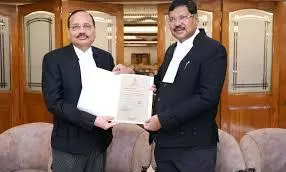

The process of appointing a new Chief Justice of India began on Monday with the outgoing Chief Justice B.R. Gavai recommended Justice Surya Kant as his successor on his retirement on November 23. Justice Kant is currently the senior-most judge of the Supreme Court. The Law Ministry will now forward the recommendation to the Prime Minister, who will submit it to the President for approval. Once the President issues the official notification, Justice Surya Kant will formally assume office on the appointed day. Justice Gavai’s tenure lasted just six months. In the case of Justice Surya Kant, he is expected to serve for about 15 months, until his retirement on February 7, 2027. As the head of Indian judiciary system, he will inherit a massive backlog of nearly 4.7 crore cases in the lower courts and about 85,000 cases pending before the Supreme Court itself. While no one expects these systemic issues to be solved overnight, all eyes will be on the new Chief Justice to see whether he can make a meaningful impact on India’s long-standing crisis of judicial delays.
Also read: Sonam Wangchuk’s detention: SC defers hearing on plea to Nov 24
Apart from the massive backlog of regular cases, the Supreme Court is also faced with several crucial constitutional matters awaiting decision. Justice Surya Kant will assume office with an advantage of having been part of the bench in many landmark constitutional cases in recent years. He was among the judges who heard petitions challenging the dilution of Article 370, which granted special status to Jammu and Kashmir, as well as the case concerning alleged spying using Pegasus spyware, and the 2022 case that led to the suspension of the colonial-era sedition law. The new Chief Justice now faces significant challenges, both in terms of the number and complexity of the cases before the court. Beyond serving as the final appellate forum for disputes coming up from lower courts, the Supreme Court’s cardinal role is to interpret the Constitution and to adjudicate on its violation either on its own or when approached by litigants, thereby upholding the rule of law and justice. However, the efficacy and credibility of the institution are often measured by how swiftly and thoroughly it resolves constitutional cases. As for pending cases on constitutional issues, there are over fifty such cases that await the verdict of the apex court, while only twenty-five have been decided in the past four years.
Also read: SC refuses to entertain plea to quash case over Facebook post on ‘Babri Masjid
The Waqf Amendment Act, which came into force in April this year, was taken up by outgoing Chief Justice B.R. Gavai's bench during his brief six-month tenure. However, instead of delivering a verdict, he only issued an interim order temporarily staying the implementation of certain provisions of the law and leaving the rest to be in force, though under challenge still. The legislation has drawn widespread concern and opposition from the Muslim community, which views several of its provisions as having far-reaching adverse implications. The Supreme Court’s interim order has temporarily halted the implementation of clauses in the Act: the court limited the number of non-Muslim members on state Waqf Boards and Central Waqf Council and withheld the provision that only those who have practiced Islam for at least five years can make Waqf donations. The court has also stayed the clause giving the District Collector—a government official who thereby represents a party in disputes—the power to decide on contested Waqf properties. In addition, the order puts on hold the complete ban on the long-standing principle of Waqf by use although the provision mandating registration of waqf properties will remain in force. The Muslim community, a key party to the ongoing case, is now awaiting the court’s final judgment on these contentious issues. It is expected that the new Chief Justice will move the case forward and deliver a fair and comprehensive verdict during his fifteen-month tenure.
Also read: SC rebuke to Delhi Police over bail delay rekindles hope for anti-CAA activists
A more recent, and unprecedented, matter that came up before the Supreme Court is the reference sent by the President seeking the Court’s opinion. Earlier this year, the Supreme Court delivered a landmark judgment in response to Tamil Nadu’s petition challenging the actions of state governor who withheld or delayed bills passed by the legislature. Tamil Nadu had argued that such actions by governors — who represent the Centre — were incompatible with India’s federal structure and that safeguards were needed to prevent such interference. In its ruling, the Constitution Bench held that neither governors nor the President had the power to delay indefinitely passed by the state assemblies or the parliament as the case may be. It set specific time limits, stating that governors must either approve or return a bill within set months and ruled that the President must make a decision on bills passed by the parliament within three months; if no decision is made within that period, the government can assume approval and proceed accordingly. Following this verdict — which effectively places restrictions on the President himself, who is also the appointing authority of judges — the President referred the matter back to the Supreme Court to examine whether it is in line with Constitutional provisions regarding governors' and Presidents' assent on bills. The Court has reserved its verdict after hearing arguments from Tamil Nadu, the Centre, and other parties who impleaded themselves. The five-judge Bench hearing the case is headed by outgoing Chief Justice B.R. Gavai, with Justice Surya Kant as one of its members. Justice Gavai’s retirement and Justice Surya Kant’s assumption of office come at a time when such constitutional cases loaded with grave significance for India’s democratic and federal framework are pending. Citizens now await the outcome of these cases, both before and after the transition at the helm of the country's judiciary.