














Supreme Court quashes FIRs under UP anti-conversion law, says criminal law can’t be used to harass innocents
text_fields

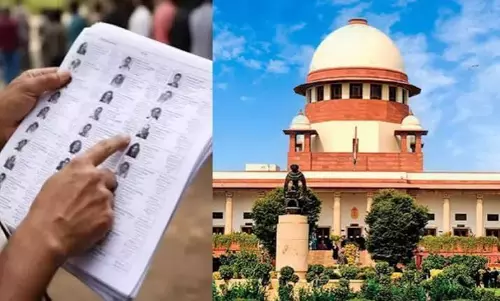
The Supreme Court on Friday quashed several FIRs filed under the Uttar Pradesh Prohibition of Unlawful Conversion of Religion Act, 2021, ruling that the cases were riddled with legal and procedural flaws and lacked credible evidence.
The court said that criminal law should not become a “tool to harass innocent persons.”
A bench of Justices J.B. Pardiwala and Manoj Misra delivered the verdict while hearing petitions against six FIRs filed in Fatehpur district, including those naming Rajendra Bihari Lal, Vice-Chancellor of Sam Higginbottom University of Agriculture, Technology and Sciences (SHUATS). Justice Pardiwala authored the 158-page judgment.
The bench quashed five of the FIRs, observing that they were “vitiated by legal infirmities, procedural lapses, and lack of credible material,” adding that continuing such prosecutions would be a “travesty of justice.”
“The criminal law cannot be allowed to be made a tool of harassment of innocent persons, allowing prosecuting agencies to initiate prosecution at their whims and fancy, on the basis of completely incredulous material,” the court said, pointing to “glaring infirmities” in one of the FIRs filed in 2022.
The court criticised the police for filing multiple FIRs over the same alleged incident after a delay, saying, “It was not open to the police to overcome the difficulty by getting persons with vested interests to make complaints regarding the same alleged incident after a considerable delay and thereafter initiate a fresh round of investigation against largely the same set of accused persons.”
The bench dismissed arguments that the FIRs should not be quashed under Article 32 of the Constitution, which empowers citizens to move the Supreme Court for the enforcement of fundamental rights.
“This court, as the highest constitutional court, has been conferred with the powers as enshrined under Part III of the Constitution to provide remedies against the violation of fundamental rights... Once the Constitution has cast such a responsibility upon it, this Court need not direct a petitioner to pursue an alternative remedy,” the judgment stated.
The court said that the extraordinary facts of the case justified quashing the FIRs. It also examined each FIR in detail, noting that in none of them had any alleged victim of conversion approached the police directly.
One of the six FIRs was, however, detached for separate adjudication as it involved additional offences. The bench clarified that the interim protection granted to the accused in that case would remain until the matter is resolved.
The judges reiterated that courts are “empowered and obligated” to act when investigative powers are being misused or when justice would otherwise not be served.
Addressing the Uttar Pradesh anti-conversion law, the bench noted that it prescribes special procedural norms distinct from the Criminal Procedure Code (CrPC). It said, “It is a settled position of law that the intention of the legislature should be construed from the plain text of the statute... and the courts should not depart from the meaning which is manifest from the plain text.”
The court also questioned the reliability of witness statements in one of the FIRs, observing that “neither the witnesses underwent unlawful religious conversion, nor were they present at the place of the alleged mass conversion dated April 14, 2022.”
Citing previous rulings, the bench said that “existence of multiple FIRs for the same alleged incident stamps an abuse of investigative powers,” and that repeated FIRs “undermine the fairness of the investigative process and expose the accused to unwarranted harassment.”
The six FIRs were lodged between December 2021 and January 2023 under sections 307 (attempt to murder), 504 (intentional insult), and 386 (extortion) of the Indian Penal Code, along with provisions of the UP anti-conversion law.
One of the FIRs, filed on April 15, 2022, at Kotwali police station in Fatehpur, was based on a complaint by Vishwa Hindu Parishad Vice President Himanshu Dixit. It accused 35 named individuals and 20 unidentified persons of converting 90 Hindus to Christianity at the Evangelical Church of India on April 14, Maundy Thursday, a significant day for Christians.
The complainant alleged that Hindus were “put under undue influence, coercion, and lured through fraud and the promise of easy money.”
In its ruling, the Supreme Court emphasised that using criminal law without credible evidence “strikes at the very foundation of fairness in the justice system” and warned against misusing such laws to target citizens.