














The three-language policy creating crisis again
text_fields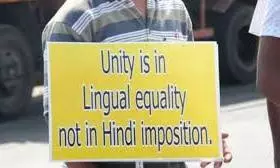

The CBSE, the central authority for school education, is back in the news, though not in a very favorable light. Already facing substantial criticism over its handling of Class 12 exam valuations, the CBSE (Central Board of Secondary Education) is now under scrutiny for its unscientific stance and hasty moves regarding the three-language formula. In a circular issued on May 15, the CBSE made it mandatory to teach three languages starting from Class 9. On a collective petition filed by several parties against this directive, the Supreme Court has scheduled a hearing for July 15 and 16 . However, the court has refused to stay the circular for the time being. Prior to this, other related circulars had been issued on April 9 and May 4. Schools were required to upload the details of their selected languages to the CBSE portal before May 31. Under this three-language formula, the primary condition is that students reaching Class 10 must have studied three languages, at least two of which must be native Indian languages. The Centre argues that this language policy aligns with the National Education Policy (NEP) of 2020. However, the parties challenging it in court point out that the policy document is merely a guiding framework and not a statute that mandates implementation.
Also read: SC seeks Centre, CBSE reply on plea against three-language policy
Language policies have long invited opposition from various states, particularly the non-Hindi-speaking southern states. The intense anti-Hindi agitations in Tamil Nadu during the 1960s had heated up the issue at the national level. It was the recommendations of the Kothari Commission, appointed during that era, that introduced the principle of the three-language formula in 1968. Although it did not present a scenario where Hindi had to be chosen mandatorily, Tamil Nadu opposed it because, in practice, the lack of facilities to teach non-Hindi Indian languages would result in a situation where studying Hindi effectively became compulsory. Consequently, the state insisted it would only adopt a two-language policy consisting of English and Tamil. This was how the state embraced the two-language formula under the leadership of the then Chief Minister, C.N. Annadurai. Even today, Tamil Nadu remains the only state that as a norm teaches only two languages. The new Vijay government also has made it clear that they reject any language policy that indirectly imposes Hindi and will only accept a two-language formula.
Also read: Tamil Nadu will continue two-language policy, says TVK govt
It was highlighting the academic burden, the shortage of teachers and textbooks, and the infrastructural limitations in schools, that the Chief Justice's bench made its preliminary observations on the matter. Kapil Sibal, the counsel for the petitioners, argued that forcing the study and learning of a language not chosen by their will, denies states and students their freedom of choice, thereby violating the federal principles of the Constitution. The CBSE's counsel clarified that although studying three languages is mandatory in Classes 9 and 10 under the Board regulation, there will be no board exam for the third language in the Class 10 examinations; instead, scores based on internal class assessments will be added to the mark-sheet. As of now, the apex court has issued notices to the CBSE and NCERT to hear further arguments.
Also read: CBSE gives schools 7 days to implement 3-language policy
It must be assumed that the CBSE and the Central Government have not taken an open approach toward this matter. The Board's circular itself imposes restrictions on schools without granting sufficient time. It is only natural that children and parents, who are suddenly forced to learn a new language, get jittery about this. There is also an anomaly in implementing such a policy through a circular from a board — which is merely an executive body — without the approval of Parliament. Furthermore, the NEP cited by the Board itself guarantees that no language will be imposed upon any student and that a flexible approach will be maintained. In practice, however, that is not what is happening. The Board came up with the new condition just weeks after announcing that the implementation of the new policy had been deferred until the 2029–30 academic year. As an act of wisdom, the Board should have attempted to build a consensus, at least to hear all sides, by providing an opportunity for discussions with all relevant stakeholders, including students, teachers, CBSE authorities, legislators, and education experts. The central authorities must abandon the practice of deciding everything in advance and then either confronting or ignoring criticisms, especially on a matter that directly impacts the future generation of citizens.
Also read: Hindi a friend to all Indian languages, says Amit Shah