
















The arrival of Tarique Rahman - and the shadow of Muhammad Yunus
text_fields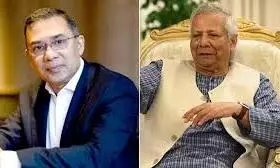

Bangladesh Nationalist Party (BNP) leader Tarique Rahman, who came to power with a landslide victory in the 13th parliamentary elections held in Bangladesh on February 12, took office as the 11th Prime Minister on Tuesday. With this, it can be said that the uncertainties that began with the student uprising in June 2024 and evolved into a national struggle, have subsided for now. Tarique Rahman, the son of former Prime Minister Khaleda Zia and former President General Ziaur Rahman, has come to power without the baggage of a contentious political past. As a party that has secured a two-thirds majority, the BNP alliance will find it easier to take administrative decisions. The Jamaat-e-Islami-led alliance, which won 77 seats, will act as a responsible and vigilant opposition, said JI Shafiqur Rahman.
Also read: Indian diplomatic swing in Dhaka, engaging Bangladesh Govt and Jamaat-e-Islami
Some crucial issues in Bangladesh's political sphere were decided during the interim government itself. These administrative reforms were carried out by Muhammad Yunus, Nobel laureate and pioneer of the world-renowned Grameen Bank, who led the interim government from August 2024 to February 2026. Yunus played a significant role in the democratic transition process, including ensuring that the February 12 elections, although not entirely free from allegations of irregularities, were conducted in a largely orderly manner. It can be said that Yunus, who enjoys popular acceptance and possesses strong leadership skills, came to power at a time when the country was in turmoil and . Always a thorn in the side of former Prime Minister Hasina Wajid, Yunus had disqualified the Awami League from the elections given this background and had repeatedly urged India, which had granted asylum to Hasina, to send her back. In addition to this, several other crucial decisions were taken. It was the unelected Yunus administration that signed a trade deal, making Bangladesh’s garment exports tariff-free, provided they are made out of US made cotton in the wake of the US tariff war — and that too just ahead of the election.
Also read: Tarique Rahman sets ‘Bangladesh first’ tone for India ties in first post-election address
Another notable aspect is that simultaneously with the parliamentary elections a referendum was conducted on administrative reforms known as the July Declaration. It secured a convincing 72.9 percent of the total votes cast. All of these reforms were drafted by a committee appointed by Muhammad Yunus. Even as Yunus states that he will step down and hand over power to the people’s elected leadership, his shadow continues to loom over the process. The July Declaration includes reforms such as the creation of an upper house of parliament, seat allocation in proportion to a party’s share in the lower house, and a ceiling of two terms for the post of prime minister. The last clause of these was intended to prevent a slide into dictatorship. On this basis, a second oath was also prescribed for members to let the new parliament also act as a constituent assembly for constitutional amendments. However, the majority of Bangladesh Nationalist Party (BNP) members abstained from taking that oath. On the other hand, the opposition Jamaat-e-Islami overall supports these amendments. Jamaat and its ally, the National Citizens Party (NCP), have stated that they will take to the streets to ensure the enactment of the proposed reform document.
Also read: Bangladesh Jamaat-e-Islami raise concerns about integrity of poll results
For India–Bangladesh relations, there are points to note regarding the recent regime change and its implications. The Modi government has so far adopted a positive approach towards the democratically elected government, without raising concerns linked to India’s past friendship with the Awami League regime and Hasina Wajid. It has also been observed that a brief but significant meeting took place between the leader of the opposition, the Ameer of Jama'ate Islami Shafiqur Rahman, and India’s Foreign Secretary, Vikram Misri, who attended the swearing-in ceremony. The meeting between the Indian leadership, which by and large remains wary of Jamaat, and the leader of a party generally perceived as holding anti-India positions carries implications beyond routine diplomacy. The Tarique Rahman administration has also expressed interest in improving bilateral relations with India in a manner that supports the progress of both countries. At the same time, concerns have been voiced by both sides regarding minority issues. Tarique has, on more than one occasion, remarked that the situation of minorities in India is a cause for concern. India, for its part, has repeatedly raised the issue of the safety and well-being of minorities in Bangladesh. It is hoped that such mutually unsettling remarks from both sides will gradually die down as the phase of turbulent popular anger passes. It is also hoped that the leadership of both countries will exercise caution in this regard.
Also read: Two BNP Hindu candidates link victory to equal rights for Hindus in Bangladesh