















Indian diplomatic swing in Dhaka, engaging Bangladesh Govt and Jamaat-e-Islami
text_fields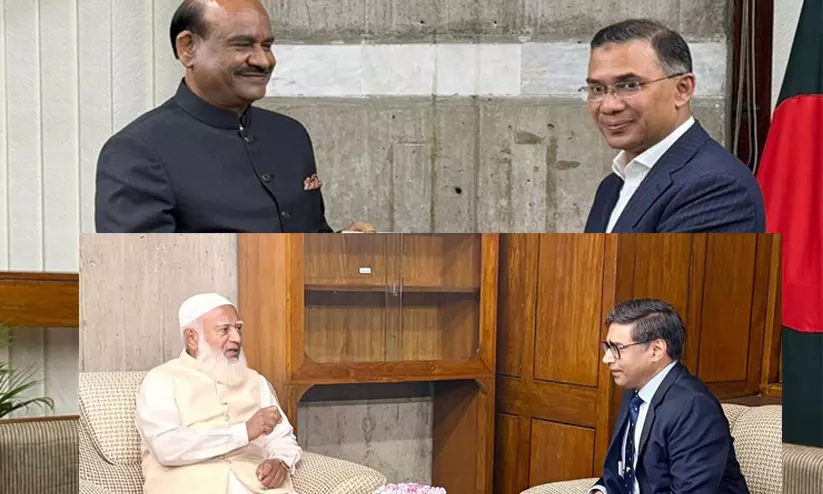

The newly appointed Prime Minister Tarique Rahman embraced diplomatic cordials from India during his oath-taking, with Om Birla representing India and conveying Prime Minister Narendra Modi’s wish for fortified cooperation between the two neighbours, while Foreign Secretary Vikram Misri undertook a meeting with the Leader of the Opposition and Jamaat-e-Islami ameer Shafiqur Rahman.
The carefully choreographed engagements underscored India’s resolve to engage the full sweep of Bangladesh’s recalibrated political landscape, for while Birla personally handed over Modi’s letter to Rahman after the ceremony, Misri’s brief but symbolically potent interaction with the Jamaat chief marked the first public acknowledgement of a channel long maintained at arm’s length.
In his letter dated February 16, Modi invoked shared history and civilisational affinity as the bedrock of bilateral ties, and he articulated a vision in which India and Bangladesh would become catalysts for each other’s sustainable growth, working in concert for reciprocal security and mutual prosperity across sectors as diverse as connectivity, trade, technology, energy, healthcare and education.
While Birla’s presence and the Prime Minister’s letter underscored continuity in state-to-state engagement, it was Misri’s ten-minute interaction with the head of Bangladesh Jamaat-e-Islami that marked a subtle yet unmistakable inflection in New Delhi’s Bangladesh policy, for successive Indian governments had historically maintained a studied distance from the party because of its role during the 1971 Liberation War and its perceived ideological proximity to Pakistan, according to The Wire.
The meeting, held within the precincts of Bangladesh’s Parliament, constituted the first public acknowledgment of engagement between India and the Jamaat’s top leadership, and it unfolded against the backdrop of quiet contacts that had been developing over recent months through diplomatic channels, including outreach from the Indian High Commission after the ameer’s bypass surgery and a formal invitation extended to the party for Republic Day celebrations.
By describing the interaction as part of its practice of “routinely meeting with several interlocutors”, the Ministry of External Affairs sought to frame the engagement as procedural rather than exceptional, yet the symbolism was unmistakable, for the Jamaat now commands a substantial parliamentary presence as the leading force within the opposition alliance and thus occupies an institutional role that India can no longer disregard.
In its statement, the High Commission emphasised that Misri conveyed greetings to Dr Rahman on his new responsibility and reaffirmed India’s enduring, people-centric commitment to Bangladesh, while the Jamaat leader spoke of deep civilisational bonds and expressed optimism for strengthened bilateral relations, thereby softening the edges of a relationship long defined by suspicion.
The decision of Birla, as on an earlier visit by External Affairs Minister S. Jaishankar, to leave Dhaka without meeting outgoing interim chief adviser Muhammad Yunus further underscored a calibrated prioritisation of future power centres, suggesting that India’s strategic calculus now rests upon sustained engagement with both the ruling establishment and an emboldened opposition in which the Jamaat figures prominently.