












Policy is clear; challenges remain
text_fields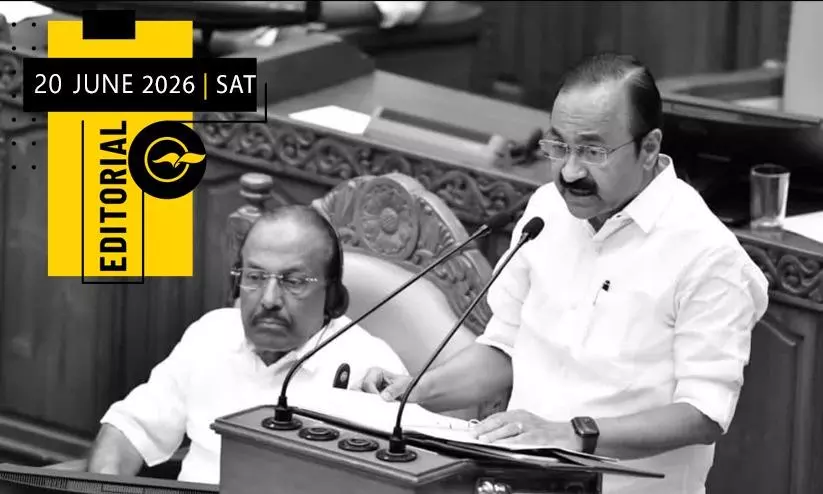

With the introduction of a roadmap for the development and welfare activities to be implemented in the state over the next five years, the maiden budget presented by Kerala Chief Minister VD Satheesan, who also holds the Finance portfolio, is more than just a blueprint for the action plans of the current financial year; it is also a policy statement. It can be said that this is a working document of the ideas he put forward during his Puthuyuga Yatra as the Leader of the Opposition; at the same time, this revised budget serves as a correction to the plans and policies that were criticised by the Opposition under the previous government. As a policy document containing several innovative ideas capable of transforming Kerala’s development aspirations in a new direction, this budget raises expectations. However, it also leaves some questions unanswered. It appears that the government’s approach is to lay the groundwork for turning these ideas into reality through precise policy formulation rather than making grand populist announcements aimed at winning applause. Therefore, those who expected surprises in the budget may be disappointed for the time being. The state is currently facing a range of challenges, the most significant among them being on the economic front. Kerala’s debt burden has crossed Rs 5 lakh crore, while 77 per cent of its revenue income is spent on salaries, pensions and interest payments. Its own tax revenue remains lower than the average of major states. The state also does not always receive its due share from the Central government. Alongside this crisis, structural changes are taking place in the state’s population. Kerala’s youth population has declined, while the elderly population has increased. Meanwhile, our young people are increasingly moving into long-term migration in pursuit of higher education and employment opportunities. Against this backdrop, the Chief Minister argues that traditional methods alone will not be sufficient to address the economic disadvantages and the challenges arising from demographic changes. Therefore, the budget speech makes it clear that the government's objective is to stimulate the economy through novel and innovative approaches and, in turn, generate revenue for the treasury to ensure equitable distribution. Although there may be several areas where one may disagree with this approach, it must be acknowledged that it is a sound and stable policy.
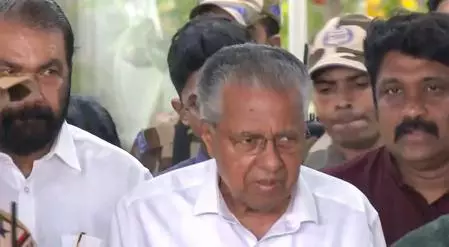
This cannot be described as a full-fledged budget. It is only a revision of the final budget of the second Pinarayi government, presented by K.N. Balagopal on January 29, 2026. That budget had estimated an additional Rs 20,500 crore under heads such as the Revenue Deficit Grant and the Central Tax Share. Naturally, since those amounts were reduced in the revised budget, allocations have also declined proportionately. Even so, apart from providing for the state’s routine expenditure, the budget has allocated funds for the initial implementation of the Indira Guarantee, one of the UDF’s key election promises. Although the overall expenditure has been reduced, allocations for the Scheduled Caste and Scheduled Tribe sectors have not been curtailed, and the increased allocation for the Centre’s new employment guarantee scheme compared with the original budget reflects the government’s concern for the basic sections of society. The fishermen community has also received considerable attention. Apart from this, the budget discusses several new ideas. The most important among them is Mission Samudra. The objective of this project is to connect Kerala’s major and minor ports and water resources, place the state prominently on the global maritime map, and thereby create a new maritime economy. Geographically, the project has immense potential. However, it also carries its own risks and development initiatives that recognise these realities alone can be meaningful. The budget also proposes several other new ideas, including One Kerala, Destination Point and a Tribal University.
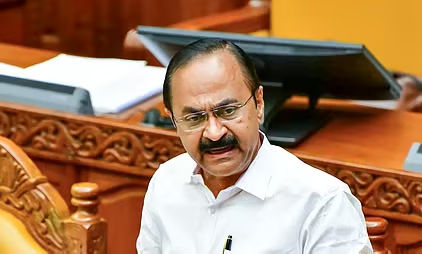
The remaining question is how these ideas will be implemented. The Chief Minister answered this in both the budget speech and at the subsequent press conference. The answer lies in the path of private investment. Many of the ideas presented by V.D. Satheesan open the door to substantial private investment, including in Kerala’s health and education sectors. Mission Samudra is undoubtedly one such project. Naturally, the government is likely to face criticism over the implementation of these projects. At the same time, the imbalance in the distribution of development projects is also evident in this budget. The two new medical colleges are located in South Kerala, while, hospitals in Malabar are left with the promise, as usual, of being “upgraded”. It is also disappointing that despite the abundance of ideas in the budget, the higher secondary education crisis faced by students in Malabar remains unresolved. At the same time, the proposal for a fresh study on the formation of new districts deserves appreciation. In any case, V.D. Satheesan has clearly outlined Team UDF’s development and economic policy. A preliminary reading of the budget speech suggests that the government is also realistically aware that the path to implementing these proposals will be strewn with hurdles.