













World Cup: the question my son asked at the stadium
text_fields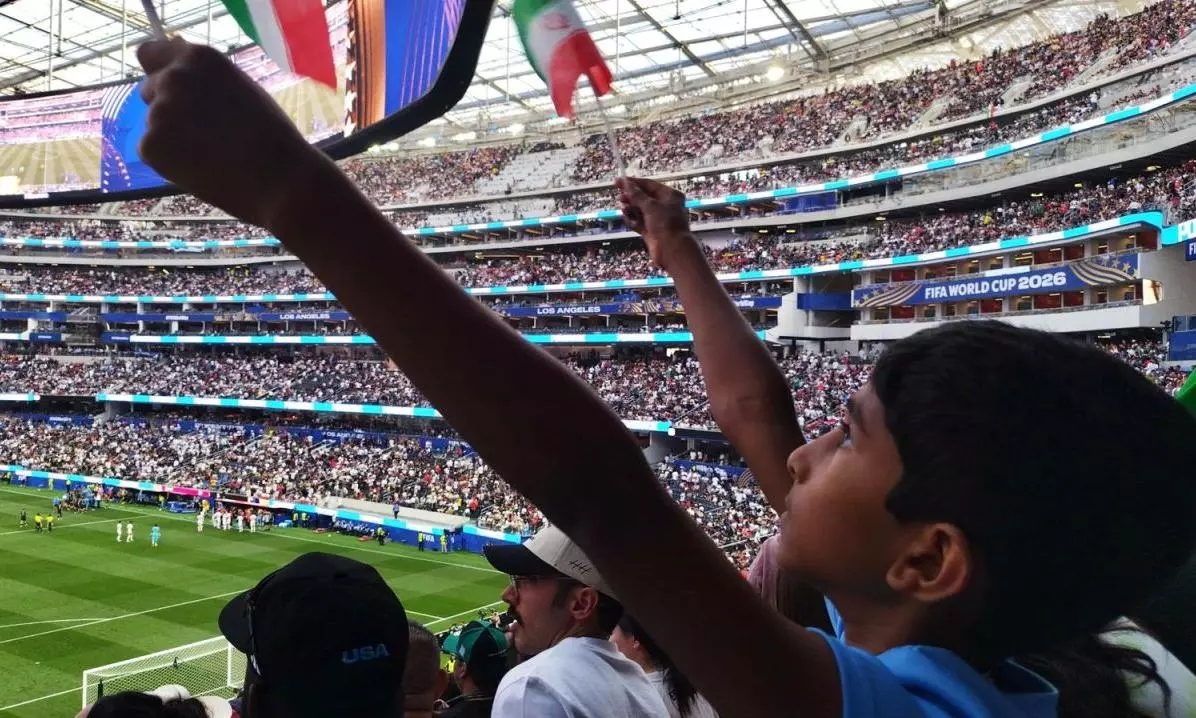
The author's son at the World Cup stadium
"Why are they angry at me?"
My eight-year-old son asked the question while clutching a flag and looking up at me with genuine confusion.
Around us, tens of thousands of spectators filled SoFi Stadium in Los Angeles. Iran was playing New Zealand in the FIFA World Cup. The atmosphere was electric. Drums echoed through the stands. Supporters sang, waved flags, and celebrated every moment of the match.
Yet for my son, the evening became about something very different.
He had brought an Iranian flag to the game. He was not making a political statement. He was doing what children around the world do at sporting events—supporting a team and enjoying the spectacle.
But several adults confronted him because of the flag he carried.
Other children and women carrying the same flag appeared to face similar hostility. Security personnel intervened more than once.
My wife and I tried to reassure him, but his question lingered.
Why were people angry?
The answer, of course, lies in history.
Many members of the Iranian diaspora carry deep wounds. Some left Iran because of political persecution. Others experienced imprisonment, exile, or loss. Decades after leaving their homeland, those experiences continue to shape their identities.
History does not disappear simply because people cross borders.
Inside the stadium, those unresolved tensions were visible everywhere.
Some spectators carried Iran's official national flag. Others carried the lion-and-sun flag associated with pre-revolutionary Iran. Some passionately supported Team Melli. Others openly cheered for New Zealand.
To a child, these contradictions made little sense.
To adults, they reflected decades of political conflict.
What struck me, however, was not the disagreement itself.
Disagreement is normal. It is healthy. Every society contains competing visions of the future.
What troubled me was how easily disagreement became hostility.
One of the great challenges of our age is that we increasingly struggle to separate people from politics.
We see this everywhere.
We reduce nations to governments. We reduce individuals to ideologies. We assume that a flag, a language, or a nationality tells us everything we need to know about another person.
The result is that empathy becomes harder.
This tendency extends far beyond the Iranian community.
Across the world, political polarization is encouraging people to see opponents not merely as mistaken but as illegitimate. Social media amplifies outrage. Political movements reward tribal loyalty. Nuance becomes a casualty.
The World Cup, ideally, should provide a temporary escape from these divisions.
Yet politics followed us into the stadium.
Iran's team reportedly remained in Mexico until shortly before the match and was expected to leave almost immediately afterward. Supporters complained about visa difficulties and ticketing controversies. Even before the game began, politics had already shaped the experience.
And yet there were moments of hope.
Many Iranian spectators later approached our family to apologize for the behaviour of those who had crossed the line. Their kindness reminded me that most people, regardless of politics, still recognize the importance of decency and respect.
That may be the most important lesson from the evening.
The world does not need less disagreement.
It needs more humanity.
Children understand this instinctively.
My son did not see governments, revolutions, or political factions. He saw people. He saw a football match. He saw a flag as a symbol of a country rather than a declaration of ideology.
Perhaps that is why his question was so powerful.
Why are they angry at me?
It is a simple question.
And perhaps it reveals something profound about the world we have created.
Sometimes children see truths that adults spend a lifetime forgetting: that people are more than their politics, that nations are more than their governments, and that our shared humanity should always come before our differences.
[Faisal Kutty, J.D., LL.M. is a lawyer, law professor and regular contributor to The Toronto Star and Newsweek. He is affiliate faculty at the Rutgers University Center for Security, Race and Rights and Associate Professor of Law Emeritus at Valparaiso University. You can follow him on X @faisalkutty]