











Echoes of Pamuk’s autocratic institute in a Kerala school
text_fields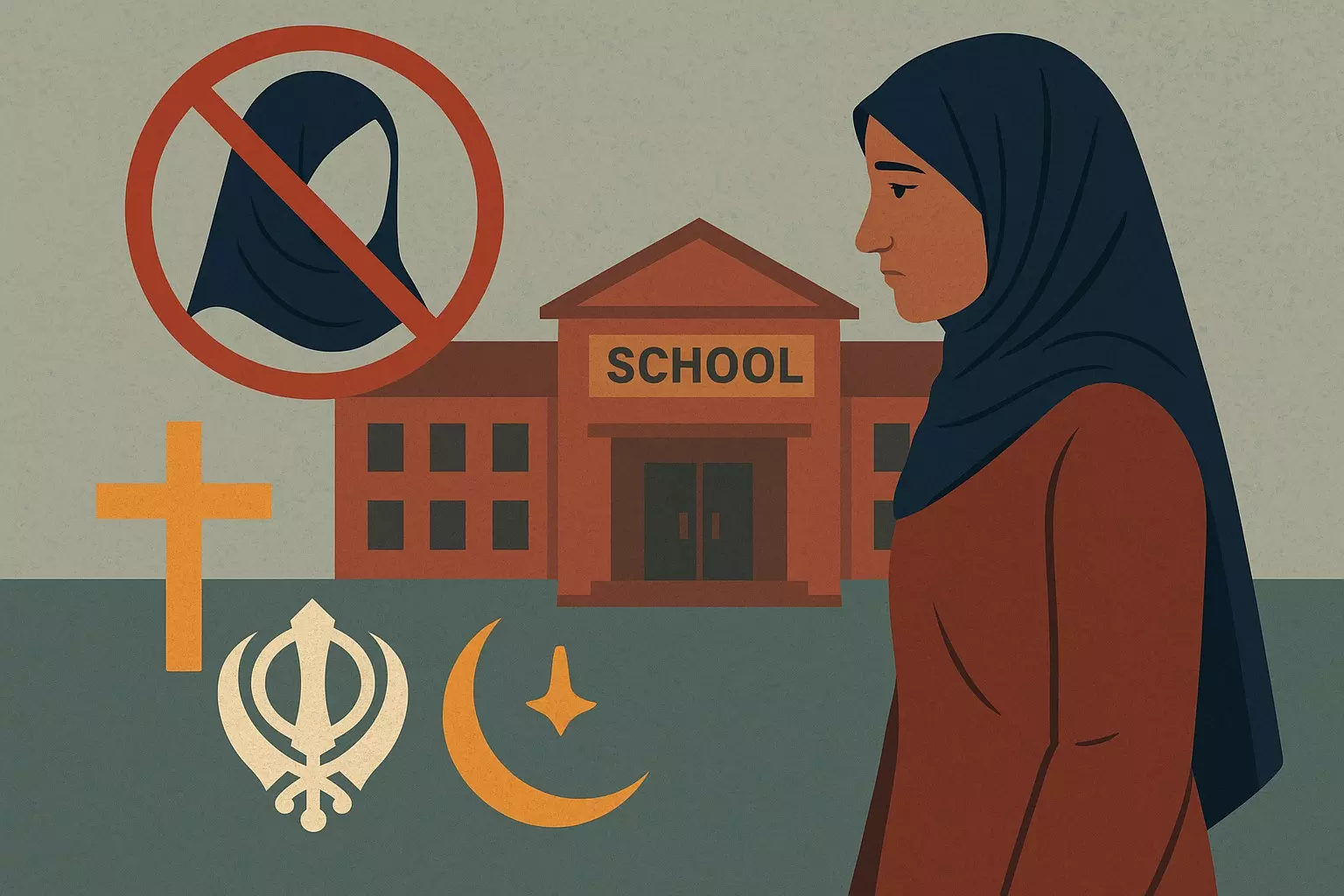

Orhan Pamuk won the Nobel Prize for Literature in 2006. It prompted me to read his remarkable novel Snow. To my mind, it remains his greatest work. The story, set in the bleak, snow-covered town of Kars, is about loneliness, politics, and the clash between faith and modernity.
But what lingers most is its portrayal of an institute where several young girls mysteriously take their own lives. Their deaths are acts of defiance against an autocratic, secular government that bans the wearing of headscarves.
In Snow, the hijab becomes a symbol of protest — of women asserting their right to faith and choice. And in a bitter twist of irony, an Islamist militant ends up killing the head of the institution. Pamuk’s novel explores the tragedy that unfolds when personal belief collides with the arrogance of imposed secularism.
I remembered this fictional institute when I read, with disbelief, about a Catholic school in Kerala that made an issue of a single Muslim girl who wanted to wear a hijab in class. She had worn a scarf matching the school uniform. It did not violate the dress code in any meaningful way. Yet the authorities chose to see this simple act of modesty as rebellion.
The irony is inescapable. A school that claims to teach tolerance and discipline ended up stoking intolerance over a square piece of cloth.
Only last fortnight, a Christian friend of mine started an online business selling scarves in different colours for Christian women attending church. A few days earlier, my wife too had bought several scarves in soft shades — for the same purpose.
Traditionally, Christian women cover their heads with the end of their sari while inside the church. My wife found it inconvenient to keep adjusting the pallu. The scarf was a practical alternative — not called a hijab, of course, but serving the same purpose: reverence and modesty.
I am reminded of a relative of mine who was married to an African woman. She was a Christian, and during her visit home, I noticed she always kept her head covered. When I asked her why, she said that in her country, women covered their hair all the time — even indoors, it was part of their culture, not an act of religious rigidity.
Headgear, indeed, has been part of human culture for centuries. In West Asia, men wear a keffiyeh — a square cloth held in place by a cord called the agal. This evolved as a practical response to the desert’s dust storms, leaving sand particles in the hair. In Rajasthan, too, men and women cover their heads for protection and pride. In north India, women still cover their heads with the sari end while in public or speaking to elders. Cultural modesty transcends religion.
Take Nuh, the only Muslim-majority district in Haryana. Few realise that the name “Nuh” comes from Noah, revered in both the Bible and the Quran. Though it has one of the lowest literacy rates in India, it also boasts the best man-woman ratio.
I have a personal connection to Nuh. As chairman of a senior secondary school there, run by Deepalaya — the NGO founded by seven Mar Thoma Christians in 1979 — I often interacted with the community. Our CBSE school placed no restriction on girls wearing matching headscarves. Our goal was education, not moral policing.
We believed good schooling meant nurturing minds, not altering habits. I remember inviting accomplished Muslim women — like Neema Noor, now a judge in Kerala; Ilma Afroz, one of India’s first Muslim women IPS officers; and Kashaf Maheen, now doing research in the U.S. — to interact with our students. They inspired the children far more than any sermon could.
Once, an Iranian couple doing their PhD in Delhi met me to thank the school. Their children, they said, had learned more than academics — they had learned equality. That, to me, was true education.
Against this background, the Kerala school’s obstinacy over a single headscarf seems petty. The principal, a nun who wears her habit daily, could have shown more empathy. She should have understood that modesty and devotion take many forms. By making an issue out of nothing, she became a pawn in the game of dividing communities that once lived in mutual respect.
The story reminds me of something academic, and author Achin Vanaik’s father once told me. He narrated an incident from the time his son was studying in a school in New York. One day, young Achin refused to go to school because classmates teased him, asking whether there was a snake hidden in his chutti — the little turban Sikh boys wear.
The father, a diplomat, took a wiser route. He sought permission to address the school assembly. There, he explained that Sikhs never cut their hair and that the turban merely holds it together. To demonstrate, he opened his son’s chutti, revealing neatly tied hair. He then untied his own turban and showed how it was folded and worn. The teasing stopped. Education had done its quiet work.
India, too, has shown similar wisdom in matters of faith and conscience. Eminent lawyer Fali S. Nariman, in his autobiography Before Memory Fades, mentions the case of three children belonging to a Jehovah’s Witness family in Kerala. They were expelled from their school for not singing the national anthem. However, the Supreme Court ruled that they did not show any disrespect to the anthem. They did not sing it because their religion did not allow them to sing except to praise their God.
We live in times when every piece of cloth, every symbol of faith, is politicised. The hijab, the turban, the cross, or the tilak — each becomes a battlefield where reason and tolerance are the first casualties. Those who ban scarves in classrooms forget that education is not about erasing identity but embracing it.
Perhaps the nun in Kerala meant no harm. But in denying that child her simple act of modesty, she unwittingly echoed Pamuk’s fictional bureaucrats — those who sought to save faith by killing freedom. And that, indeed, is the tragedy of our times: when faith loses compassion, and secularism loses sense.
After all, a scarf — whether you call it a hijab, a veil, or a head-cover — is just fabric. But the dignity it protects is made of something far finer: the fabric of humanity itself