














Sabarimala case: Tharoor says law must respect faith, calls it lesson for LDF
text_fields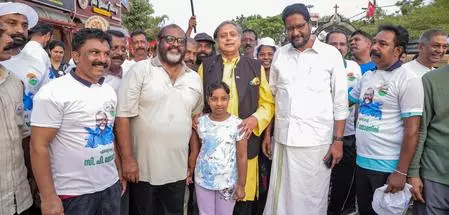

Thiruvananthapuram: Congress leader Shashi Tharoor stated on Tuesday that those interpreting the law must consider faith, noting that it is necessary to understand and respect people's faith.
Speaking to the media here, the Thiruvananthapuram MP highlighted the Sabarimala women's entry issue and the lessons learned from the controversy.
He said he had written in detail about the matter earlier and urged people to read his views.
Referring to the controversy over the entry of women of menstruating age into the Sabarimala Temple, Tharoor said the Left government in Kerala had realised its mistake, PTI reported.
"One of the very important lessons that the LDF government has learned... is that you cannot just act blindly, without regard to the particularities of the wishes of the people and the faith of the people," he said.
He underlined that while the Constitution and the courts must be respected, they function within a society shaped by deep beliefs.
"We are all in favor of the Constitution. We all respect the Supreme Court. But the Constitution and the court serve a society where people have rather profound beliefs," he said.
Explaining the traditional practice at the hill shrine, Tharoor said, "As we all know, Lord Ayyappa in Sabarimala is an Nitya Brahmachari, and he has gone and taken refuge in that jungle shrine in order not to see any women of menstruating age." "And this is why for centuries the practice has been that women below 50 are not normally welcome in the sanctum sanctorum of the shrine or in the precincts of the shrine. And this has been respected by all believers.
"Now, you may quarrel about the belief and you may say the belief is one thing or another. But the truth is faith has always had yardsticks that are different because faith rests on belief and not on law," the Congress Working Committee member said.
Reiterating his key point, Tharoor said, "Those who are actually interpreting the law in the context of faith, have to understand and respect the faith of the people." Referring to the events following the 2018 Supreme Court verdict, he said, "The LDF learned a very hard lesson when they disregarded the faith of the people and tried to enforce the judgment." Tharoor noted that, in practice, "that judgment has not been enforced for several years now." Welcoming the change in the state government's stand, Tharoor said, "The LDF has changed its position… that the traditional practice must be respected. We welcome that." He added that changes in such matters should be gradual.
"If change is to come, it will come through the evolution of people and not by imposition either by judges or by chief ministers," Tharoor said.
At the same time, he said the government, which tried to forcefully implement the apex court verdict, owed an apology. "They need to give an apology to the people for the way they behaved back in 2018 and 19," he said.
Tharoor's remarks come as the Supreme Court resumes hearing the Sabarimala case along with other matters of faith.
The Centre, represented by Solicitor General Tushar Mehta, has argued that the issue falls within religious faith and should be left to denominations, not courts.
In September 2018, a five-judge Constitution bench, by a 4:1 majority verdict, had lifted the ban that prevented women between the ages of 10 and 50 from entering the Sabarimala Ayyappa temple and held that the centuries-old Hindu religious practice was illegal and unconstitutional.
On November 14, 2019, another five-judge bench headed by the then CJI Ranjan Gogoi, by a majority of 3:2, referred the issue of discrimination against women at various places of worship to a larger bench.
The bench had then framed broad issues on freedom across religions, saying they cannot be decided without any facts of the particular case.
Besides the Sabarimala case, the verdict also referred to the larger bench the issues of Muslim women's entry into mosques and dargahs, and the entry of Parsi women, married to non-Parsi men, to the holy fire place of an Agiary.
On February 16, the top court had said it would commence the final hearing in the matter on April 7, which was expected to conclude on April 22.
Earlier, the top court read out seven questions it had framed on the scope of religious freedom.