








Amid criticism of history distortion, Minister admits RSS's key role in drafting education policy
text_fields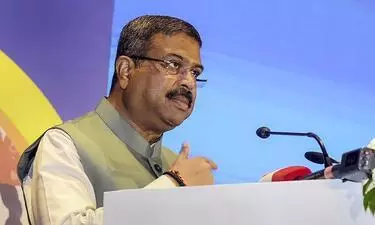

Amid controversy revolving around the RSS's influence over drafting the National Education Policy (NEP) 2020, where critics alleged distortment of history in line with the Hindutva agenda, the Union Education Minister Dharmendra Pradhan openly acknowledged the RSS-affiliated Vidya Bharati’s undeniable role in shaping the National Education Policy, while asserting that several of its long-standing practices had now been incorporated into the national curriculum.
Addressing a programme of Vidya Bharati at the beginning of the new academic year, Pradhan said that although the organisation represented a small portion of the education ecosystem, its influence had been disproportionately significant, and he remarked, “Although Vidya Bharati represents only around one per cent of the larger education ecosystem, that one per cent is like a drop of nectar.”
He further elaborated that the organisation had demonstrated benchmarks for educational delivery, adding, “It has shown what the standards of education should be, what learning outcomes should be, what competencies should be, how teaching should happen, and what values should be imparted.”
Emphasising his association with the education sector, the minister stated that Vidya Bharati had consistently guided policy decisions, and he noted, “Whether it is textbooks, medium of instruction, language, or social development, I have considered Vidya Bharati to be a successful reference point.”
He also credited the organisation as a source of inspiration behind NEP 2020, saying, “I can say with confidence that Vidya Bharati has been one of the inspirations behind the National Education Policy. The values, skill development methods, and teaching practices of Vidya Bharati have now been incorporated into the national curriculum.”
Pradhan pointed out that several initiatives promoted by Vidya Bharati had found reflection in national reforms, and he observed, “The National Education Policy has said that there should be ten ‘bagless school days’. Vidya Bharati had such a tradition from the very beginning.”
Highlighting the role of language in learning, he expressed support for mother tongue-based education, stating, “I believe in Vidya Bharati’s mother tongue-based system of education, which increases clarity, critical thinking, design thinking, and productive thinking in children.”
While urging broader collaboration in education, the minister said learning must extend beyond formal institutions, and he remarked, “Education happens in families, in society, in groups, and also in schools. Unless education becomes part of society, it will not become truly meaningful.” He also called for expansion of community participation, adding, “Earlier, there were only parent-teacher meetings, but we are now transforming that into school management committees and community-based responsibility for education.”
Pradhan further announced that new NCERT textbooks for Classes 1 to 8 had been finalised, while Class 9 books would be available within a month, and he underlined the introduction of computational thinking and artificial intelligence at earlier stages, stating, “Students will learn what artificial intelligence (AI) is, what its limits are, what its possibilities are, and how computational thinking can shape the future.”
He concluded by expressing appreciation for the organisation’s role, saying, “Vidya Bharati has been a responsible guide for us, and that is why we have been able to move ahead.”