
















SC questions EC over ‘logical discrepancy’ in Bengal voter rolls
text_fields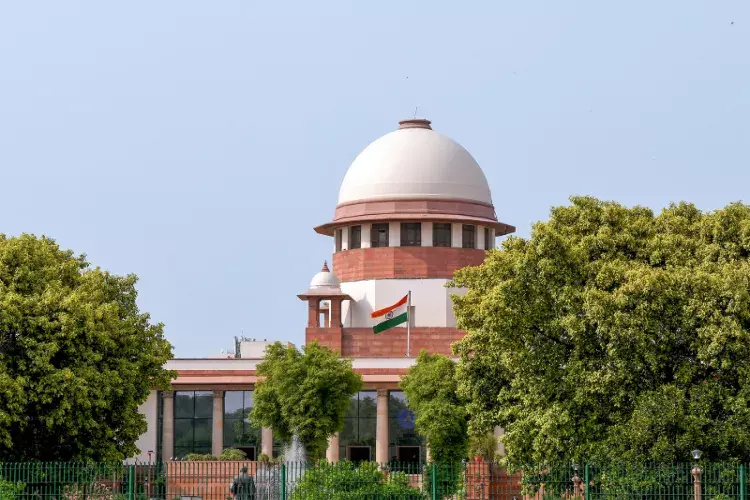

New Delhi: The Supreme Court on Monday observed that the Election Commission of India appeared to have deviated from its Special Intensive Revision (SIR) process in West Bengal by introducing a new category termed “logical discrepancy”.
According to reports, such discrepancies include mismatches in parents’ names, unusually small age gaps between parents and children, and cases where the number of children exceeds six.
During the hearing, Justice Joymalya Bagchi questioned the implications of large-scale voter exclusions, particularly if the number of excluded voters exceeded a candidate’s winning margin. “Suppose the margin is 2% and 15% of the electorate mapped could not vote… we would definitely have to apply our minds,” he remarked.
The judge also emphasised the need for a “robust appellate mechanism” to address appeals from voters whose names were removed from the rolls.
The bench noted that the poll panel appeared to have departed from its earlier stand in the Bihar SIR exercise, where it had maintained that individuals listed in the 2002 electoral rolls would not be required to submit additional documents.
The Election Commission had published the final electoral roll for West Bengal on February 28, excluding over 61 lakh voters. The process continued thereafter, with around 60 lakh “doubtful and pending” cases under adjudication following objections to the draft rolls released in December. Subsequent supplementary lists saw the inclusion of additional voters.
A bench comprising Chief Justice Surya Kant and Justice Bagchi was hearing a petition filed by individuals whose appeals against their exclusion are pending before appellate tribunals. The petitioners sought an extension of the April 9 deadline for freezing electoral rolls, arguing that it would allow them to vote in the upcoming Assembly elections scheduled for April 23 and April 29, with counting on May 4.
The petitioners stated that they were included in the 2002 electoral rolls and possessed Aadhaar cards and passports as proof of identity.
Initially, the court expressed reluctance to intervene, suggesting that appellate tribunals should handle the matter. However, petitioners’ counsel alleged that the Election Commission was not cooperating with the tribunals by failing to provide necessary documents.

Justice Bagchi pointed out inconsistencies in the Commission’s submissions, noting that in the Bihar case it had clearly stated that those listed in the 2002 rolls need not submit documents. “Now you are improvising the submissions which you made earlier,” he remarked.
Appearing for the Commission, lawyer Dama Seshadri Naidu clarified that such individuals are not required to upload documents, except to establish that they are the same persons listed in the 2002 rolls.
The court also acknowledged the possibility of errors in the adjudication process due to the large volume of cases handled by judicial officers. “If you go through 1,000 documents a day, if accuracy is 70%, the activity should be rated as excellent… so margin of error will be there and we need a robust appellate forum,” Justice Bagchi observed.
While dismissing the petition, the Supreme Court allowed the petitioners to continue pursuing their appeals before the tribunals and stated that “necessary consequences shall follow” if their appeals succeed.
As part of the revision exercise, nearly 91 lakh voters—around 11.9% of West Bengal’s 7.6 crore electorate—were removed from the rolls. The process concluded on April 6 after judicial officers adjudicated approximately 60 lakh claims and objections. Voters removed during this process can appeal before 19 tribunals established for the purpose.

Earlier, on February 20, the Supreme Court had directed the appointment of judicial officers of the rank of district judge or additional district judge to assist in the revision process. On March 10, it ordered the formation of appellate tribunals comprising former High Court chief justices and judges to hear appeals against voter exclusions.