














Kejriwal cites RSS links and biased judgments in seeking Justice Swarana Kanta recusal
text_fields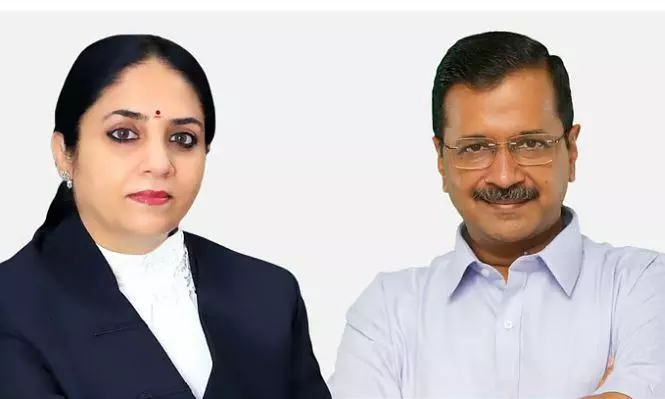

The Delhi High Court on Monday witnessed a charged and layered hearing as former Delhi Chief Minister Arvind Kejriwal pressed for the recusal of Justice Swarana Kanta Sharma, asserting that her alleged ideological connection with the RSS and BJP, coupled with what he characterised as a discernible judicial predisposition in the excise policy case, had engendered a reasonable apprehension of bias.
Appearing before the court, Kejriwal reiterated that his plea was not predicated on imputing personal impropriety but on the broader and constitutionally significant principle of perceived impartiality, contending that prior judicial observations and the judge’s participation in events organised by the Adhivakta Parishad had cumulatively eroded his confidence in securing a dispassionate adjudication.
He further invoked public statements attributed to Union Home Minister Amit Shah to argue that the proceedings were already enveloped in a politically charged atmosphere.
Senior advocate Sanjay Hegde, advancing submissions on behalf of Kejriwal and other accused, including Manish Sisodia, underscored that the doctrine of recusal hinges not merely on demonstrable bias but equally on the legitimacy of the litigant’s apprehension.
He argued that extensive findings recorded in prior orders could reasonably be construed as pre-judgment. He maintained that the evaluative threshold in revisionary jurisdiction is inherently narrower than in appellate scrutiny, yet the tenor of earlier observations appeared to traverse into merit-based conclusions.
Interrupting at intervals, the bench delineated the narrow contours within which recusal could be considered, emphasising that mere dissatisfaction with judicial observations or the fact of having heard connected matters could not, in isolation, constitute sufficient grounds.
The court noted that the central thread running through the applications was the contention that strong prior observations had rendered it incapable of adjudicating the matter dispassionately.
The Central Bureau of Investigation, represented by Solicitor General Tushar Mehta, opposed the recusal plea with marked vehemence, terming the allegations “unscrupulous and sweeping” while asserting that participation in non-political legal seminars could not be extrapolated into ideological alignment.
Mehta further remarked that if Kejriwal intended to argue personally, procedural propriety required him to discharge his counsel, adding pointedly that the courtroom was not a stage for theatrics.
As proceedings progressed, the court recorded that while it might be institutionally capable of adjudicating without bias, the focal inquiry remained whether a litigant’s apprehension had attained the threshold of reasonableness.
Hegde, in response, argued that the perspective to be adopted was not that of the judge but of an individual contesting for personal liberty, and that even a momentary judicial certainty warranted introspective recalibration.