














Kerala forms expert panel to study E Sreedharan's high-speed rail proposal
text_fields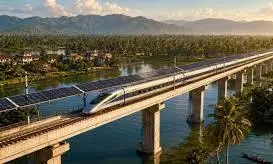

The Kerala government has constituted an expert committee to examine the feasibility of a proposed high-speed rail corridor between Thiruvananthapuram and Kannur based on a proposal submitted by Delhi Metro Rail Corporation (DMRC) and metro man E Sreedharan.
The move comes after the state decided to discontinue steps related to the SilverLine or K-Rail project proposed by the previous CPI(M)-led government. The Congress had strongly opposed the project while in Opposition.
Sreedharan recently submitted DMRC's interim report for the corridor.
The state transport department has tasked a four-member expert committee with evaluating the project's technical and financial feasibility, environmental impact, socio-economic benefits, and implementation challenges. The panel includes Transport Secretary J Vinayan, finance expert Dr C Veeramani, environmental expert Sreedhar Radhakrishnan, and Sreedharan.
The committee has been asked to submit its recommendations within three weeks.
According to the interim report, the proposed Kerala High-Speed Rail corridor will be a 473.2-km double line connecting Thiruvananthapuram City at Poojapura to Kannur's Mundayad through 23 stations. The line will be fully elevated except for a 6.5-km tunnel section in Thiruvananthapuram.
The corridor is expected to connect all airports in Kerala except Kannur Airport, which will be linked through a dedicated 10-km road. Travel time between Thiruvananthapuram and Kannur is estimated at three hours and 30 minutes.
The project cost is estimated at Rs 60,000 crore. Of this, Rs 36,000 crore is proposed to come through equity contributions from the Centre and the state in a 51:49 ratio, while the remaining Rs 24,000 crore is expected to be raised through crowdfunding.
The report proposes meeting the railway's energy requirements through a captive solar power network, with surplus electricity to be supplied to the Kerala State Electricity Board. It states that the project could become the world's first fully green high-speed rail corridor.
The line has been proposed on standard gauge tracks, with trains designed for a maximum speed of 200 kmph, an operational speed of 180 kmph, and an average commercial speed of 140 kmph.