















Justice Dhulia says passport should prove citizenship, calls voter document rules ‘exclusionary politics’
text_fields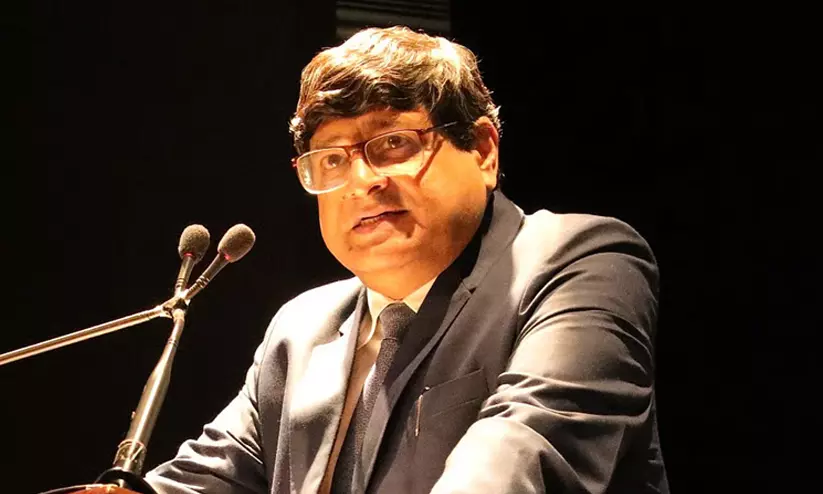

New Delhi: Former Supreme Court Judge Justice Sudhanshu Dhulia has sharply criticised the ongoing voter list revision process, saying the requirement for citizens to furnish documents to prove their citizenship amounts to “exclusionary politics” and violates civil rights.
Speaking on senior advocate Kapil Sibal’s programme ‘Dil Se’, Justice Dhulia said the present procedures impose an unfair burden on citizens and risk undermining the fundamental right to vote. His remarks come amid intense debate over whether a passport can be treated as valid proof of citizenship.
He argued that India’s constitutional framers never envisaged such an approach and that legal presumptions must favour citizenship, not cast doubt on it. Denial of citizenship or voting rights on the grounds of lacking documents such as birth certificates is unacceptable, he said. “If you are in India, the legal presumption is that you are an Indian citizen. It is not the citizen’s duty to prove citizenship; rather, it is the government’s responsibility to prove that someone is not a citizen,” Justice Dhulia said.
All government policies, he stressed, are meant to benefit citizens, and a person’s citizenship should not be questioned merely for lack of formal documentation or without strong reasons. To illustrate the impracticality of insisting on birth certificates, he referred to his own experience, noting that he was born at home and that such circumstances were common for millions of Indians during the Partition era. Many people of his generation and earlier, he pointed out, still do not possess birth certificates.
Justice Dhulia also criticised the government’s position that a passport is merely a travel document. When Indian law allows only citizens to hold passports, he asked, how can a person with a passport be treated as a non-citizen? He noted that countries such as the United States and the United Kingdom accept passports as proof of citizenship and questioned why India alone refuses to do so.
He warned that the powers given to booth-level officers during voter list verification are potentially dangerous. Allowing such officials to question citizenship and delete names from electoral rolls is detrimental to democracy and creates unnecessary fear among voters, he said.
Reiterating his core argument, Justice Dhulia maintained that the burden of proving that someone is not a citizen lies with the state, not the individual. “If I am living here, what is the presumption? If I were a citizen of another country, I would be here on a visa and would leave. If that is not the case, I am an Indian citizen. If I am not, it is for the government to prove it,” he said.
Earlier, former Supreme Court judge Justice Madan B. Lokur had also criticised the Union government’s stance that a passport is not proof of citizenship, calling it a misinterpretation of the law with serious constitutional implications. Observers believe such pointed criticism from senior members of the judiciary on citizenship documentation could pose a significant political challenge for the Centre.