









Taiwan announces ‘T-Dome’ air defence system to strengthen security against China
text_fields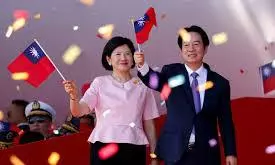

Taiwan on Friday unveiled plans for a new multi-layered air defence system, dubbed “T-Dome,” aimed at countering potential threats from China.
President Lai Ching-te said the initiative would be supported by increased defence spending and called on Beijing to renounce the use of force to seize the island.
Democratically governed Taiwan has faced growing military and political pressure from China, which considers the island its own territory. Taiwan, in response, is modernising its armed forces and boosting defence budgets, while China continues to expand its military capabilities with stealth fighter jets, aircraft carriers, and a wide range of missiles.
Lai said in his National Day address that the increase in defence spending had a clear purpose: it was necessary to counter enemy threats and drive the development of Taiwan’s defence industries. He added that Taiwan would accelerate the construction of the T-Dome, establish a rigorous multi-layered air defence system with advanced detection and interception capabilities, and create a safety net to protect the lives and property of its citizens. His speech was met with applause from the audience.
While Lai did not provide technical details about T-Dome in his first public mention, the system is intended to be similar to Israel’s Iron Dome.
A senior presidential office official, speaking on anonymity, said that the T-Dome’s spending plans would be included in the budget proposal set to be presented by the end of the year. The official added that Taiwan hopes to build a more comprehensive air defence network with a higher interception rate and noted that other countries, including the United States, are developing comparable systems.
Currently, Taiwan’s air defence relies on U.S.-made Patriot missiles and domestically developed Sky Bow systems. Last month, at a major arms show in Taipei, Taiwan, also unveiled the Chiang-Kong missile, capable of intercepting mid-level ballistic missiles at higher altitudes than the Patriots.
China reacted angrily to Lai’s speech. Chinese Foreign Ministry spokesperson Guo Jiakun said that seeking independence by force would only draw Taiwan into conflict. He added that the individual peddled the separatist fallacy of Taiwan independence, which, he claimed, once again exposed his stubborn nature as a troublemaker, creator of danger, and war-maker.
Lai reiterated that Taiwan seeks peace and stability and urged China to avoid coercion. He remarked that looking back at World War II, many people had experienced the suffering of war and the pain of invasion, and emphasized that lessons should be learned to ensure the tragedies of history are never repeated.
A U.S. administration official welcomed Lai’s commitment to increase defence spending and his call for peace, stating that they would not speculate on how Beijing might react. The official added that, as a general policy, routine speeches should not be used as a pretext for any coercive or military action.
Taiwan’s National Day marks the 1911 uprising that led to the overthrow of China’s last imperial dynasty and the establishment of the Republic of China. After losing the civil war to Mao Zedong’s forces in 1949, the Republican government relocated to Taiwan, where the Republic of China remains the island’s formal name.