
















Lord Ram temple at Lahore Fort reopened to public after restoration
text_fields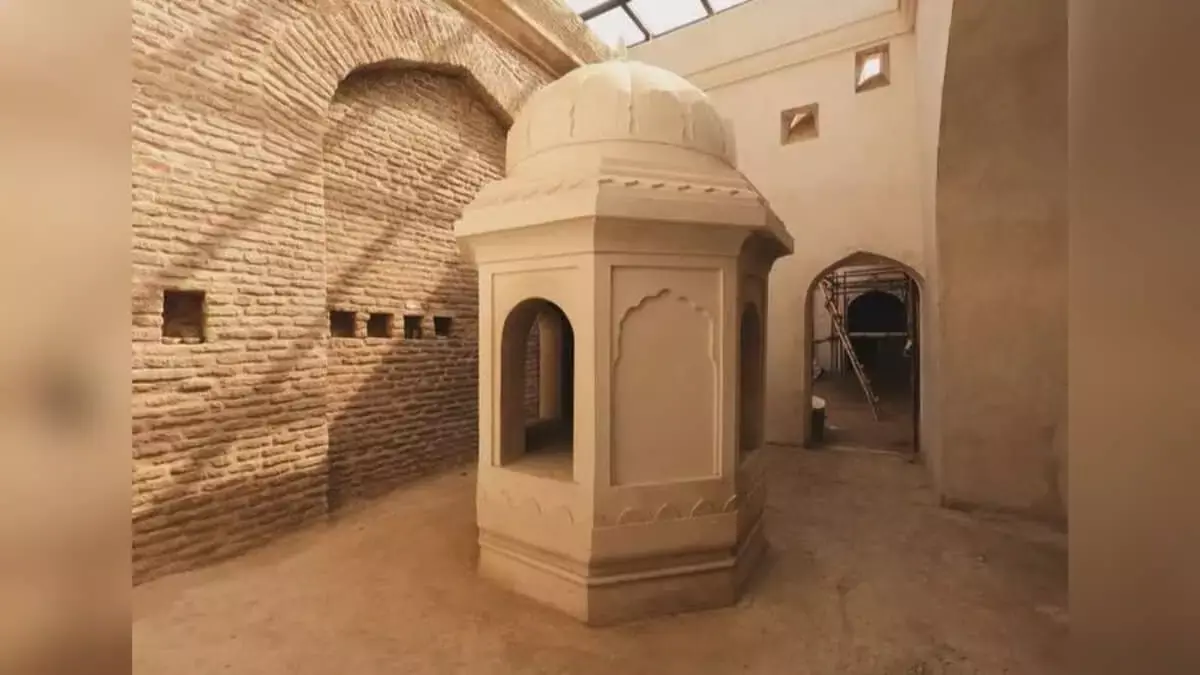

Lahore: The Loh Temple, dedicated to Lava, one of Lord Ram’s sons, located inside the historic Lahore Fort in Pakistan’s Punjab province, has been fully restored and opened to the public.
The Walled City Lahore Authority said on Tuesday, January 27, that it has completed the conservation of the Loh Temple along with two other heritage structures, the Sikh-era Hammam and the Athdara Pavilion of Maharaja Ranjit Singh, in collaboration with the Aga Khan Cultural Service-Pakistan.
The Loh Temple consists of a cluster of interconnected chambers within the Lahore Fort complex. It is an open-to-sky space that houses a memorial shrine. Dedicated to Lava, also known as Loh, the temple holds religious significance for Hindus, who believe that the city of Lahore derives its name from him. The monument had earlier undergone partial restoration in 2018.
Walled City Lahore Authority spokesperson Tania Qureshi said the restoration initiative aims to highlight the Lahore Fort’s rich cross-cultural heritage, reflected in its Sikh and Hindu temples, Mughal-era mosques and structures from the British period. She added that extensive conservation techniques were employed during the restoration process.
Last year, a Sikh researcher identified around 100 monuments at the Lahore Fort that were maintained during the Sikh era between 1799 and 1849, underlining the site’s historical importance. Of these, nearly 30 monuments no longer exist.
To offer visitors a deeper understanding of the fort’s history during the Sikh Empire, the Walled City Lahore Authority commissioned US-based Sikh researcher Dr Tarunjit Singh Butalia to write a tour guidebook titled Lahore Fort during the Sikh Empire.
“The Lahore Fort, a deeply sentimental monument ingrained in the Sikh psyche, served as the seat of power for the Sikh Empire for nearly half a century,” Dr Butalia told PTI. He said the fort holds personal significance for him, noting that his ancestors held prominent positions in the Sikh court, as recorded in Umdat ut Tawarikh, the Persian court chronicles.
With PTI inputs