













Three U.S. scientists win 2025 Nobel Prize in Physics for quantum tech
text_fields

New Delhi: Three U.S. scientists have been awarded the 2025 Nobel Prize in Physics for pioneering experiments that brought quantum physics to life on a chip, revealing its workings on a tangible, macroscopic scale.
The prestigious recognition highlights their groundbreaking research that has paved the way for the next generation of quantum technologies, including quantum cryptography, quantum computing, and quantum sensing.
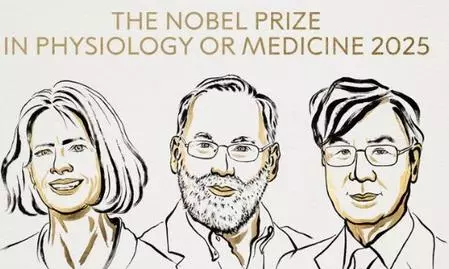
The laureates are John Clarke of the University of California, Berkeley; John M. Martinis of the University of California, Santa Barbara; and Michel H. Devoret, affiliated with both Yale University, New Haven, and the University of California, Santa Barbara. The trio will share the prize money of 11 million Swedish kronor.
According to the Royal Swedish Academy of Sciences, the three scientists were honoured “for the discovery of macroscopic quantum mechanical tunnelling and energy quantisation in an electric circuit.”
Quantum mechanics, a fundamental theory of physics, allows particles to pass directly through barriers — a phenomenon known as tunnelling. Typically, when large numbers of particles are involved, these quantum effects fade and become imperceptible.
However, the laureates’ experiments defied this limitation. They demonstrated that quantum mechanical properties can manifest on a scale large enough to be observed and measured in everyday terms. Using an electrical circuit, they successfully showed both quantum mechanical tunnelling and quantised energy levels in a system large enough to hold in one’s hand.
“It is wonderful to be able to celebrate the way that century-old quantum mechanics continually offers new surprises,” said Olle Eriksson, Chair of the Nobel Committee for Physics. “It is also enormously useful, as quantum mechanics is the foundation of all digital technology.”
He noted that even the transistors powering modern computer microchips are examples of established quantum technology that underpins today’s digital world.
Last year, the 2024 Nobel Prize in Physics was awarded to John J. Hopfield and Geoffrey E. Hinton for their pioneering research in machine learning, recognised “for foundational discoveries and inventions that enable machine learning with artificial neural networks.”He noted that even the transistors powering modern computer microchips are examples of established quantum technology that underpins today’s digital world.
Last year, the 2024 Nobel Prize in Physics was awarded to John J. Hopfield and Geoffrey E. Hinton for their pioneering research in machine learning, recognised “for foundational discoveries and inventions that enable machine learning with artificial neural networks.”

With IANS inputs