
















Powerful space camera captures Perseverance rover as it nears marathon milestone on Mars
text_fields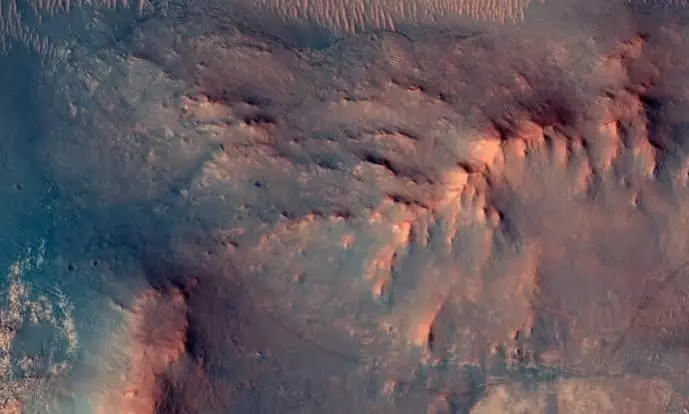

NASA has released a striking new image showing its Perseverance rover as a tiny speck on the Martian surface. It was captured just a day before the robotic explorer completed a marathon-distance journey across the Red Planet.
The image was taken on June 13 by the High-Resolution Imaging Science Experiment (HiRISE) camera aboard NASA's Mars Reconnaissance Orbiter. It shows Perseverance travelling across rugged terrain west of Jezero Crater, in an area nicknamed "Arbot", with its winding wheel tracks clearly visible.
On June 14, the rover crossed 42.195 kilometres of driving distance, equivalent to a full marathon, on the 1,890th Martian day, or sol, of its mission.
Perseverance achieved the milestone in just over five years after landing on Mars in February 2021. The previous record-holder, NASA's Opportunity rover, took more than 11 years to cover the same distance.
HiRISE, operated by the University of Arizona, is among the most powerful cameras orbiting Mars. From hundreds of kilometres above the planet, it can capture objects smaller than one metre across. In the latest image, Perseverance appears as a tiny blue-green dot against the red landscape, with its tracks marking its route across ancient bedrock.
The rover's primary mission is to search for signs of ancient microbial life and collect rock samples for a future mission to return them to Earth.
Its journey has taken it from the floor of Jezero Crater to an ancient river delta and now beyond the crater's rim, allowing scientists to study a wide variety of geological formations.
According to NASA, Perseverance is currently exploring some of the oldest rocks ever examined during the mission, estimated to be around four billion years old. Researchers hope these samples will provide new insights into Mars' early history and whether the planet once had conditions capable of supporting life.