








JWST fails to detect atmospheres of ‘super-puff’ planets in Kepler-51 system
text_fields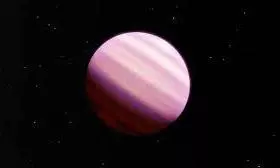

Astronomers studying the distant Kepler-51 system have been left puzzled after the James Webb Space Telescope failed to detect expected atmospheric signatures on its unusual “super-puff” planets.
Located about 2,615 light-years away, the system contains three exoplanets — Kepler-51b, c, and d — first discovered by the Kepler Space Telescope.
These planets are comparable in size to Saturn but have extremely low mass, making their density similar to cotton candy.
New research shows that while the planets have radii seven to ten times that of Earth, their masses range from only 3.7 to 5.6 times Earth’s mass. This sharply contrasts with Saturn, which is similar in size but has a mass about 95 times that of Earth.
The findings challenge existing theories of planet formation, which suggest that gas giants form around dense, massive cores that pull in surrounding gas. In the case of these planets, scientists observed small cores paired with extremely large atmospheres, a combination not explained by current models.
Researchers had hoped that observations using the James Webb telescope’s Near Infrared Spectrometer would reveal chemical signatures in the atmosphere of Kepler-51d. Such signatures are typically detected when a planet passes in front of its host star, allowing scientists to analyse starlight filtered through its atmosphere.
However, no such signals were detected.
Scientists now suspect that a thick layer of hydrocarbon haze may be obscuring the atmospheric features, similar to conditions seen on Titan.
The planets also orbit closer to their host star than Venus does to the Sun, adding to the mystery of how such low-density worlds could form and persist under these conditions. Researchers are now awaiting further observations, particularly of Kepler-51b, to determine whether similar haze is masking atmospheric details across the system.