
















Astronomers measure mass and distance of rogue planet for first time
text_fields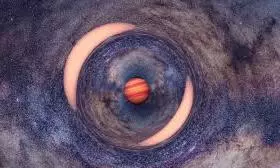

Astronomers have measured both the mass and distance of a rogue planet for the first time, offering new insight into planets that drift through space without orbiting a star.
The findings were published in the journal Science.
Rogue planets are difficult to detect because they do not emit light of their own and are not bound to any star.
In this case, researchers observed a microlensing event, in which the gravity of the planet briefly magnified the light of a background star. By combining data from multiple ground-based telescopes with measurements from the European Space Agency’s Gaia spacecraft, scientists were able to overcome a long-standing problem known as the mass-distance degeneracy.
The event, labeled KMT 2024 BLG 0792 and OGLE 2024 BLG 0516, was observed from two different locations, allowing researchers to determine that the planet has about 22 percent of Jupiter’s mass, slightly less than Saturn. The planet is located around 3,000 parsecs from Earth, or nearly 10,000 light-years away.
Analysis showed that the background star involved in the event was a red giant.
Scientists say the discovery supports theories that rogue planets are formed in protoplanetary disks and later ejected through violent gravitational interactions. Future observations could help explain how planetary systems evolve and how common these free-floating planets are in the Milky Way.