












Pakistan–Turkey–Saudi defence pact: Is it a threat to India?
text_fields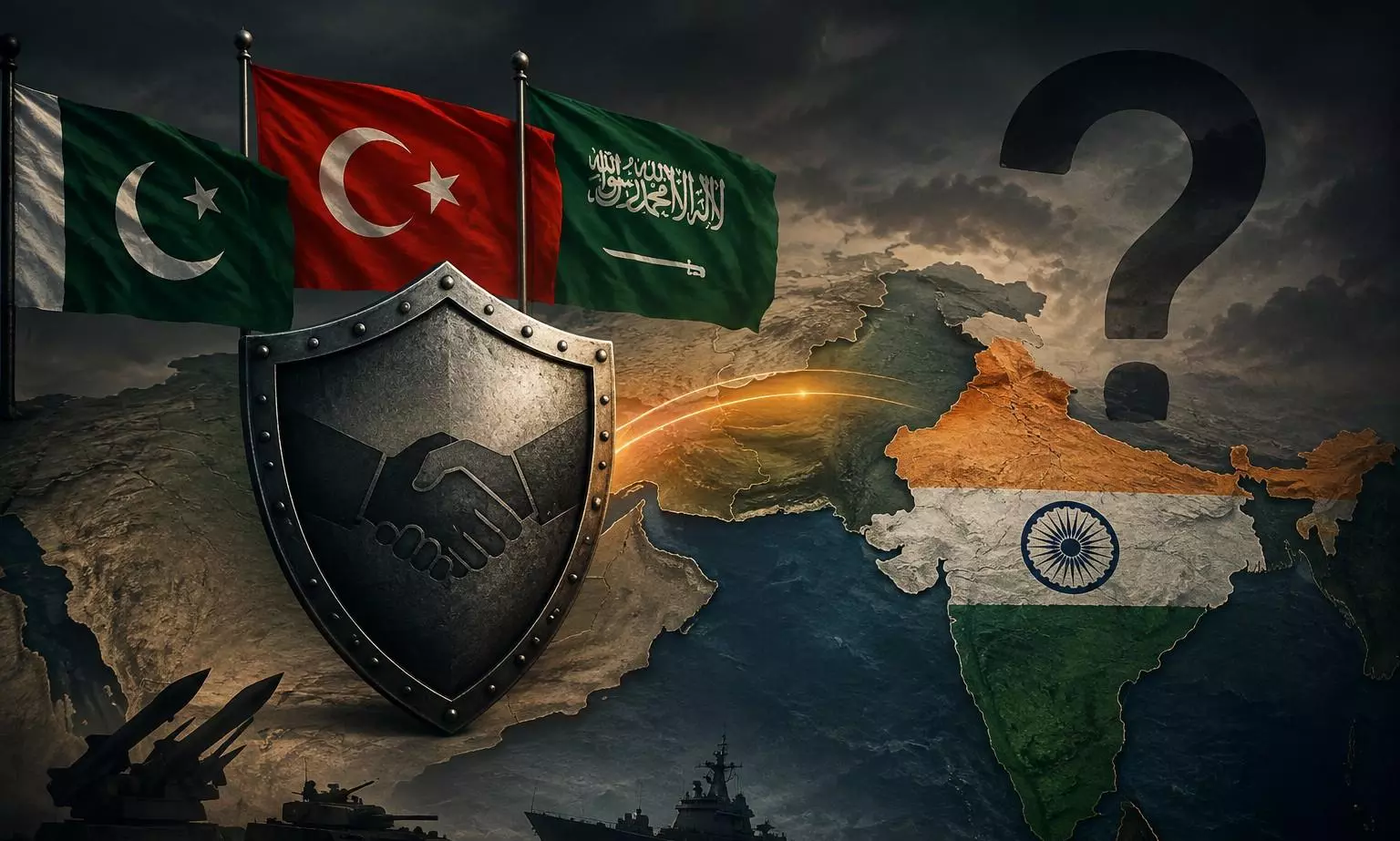

On 7 August, the pact between the three Sunni Muslim countries was signed in Mecca. The Mecca Joint Defence Agreement (MJDA) was formed, whereby the three nations agreed to come to each other's defence if any of them were attacked. Crown Prince Mohammed bin Salman of Saudi Arabia, President Recep Tayyip Erdoğan of Turkey, and Prime Minister Shehbaz Sharif of Pakistan were present to sign the MJDA.
The choice of Mecca as the venue was not coincidental. Indeed, the Pakistani government press communiqué underscored that Sharif had performed Umrah before negotiating the pact. The preamble to the MJDA cites Islamic solidarity as one of the reasons for it.
There has been a Strategic Mutual Defence Agreement (SMDA) between Pakistan and Saudi Arabia since 2025. The MJDA meant that Türkiye joined the existing SMDA. Turkey has been explicit that the MJDA will be similar to NATO. There shall be a permanent secretariat, but its location has not yet been decided. There will be more liaison officers from each MJDA country permanently stationed in the other two MJDA nations.
Note that if one of the three MJDA states attacks another country, the other two MJDA allies are not obliged to come to the aid of the member of the MJDA that started the war. It is a fact that countries seldom admit to starting a war. There may be sniping or skirmishing before a war starts, and an aggressor may use this as a pretext for turning it into a full-scale war. If there is no such incident, then an aggressor can create a false-flag incident.
India is unsurprisingly unhappy about the MJDA. New Delhi has been largely reticent about the MJDA. India has managed to maintain cordial relations with Saudi Arabia and Turkey despite their closeness to India's traditional foe, Pakistan. Anything that strengthens Pakistan is presumably bad news for India. Will it embolden Pakistan to escalate the Kashmir conflict? No one in Turkey or Saudi Arabia has ever suggested attacking India.
Tehran has reasons to be worried about the pact. Iran has enough trouble fending off Israeli and US attacks. Iran has suffered thousands of deaths in 2026. If, in theory, Saudi Arabia, Turkey, and Pakistan were all to attack Iran, then Iran would be finished. The Iranians stopped attacking Saudi Arabia early in 2026 because they did not want the Saudis to retaliate.
Not everyone in Turkey is happy about the agreement. As the MJDA is based on Islam, it undermines secularism. Turkey had amicable relations with Iran, and this is now in jeopardy. Turkey is proud that it has not fought another country for a century, and this pact seems to risk war.
The US has been uncharacteristically quiet about the MJDA. Some in the United States speak of withdrawing forces from the Persian Gulf. That worries some Gulf Arabs. The MJDA can be seen as partly intended to prepare for such an eventuality.
Saudi Arabia is renowned for its oil wealth. Its armed forces have long had state-of-the-art weapons. However, they are often poorly trained and badly led. Not all the officers in the armed forces are capable of managing a large military. And this matters when the most sophisticated weapons are useless in the hands of undertrained troops.
In 1979, when Juhayman took over the Grand Mosque in Mecca, the Saudi Arabian Army was unable to dislodge him quickly. Likewise, in 1990, when Kuwait was annexed by Iraq, the Saudis knew they could not defend their homeland if the Iraqis invaded, even though Iraq had inferior Soviet assets.
Pakistan has provided technical support and training for the Saudis. This has helped somewhat. In 2025, Pakistan sent troops to Saudi Arabia at Riyadh's request.
Pakistan is a nuclear-armed state. Some Saudis had hoped that they would be covered by the Pakistani nuclear umbrella, but the MJDA does not say that. For 10 years, there has been a rumour, as yet unconfirmed, that if Iran ever perfects a nuclear weapon, the Saudis will buy one from Pakistan. The Pakistanis also have numbers, whereas the Saudi Army is fairly small.
Pakistan, with its poor economic situation, desperately needs Saudi financial aid. Tens of millions of Pakistanis live in poverty, partly because the country spends tens of billions of US dollars on the military. Illiteracy is very high in Pakistan. It costs a few billion US dollars per annum just to keep the nuclear arsenal serviceable. The Pakistani nuclear weapons kill Pakistanis because they die from malnutrition and lack of healthcare, a problem that the government cannot afford to solve by itself. Saudi Arabia could have much more easily afforded to develop its own nuclear bomb.
Zulfiqar Ali Bhutto, who was president and then prime minister of Pakistan in the 1970s and initiated the development of a nuclear bomb, thereby making Pakistan the first Muslim country to achieve that capability, was overthrown by a military coup in 1977 and hanged in 1979. In his book, written in prison and smuggled out under the title If I Am Assassinated, he claimed that a foreign country had orchestrated the coup d'état because he would not abandon his country's nuclear programme.
In it, he said he could not name the country in question because doing so would result in a disadvantage for Pakistan. Many say it was the USA that did not want nuclear proliferation and that the CIA had many tentacles in Pakistan. There are problems with the theory that the United States masterminded the military coup. The United States strongly condemned the putsch. Moreover, Pakistan did not abandon its nuclear programme under Bhutto's successor, Zia-ul-Haq.
The MJDA comes as the Iran War sputters on. The USA and Israel started it on 28 February. Trump repeatedly said that the war was over, but prolonged it until June 2026. Then he restarted it in July and has since agreed to a ceasefire. The US has inflicted heavy casualties and suffered very few losses itself.
This is largely due to a low-risk strategy of using highly sophisticated missiles that allow the US to strike blows while keeping its troops largely out of harm's way. But these missiles are very costly, and the US has few of them. The rumour from the Pentagon is that the cupboard is almost bare when it comes to missiles such as Patriots. It will take several years of production to bring stockpiles back up to pre-war levels. That is partly why the United States is eager to end the war.
The Iran War hurt Turkey and Pakistan badly. Both have fragile economies, and the rise in oil prices was disastrous. Turkey said it was neutral in this war. But as a NATO member and a country with close economic ties to the United States, Turkey was suspected by the Iranians of being benevolent towards the USA rather than towards them.
The Yemeni Civil War has been fought sporadically for 25 years. The Saudis support the Yemeni government, whereas the Iranians support the Houthi insurgents, who, like 90% of Iranians, are Shia.
Pakistan and Turkey have long exchanged training aircraft and some naval vessels. The founders of Pakistan admired Turkey as one of the first Islamic republics. However, notably, Turkey is a secular state, and so was Pakistan for its first few years. President Pervez Musharraf was outspoken in his regard for Turkey in his autobiography, In the Line of Fire.
Saudi Arabia has been buying Turkish drones since 2023. Turkey produces Bayraktar ("flag-bearer"), which are some of the cheapest on the market.
Pakistan was officially neutral in the Iran War in 2026. Indeed, it played the role of an honest broker and hosted talks between US and Iranian delegations in Islamabad. Pakistan has an ambiguous relationship with its neighbour Iran. The 20% of Pakistanis who are Shia are favourably disposed towards the big power of the Shia world: Iran.
Some Pakistanis have family ties to Iran. Moreover, many Pakistanis, including Sunnis, appreciate Persian literature and respect Iran as a country that has stood up to the West and shown solidarity with Palestine. However, the Taliban reviles all Shias. The Iranians back the Shia minority in Afghanistan, who fight the Taliban to this day.
There is talk of inviting Egypt to accede to the MJDA, which would mean that the MJDA would have total control of the Red Sea and a much stronger hold in the Eastern Mediterranean. But Egypt has defence agreements with Greece and Cyprus. If the Egyptians signed the MJDA, then Greece and Cyprus would surely renounce their agreements with Egypt. Cairo has not yet decided whether that is a price worth paying.