













What to expect from the ‘mother of deals’
text_fields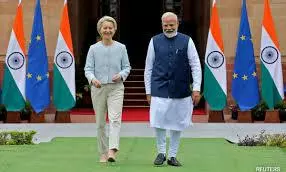

The free trade agreement signed on Tuesday, January 27, at the 16th EU-India Summit in New Delhi is considered historic. Initial negotiations for the agreement had been held as early as in 2007 but stalled in 2013. The major sticking points until then were issues such as market access, intellectual property rights, labor standards, and sustainable development. The talks stalled in 2013 mainly due to the inability to reach an agreement on tariffs on automobile products, wine, IT, and data security. In the talks that resumed in 2022, the recent imposition of heavy tariffs by US President Donald Trump has, in a sense, accelerated the efforts of the EU countries and India. Now, with the signing of the agreement by Prime Minister Narendra Modi, European Union Council President Antonio Costa, and European Commission President Ursula von der Leyen, the start of an economic pact is set in motion that will encompass the single market of the 27 EU member states and that of India, together representing nearly 2 billion people. The agreement is more comprehensive and covers more countries than previous trade agreements India signed with other countries. The EU is India’s 22nd largest free trade partner in an economy that together accounts for 20 percent of global GDP.
Also read: Industry experts say India–EU FTA a big win for exporters, manufacturing, investment
The essence of free trade agreements is to facilitate trade transactions between two economies as much as possible and to reduce tariffs to the greatest extent possible. Today, the equations of both economies are not as simple as they were when countries protected their domestic markets. The dominance that European countries once had in industrial products is no longer present either. India, on the other hand, has made big strides in economic growth and self-sufficiency. Therefore, the economic equations of five decades ago have undergone a sea-change today. In addition, market access restrictions between countries have begun to be significantly reduced, diluted, or completely eliminated at the global level. Although the World Trade Organization and agreements such as GATT have had a decisive influence on this process, the reactionary actions of its prime mover of these changes, the United States, have created cracks in the system.
Also read: ‘Mother of all deals’: India, EU create free trade zone of 2 bn people
India is believed to derive a major advantage in the present deal, as 90 percent of bilateral trade items will receive preferential market access and duty-free entry. India has extensive trade relations with EU countries. In 2024–25, bilateral goods trade stood at Rs 11.5 lakh crore – Rs 6.4 lakh crore in exports and Rs 5.1 lakh crore in imports. In addition, the services sector is estimated to total Rs 7.2 lakh crore in 2024. Once the agreement comes into force, it is estimated that exports worth $33 billion will benefit from duties being reduced ranging from 10 percent to zero in sectors such as textiles, clothing, leather products, footwear, marine products, diamonds, handicrafts, and automobiles. It is expected that there will be significant opportunities for the labour in the sector and that industries and trade in villages across India will be integrated into the global value chain. Kerala is also expected to see a revival in marine products, food items, and spices. For example, the Kochi and Alappuzha regions may benefit from shrimp and tuna fish, while the districts of Idukki and Wayanad may benefit from tariff reduction on spices. Petroleum products is another category that India exports to European countries. The oil refining sector may receive a boost as tariffs are reduced in the future. However, it remains to be seen which side’s products will be more popular with the other side. Apart from this, such factors will also come into play when negotiating free trade agreements with other countries as well.
Also read: Republic Day signals India’s geopolitical autonomy and global leadership: experts
However, the agreement has not come without its share of concerns. For example, the reduction in tariffs on European vehicles – which are heard to fall from 110 percent to 10 percent – could hurt the Indian automobile industry, an obvious reason why the stocks of car manufacturers Suzuki, Hyundai, Tata, and Mahindra fell by between 1.5 and 4 percent on Tuesday. The agreement, which the European Commission President called the ‘mother of all deals’, may offer greater clarity once it is fully implemented. While India’s trade with the US accounts for 17 percent of its total foreign trade and 14.6 percent with China, trade with the EU – India’s ninth-largest trading partner – accounts for only 2.4 percent. As the saying goes, ‘the devil is in the detail’, and the real benefits and challenges will be understood only when the full text of the agreement comes into force and the tariff numbers within it become known.