














The trajectory of the demographic change study
text_fields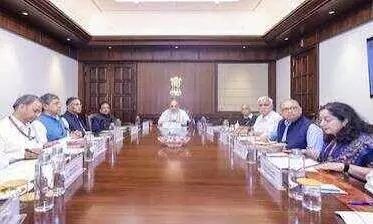

It was in his 2019 Independence Day speech that Prime Minister Modi raised concerns on a public platform about the changes occurring in the demographic structure as a major issue. Later, both he and Home Minister Amit Shah continued to address this across various platforms, including other Independence Day events. In this regard, a high-level demography task force was appointed in late last May to conduct a study and provide recommendations, chaired by Justice Prabhakar Navlekar, with four members including the Census Commissioner. The committee has been tasked with comprehensively evaluating the demographic changes occurring due to illegal immigration and other 'unusual factors', and submitting a report with remedial proposals within a year. The government highlights that demographic changes are closely linked to the country's sovereignty, national security, law and order, social fabric, and the protection of tribal communities.
Also read: 70% of 2.7M voters under adjudication in Bengal are Muslim, study find
From the statements of the Modi-Amit Shah leadership, it must be inferred that the government accords a priority to this that goes beyond a mere administrative procedure. For that reason, it is also clear that the BJP government's interest in this matter is tied to their demographic perspectives. This is precisely why the BJP leadership continues to highlight migration in northeastern states like Assam and Bengal. Through Special Intensive Revision (SIR) of voter list, which also aims at removing Bangladeshi migrants from the rolls, a large section of (mainly Muslim) voters is being removed from the voter list, thereby rendering them non-citizens—and in a subsequent stage of operations, to somehow exclude them from the population count altogether. It can be said that this BJP agenda is not something hidden within the operation, but stands fully visible. This becomes evident if one looks at the community-wise data of those who have already been excluded in the citizenship census.
Also read: SC says deletion from SIR rolls not loss of citizenship
It is relevant now to recall what Amit Shah had kept saying during the period of the anti-CAA protests. Back then Amit Shah's argument was that the CAA was meant to grant citizenship to those without it, not to strip away the citizenship of those who had it, and that such allegations were unfounded. Today, however, ruthless actions are taking place—questioning the very citizenship of existing residents, attempting to push them across the border, and demolishing the homes and commercial establishments of those excluded from the voters' list with bulldozers. The Hindutva government continues to present exaggerated and fake information and statistics regarding Bangladeshi migration to create the backdrop for all of this. Even though the Supreme Court had earlier ruled during the Assam SIR phase that no one should be denied the considerations and welfare scheme benefits due to citizens simply because their names were removed from the voter list, many BJP governments violated this order by denying basic services such as the Annapurna Yojana, the public distribution system, and caste certificates. Note that around 3.4 million appeals have been filed against the SIR decisions in Bengal. And recall also that in 2018, Amit Shah had referred to illegal Bangladeshi immigrants as "termites". It was by using such exaggerated narratives about illegal immigrants that the BJP harvested significant political gains in Bengal, Assam, and elsewhere.
Also read: SC says persons excluded in Bengal SIR entitled to welfare benefits
In this context, one can roughly deduce what the recommendations of the demographic committee appointed by the Hindutva government will look like. Although the terms of reference are demographic in nature, it has been pointed out that none of its members are experts in demography. Therefore, it can be almost certainly concluded that the core exercise is not about migration or demographic characteristics, but is part of an agenda to exclude certain communities from the register of citizens. The government has also been unable to present any scientific statistical data to support its claims regarding the extent of Bangladeshi immigration. Among the terms of reference given to the committee, there is an instruction to analyse 'structural demographic changes in religious and social communities, particularly where deviations from general trends are observed (read variations in fertility rates).' This, however, stems from inaccurate figures regarding the birth rate among Muslims and from mostly unverified campaigns. In short, under the pretext of undocumented migration, the committee will have to conduct an inquiry targeting India's major minority community in various ways. Within this, when it states that there must be 'a permanent operational mechanism for time-bound identification, detention, and deportation of illegal immigrants residing in the country', the ingredients of a BJP agenda where the citizenship register, SIR, and demographic change studies converge become complete. If India wants to lay claim to being a civilized democracy, the country must be saved from this vicious cycle at least now.