














The Centre’s new bulldozer over NGOs
text_fields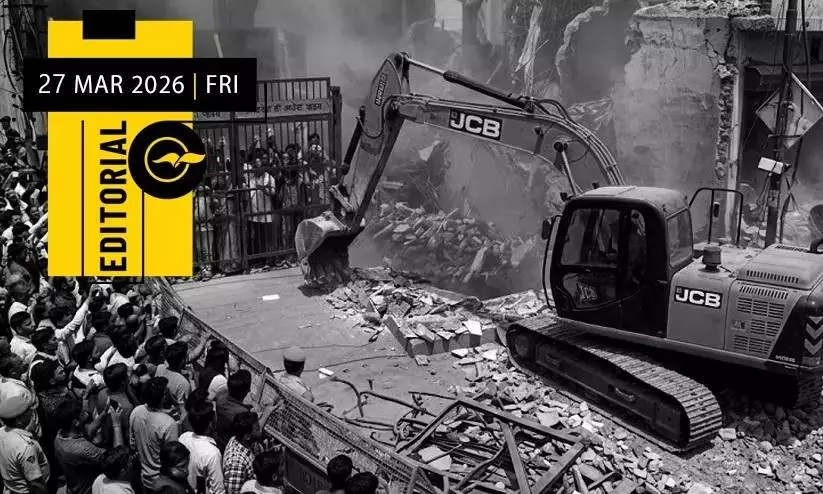

The path to prison was paved for Sonam Wangchuk, an educationist of international renown who, despite a history of aligning with central policies, emerged as a staunch advocate for the ecological sanctity and administrative autonomy of Ladakh, through the strategic exploitation of certain provisions within the Foreign Contribution (Regulation) Act (FCRA). Once his convictions led him to contest the strategic interests of the Central Government in Ladakh and to lend his formidable support to popular uprisings, he was ensnared by allegations that he had misappropriated foreign contributions for "anti-national activities". If the legislative amendments of 2020 served as the initial instrument of his entrapment, the Central Government has now advanced a far more formidable and draconian iteration of the law. With the recent introduction of these amendments in the Lok Sabha by the Union Minister of State for Home Affairs, Nityanand Rai, the completion of parliamentary formalities will herald the enforcement of a statute armed with such sharpened talons that it is destined to stifle and crush the very breath of voluntary organisations across the nation.
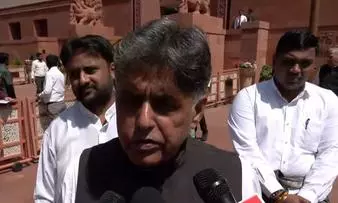
The pronouncements delivered by the Minister of State for Home Affairs during the introduction of the amendment bill serve only to fortify the burgeoning apprehensions that the recent revisions to the Foreign Contribution (Regulation) Act (FCRA)—the primary instrument governing the operations of non-governmental organisations within the nation—may be wielded as a mechanism to stifle democratic dissent and curtail the inherent freedoms of civil society. The Minister posited that the extant legal framework is hampered by certain legislative lacunae which ostensibly hinder the state’s capacity to take decisive action against organisations accused of misappropriating foreign donations for the purposes of forced religious conversions or activities deemed antithetical to the very spirit of national interest; consequently, he asserted that these modifications are designed to empower the government to effectively dismantle such loopholes. In a moment of striking candour that seemed to validate the opposition’s contention, which denounced the amendments as draconian, perilous, and a fundamental violation of the civil liberties enshrined in the Constitution, the Minister remarked that they are "indeed dangerous for those who engage in forced religious conversion using foreign contributions" as well as for those who abuse foreign funding for personal gain"

Under the recent legislative amendments, the Central Government is empowered to appoint a specialised authority to assume comprehensive control over the bank accounts, operational activities, physical establishments, and both movable and immovable assets of non-governmental organisations in instances where their FCRA licences have been revoked or denied renewal, purportedly in the interest of the general public. Should a new registration fail to be secured, the government reserves the prerogative to permanently dispose of these confiscated assets through sale or, alternatively, to transfer them to state-controlled mechanisms, thereby ensuring that no transactions involving assets derived from foreign contributions occur without the explicit prior sanction of the central government. Furthermore, it is mandated that the office-bearers of such organisations must, upon official requisition, surrender all buildings, property holdings, and relevant documentation to the state; should the renewal of permission not be accomplished within the stipulated timeframe, these assets shall be irrevocably vested in the designated authority. Legal experts have expressed serious reservations regarding whether these amendments, which appear to be in direct contravention of Article 300A concerning the right to property, can withstand constitutional scrutiny, while the opposition asserts vehemently that the bill is fundamentally unconstitutional, as it grants the executive excessive and unchecked power to formulate regulations and manage assets without Parliamentary oversight.
Since its ascension to power, the Modi government has demonstrated a most steadfast and unwavering preoccupation with the stringent regulation of non-governmental organisations, tightening the provisions of the 2010 Act through a series of successive amendments in 2016, 2018, and 2020, all under the repeated justifications of ensuring fiscal transparency and forestalling the misappropriation of resources. Since the year 2012, the foreign contribution licences of no fewer than 20,711 organisations have been summarily revoked, leaving a mere 16,026 entities currently in possession of valid FCRA certification. However, embedded within these legislative revisions is a duplicity that appears to extend preferential leniency to those voluntary groups favoured by the state. For instance, while the government codifies an almost unfettered authority to confiscate assets, it simultaneously moves to reduce the term of imprisonment for those found guilty of fund misappropriation from five years to a solitary year, a manoeuvre that mirrors the 2020 amendment which paved a convenient path for political parties to receive contributions from the Indian subsidiaries of foreign corporations, provided an Indian national holds a majority stake. Such amendments, which facilitate the swift exoneration of political allies whilst making without any hindrance those deemed "undesirable" bankrupt, are profoundly antithetical to the very essence of democratic governance. Indeed, what is manifesting through this legislative process is a "legal bulldozer" purposefully engineered to target anyone who dares to dissent from the prevailing ideologies of the state. The charitable, educational, and social welfare initiatives of Christian and Muslim voluntary organisations find themselves perilously subject to the whims or the suffocating oversight of the central authority. That is a grave state of affairs wherein the FCRA is transformed into a potent political weapon for the systematic suppression of all opposition.